
Posted May 07, 2026

By Enrique Abeyta
The MU-mentum Trap: When Good Trades Go Bad
There's a moment in every momentum cycle when a stock stops trading like a business and starts trading like a movement.
Right now, we’re entering that phase in DRAM and memory-chip stocks.
Momentum across the group has been building rapidly.
And stocks tied to memory demand like Micron are moving with the kind of aggressive price action that often appears late in a momentum cycle.
This is the point of the cycle when things get really exciting — but it’s also when things get incredibly dangerous.
Momentum investing and the rapid thematic rotations that come with it are still deeply misunderstood by most investors.
Most people think it simply means buying stocks that are going up. But that's only part of the story.
Real momentum investing is about psychology and narratives.
It’s also about institutional money piling into a theme so aggressively that the trade itself becomes more important than the underlying fundamentals.
And once that happens, the cycle can accelerate very quickly.
A stock moves higher, headlines follow, and more investors notice…
Then analysts raise price targets, financial television starts covering the theme every day, and social media amplifies the move.
Retail investors rush in, afraid of missing the next big thing. Before long, the entire sector is moving together regardless of quality.
At that point, the market often stops asking whether a company is good and starts asking whether it's part of the hot trade.
That distinction matters far more than most investors realize.
Because in the early stages of a momentum cycle, stocks usually rise for legitimate reasons. The company executes well. Earnings improve. Demand strengthens.
The underlying story makes sense. But eventually, something changes.
The stock transforms from a good story into a good trade. Once that happens, price action itself becomes the catalyst.
Most Investors Don’t Get the Momentum Game
One of the biggest misconceptions about momentum investing is the idea that you need to catch the trade at the very beginning to make money.
You don’t.
In fact, many momentum trades generate their biggest gains in the middle innings after the trend is already clearly established.
If you think about it like a baseball game, it’s perfectly fine to miss the first few innings and still enjoy the game. The real problem is figuring out when the game is about to end.
That’s where investors get into trouble.
Because momentum trades tend to end the same way they begin: suddenly.
The same psychology that pushes stocks vertically higher can reverse just as quickly once institutional money starts rotating into a new theme.
And when that rotation begins, investors who entered late often find themselves holding stocks that fall much faster than they rose.
That’s especially true when speculative names become attached to the trade.
We saw this exact dynamic play out over the last year in nuclear and power stocks.
When the AI Trade Took Over Everything
One of my favorite stocks during that period was Talen Energy. In fact, I still love this stock.
I originally called the trade early (back in March of 2025) because I believed the business itself was compelling.
Power demand was increasing, AI infrastructure was growing rapidly, and electricity was becoming one of the most important bottlenecks across the technology sector.
The thesis made sense.
Initially, Talen traded like a quality business with improving fundamentals. But as the AI infrastructure boom accelerated, something else happened.
The market stopped viewing these companies individually and started lumping them together under one massive momentum umbrella: anything related to AI power demand.
Suddenly, it didn’t matter whether a company had strong operations, real cash flow, or proven execution.
If it had exposure to nuclear, power generation, uranium, or electricity demand, investors piled in aggressively.
The entire sector went vertical.
High-quality businesses rallied. Speculative businesses rallied. Pre-revenue companies rallied.
Anything tied to nuclear energy suddenly became “must own.”
That included names like Oklo, which fundamentally were nowhere near the quality level of a company like Talen.
But during peak momentum cycles, quality temporarily ceases to matter. The theme becomes the trade. And for a while, that trade can feel unstoppable.
The Problem With Momentum
The problem, of course, is that momentum works both ways. As the old expression goes, "live by the sword, die by the sword."
Eventually, the AI trade became overheated.
Valuations are stretched too far. RSI levels across the sector reach extreme levels. Every conversation on Wall Street revolves around the same themes.
That’s usually when institutional money quietly begins rotating elsewhere.
And once that rotation started, the downturn across nuclear and power stocks was fast and brutal.
The same momentum that pushed these names sharply higher suddenly accelerated them lower. Investors who chased the trade late found themselves trapped almost immediately.
Now, here’s the important distinction.
I never lost conviction in Talen because I wasn’t owning it strictly as a momentum trade.
I believed in the underlying business and the long-term demand story.
And I understood that temporary market rotations don’t change the quality of a strong company.
So, while Talen entered a healthy consolidation period, I was comfortable holding through the volatility.
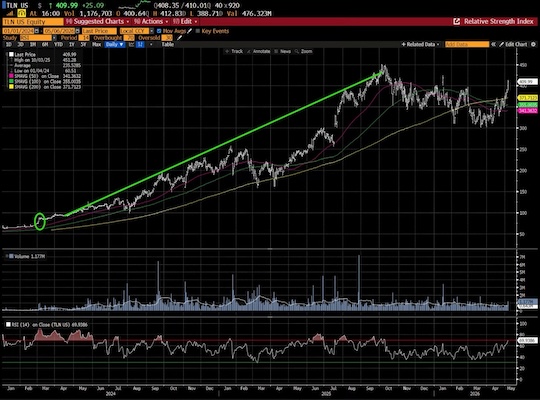 |
Today, the stock is finally emerging from its consolidation phase and regaining strength.
But many investors holding lower-quality speculative names never recovered.
They didn’t understand the difference between a good business and a good trade. And when the game ended and the theme broke, their portfolios broke with it.
That brings me to why I’m writing this today.
The Next Huge Momentum Trade Is Here
I believe we are seeing the exact same setup developing right now in DRAM and memory chip stocks.
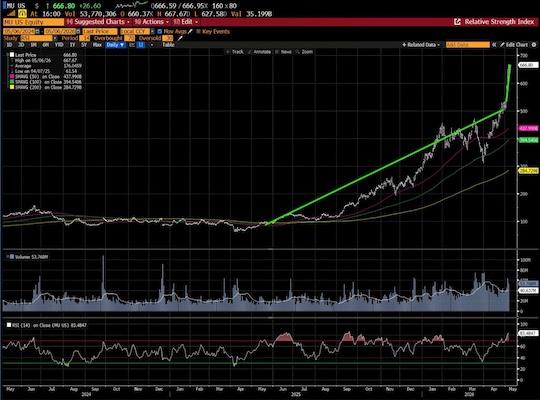
Companies like Micron Technology are absolutely legitimate businesses with real long-term tailwinds.
 |
AI infrastructure demand is real. High-bandwidth memory demand is real. Data center growth is real. This is not a fake story.
But what started as a strong standalone investment thesis is now evolving into a broader momentum trade.
And once that happens, sectors stop moving based purely on fundamentals. They start moving in response to crowd behavior.
You can already see the signs emerging throughout the group.
RSI levels have become elevated.
Retail participation has exploded.
Stocks tied to memory, DRAM, and AI infrastructure are all starting to move together in an increasingly aggressive fashion.
That doesn't mean these companies are bad businesses, far from it. But even great companies can become dangerously overheated stocks in the short term.
And that’s the part many investors fail to appreciate.
A stock can still be an excellent long-term investment while also being vulnerable to a sharp momentum-driven pullback.
What to Do About It
To be clear, I'm not telling you to panic-sell your Micron shares tomorrow morning. And I’m certainly not saying the long-term AI infrastructure story is over.
But if you’ve built substantial profits during this latest momentum run, it may be time to start trimming positions and protecting gains.
Because what goes up eventually cools off. Always.
Sometimes that cooling-off period is mild. Sometimes it's violent. But no momentum trade keeps rising forever.
And if you’re only now feeling the urge to jump into the DRAM ETF and memory stocks because the sector suddenly feels unstoppable, there’s a decent chance you’re entering the game in the later innings.
That’s exactly how FOMO works. It convinces investors that missing the trade is riskier than entering late.
In reality, entering late is often the biggest risk of all.
The smarter move is usually patience.
Wait for the excitement to cool down. Wait for the consolidation phase. Let the weak hands get shaken out.
Then come back and focus on the highest-quality survivors once the momentum resets itself.
Because the goal isn’t simply to catch the hottest trade.
It's to survive long enough to catch the next one, too.
Sign Up Today for Free!
Truth & Trends brings you market insights and trading tips you won't find anywhere else — unless you have your own personal hedge fund manager on speed dial...
Meet Enrique Abeyta, one of Wall Street’s most successful hedge fund managers. With years of experience managing billions of dollars and navigating the highs and lows of the financial markets, Enrique delivers unparalleled market insights straight to your inbox.
In Truth & Trends, Enrique shares his personal take on what’s moving the markets, revealing strategies that made him a star in the world of high finance. Whether it’s uncovering the next big trend or breaking down the hottest stocks and sectors, Enrique’s insights are sharp, actionable, and proven to work in any market condition.
Inside these daily updates, you’ll gain:
- 50 years of combined trading wisdom distilled into actionable insights.
- A behind-the-scenes look at how Wall Street pros spot opportunities and avoid pitfalls.
- Exclusive strategies that Enrique personally uses to deliver exceptional returns — no fluff, just results.
To have Truth & Trends sent directly to your inbox every weekday, just enter your email address below to join this exclusive community of informed traders.
Don’t miss your chance to learn from one of the best in the business.
Sign up now and take your trading game to the next level.

Coming Soon: The YOLO Market, Unleashed
Posted May 01, 2026
By Greg Guenthner

The First Berkshire Meeting After Buffett - Now What?
Posted April 30, 2026
By Enrique Abeyta

Strait Talk: The 15-Day Countdown
Posted April 27, 2026
By Enrique Abeyta

"Trump Accounts" Coming Soon (DO NOT Wait)
Posted April 23, 2026
By Enrique Abeyta

Word of the Day: "Oikophobia"
Posted April 20, 2026
By Enrique Abeyta
