Posted July 23, 2026

By Enrique Abeyta
The Iran Endgame, Revisited
We’re nearly five months into the war with Iran.
At this point, the U.S. has attempted just about every option that might bring this conflict to an end.
There have been negotiations, direct attacks, economic pressure, a naval blockade, and repeated efforts to work toward a peace deal.
And yet the conflict continues.
 Source: CNBC
Shipping through the Strait remains disrupted, military strikes have only intensified, and the diplomatic process has broken down.
The market may seem unfazed by the war right now. But what happens next still has serious implications.
It influences energy prices, which ultimately affects inflation, interest rates, and even the broad stock market.
So there are two questions that I want to focus on today.
What happens when every obvious option has failed? And how will this affect our investments?
The answer may be hidden in a largely forgotten chapter of history.
Almost 40 years ago, the U.S. faced a similar problem in the same narrow stretch of water and against the same adversary.
What followed did not immediately end the fighting. But it helped change its direction and produced a surprisingly positive outcome for investors.
The Last Time the Strait Was Under Siege
The story begins during the Iran-Iraq War.
By 1984, the conflict had reached a brutal stalemate. Both sides turned to attacking each other's economic lifelines, oil exports, and commercial shipping.
Iran targeted tankers connected to Kuwait and Saudi Arabia, hoping to pressure nations supporting Iraq.
The conflict became known as the Tanker War. Before long, one of the world's most important energy corridors had become a battlefield.
Sound familiar?
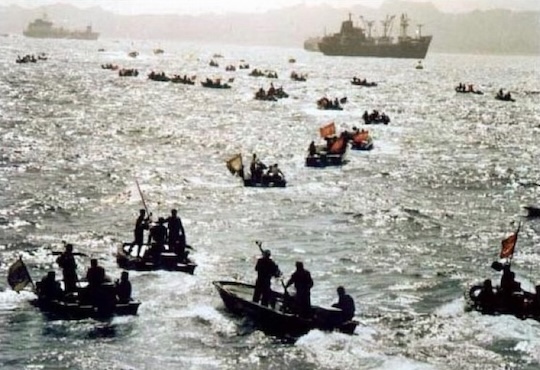 IRGC Navy Speedboats In the Tanker War, 1987. Source: Ali Fereydooni, via Wikimedia Commons
Kuwait eventually asked the U.S. for protection.
The Reagan administration responded by reflagging 11 Kuwaiti tankers as American vessels, giving the U.S. a legal and strategic basis to escort them through the Gulf.
In July 1987, Operation Earnest Will began.
American warships accompanied commercial tankers through threatened waters while surveillance aircraft and helicopters monitored Iranian activity.
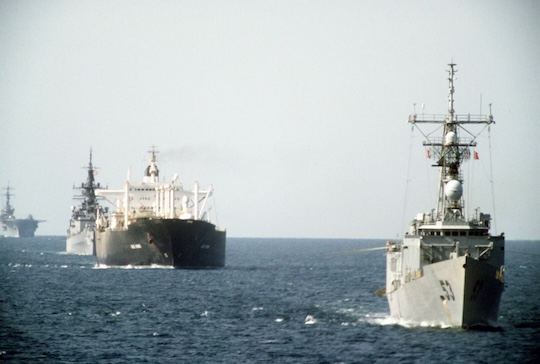 U.S. Warships Escort Tanker In Persian Gulf, October 1987. Source: PH2 Elliot, U.S. Navy, via Wikimedia Commons
Behind the scenes, U.S. special operations forces also hunted mine-laying ships and fast attack boats.
The objective was not to invade Iran or overthrow its government. It was to keep shipping moving.
Unable to challenge the U.S. Navy directly, Iran relied on the same asymmetric tactics that still define its strategy today. Mines, missiles, armed speedboats, and deniable attacks on commercial shipping.
In September 1987, American helicopters caught the Iranian vessel Iran Ajr laying mines in international waters.
U.S. forces attacked and boarded the ship, recovering mines and evidence connecting Iran directly to the campaign.
Still, the attacks continued.
Then, on April 14, 1988, the guided-missile frigate USS Samuel B. Roberts struck an Iranian mine while participating in Operation Earnest Will.
The explosion tore an enormous hole in the ship and injured 10 sailors. The frigate nearly sank, but extraordinary work by its crew kept it afloat.
Four days later, the U.S. responded.
On April 18, 1988, the U.S. Navy launched Operation Praying Mantis.
American forces attacked Iranian oil platforms being used for military surveillance and coordination.
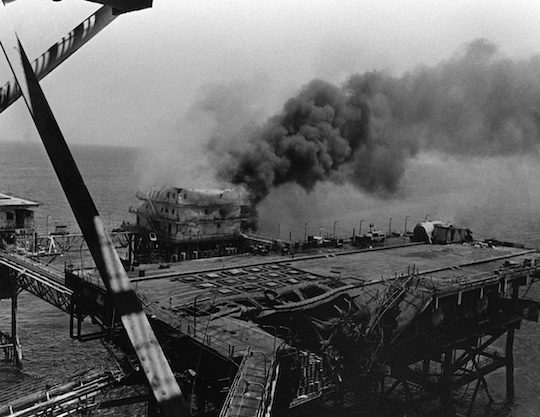 Iranian Sassan Oil Platform Burns After U.S. Attack, April 1988. Source: Naval History and Heritage Command
When Iran responded, the operation expanded into the largest U.S. surface naval engagement since World War II.
By the end of the day, American forces had destroyed Iranian surveillance platforms, sunk or crippled much of Iran's operational navy, and demonstrated beyond doubt that the U.S. controlled the Gulf.
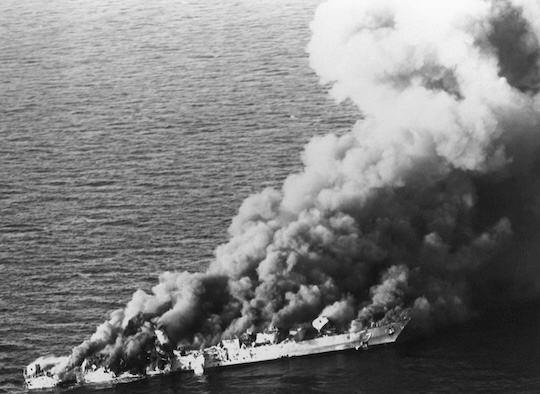 The Iranian frigate IRIS Sahand Burning After U.S. Naval Attack, April 1988. Source: Service Depicted: Navy, via Wikimedia Commons
Yet Washington also showed restraint. After crippling the Iranian frigate Sabalan, U.S. forces did not finish it off.
The message was clear: America was willing to impose overwhelming costs, but it was also offering Iran a way to stop the escalation.
Iran took it.
Operation Praying Mantis did not single-handedly end the Iran-Iraq War. Iran was already exhausted economically and militarily, and several other events followed.
But the operation demonstrated that Iran could not challenge the U.S. Navy, threaten international shipping, and avoid severe consequences.
Three months later, Iran accepted a United Nations ceasefire. The eight-year war formally ended in August 1988.
The Market Reaction Few Remember
Given the scale of the battle, you might assume Wall Street panicked. But it didn’t.
By April 1988, markets had largely recovered from the October 1987 crash, which had been driven primarily by financial, not geopolitical, forces.
On the day of Operation Praying Mantis, the Dow declined only slightly. Oil prices initially moved higher as traders feared a wider conflict.
Still, the reaction faded once it became clear that the fighting was limited and commercial shipping would continue.
The largest American naval engagement in decades did not produce a sustained selloff.
Why? Because markets do not automatically fear military action. They fear uncertainty, prolonged disruption, and economic damage with no apparent end.
Praying Mantis suggested that the U.S. controlled the escalation, that Iran could not shut down the Gulf without paying an enormous price, and that oil would continue to flow.
The operation increased military activity but reduced uncertainty.
If history is any guide, an Earnest Will-style operation could keep the Strait open while the conflict continues, leaving a persistent geopolitical risk premium in energy.
I would not be surprised to see crude oil remain in an $80–$100 range for months.
Higher oil would likely support energy stocks while weighing on much of the broader market by keeping inflation elevated and corporate costs under pressure.
A decisive operation like Praying Mantis, however, could remove that premium, allowing oil to fall and providing a tailwind for both businesses and the broader stock market.
Dusting Off a 40-Year-Old Playbook
No two conflicts are identical. Iran possesses far more advanced missiles, drones, cyber capabilities, and regional proxies today than it did in 1988.
History never repeats itself exactly. But it often rhymes.
Nearly 40 years ago, the U.S. faced many of the same challenges it faces today…
Protecting the Strait of Hormuz, preserving the free flow of global energy, and restoring deterrence without becoming trapped in another Middle Eastern ground war.
Will Washington ultimately follow a modern version of the Earnest Will and Praying Mantis playbook? No one can say for sure.
But what I do know is that we are often best served by studying history rather than reacting to headlines.
If this conflict continues to evolve along a similar path, the investment implications may unfold in stages.
An extended period of elevated energy prices could be followed by a sharp decline once markets become convinced the Strait is secure and the geopolitical risk premium is gone.
That's not a prediction.
It's simply a reminder that some of the best clues about tomorrow can often be found by looking at yesterday.
Nobody knows exactly how this conflict will unfold.
But by understanding the playbook history provides, I believe we can make better decisions than those simply reacting to the latest headline.
As always, I'll continue following these developments closely and keep you updated as the story evolves.
Sign Up Today for Free!
Truth & Trends brings you market insights and trading tips you won't find anywhere else — unless you have your own personal hedge fund manager on speed dial...
Meet Enrique Abeyta, one of Wall Street’s most successful hedge fund managers. With years of experience managing billions of dollars and navigating the highs and lows of the financial markets, Enrique delivers unparalleled market insights straight to your inbox.
In Truth & Trends, Enrique shares his personal take on what’s moving the markets, revealing strategies that made him a star in the world of high finance. Whether it’s uncovering the next big trend or breaking down the hottest stocks and sectors, Enrique’s insights are sharp, actionable, and proven to work in any market condition.
Inside these daily updates, you’ll gain:
- 50 years of combined trading wisdom distilled into actionable insights.
- A behind-the-scenes look at how Wall Street pros spot opportunities and avoid pitfalls.
- Exclusive strategies that Enrique personally uses to deliver exceptional returns — no fluff, just results.
To have Truth & Trends sent directly to your inbox every weekday, just enter your email address below to join this exclusive community of informed traders.
Don’t miss your chance to learn from one of the best in the business.
Sign up now and take your trading game to the next level.

The AI Trade's "Black Thursday"
Posted July 20, 2026
By Enrique Abeyta

3 "Stay-Away-From-Tech" Trades - TGT, INCY, SBUX
Posted July 17, 2026
By Greg Guenthner

The One Question I Ask Before Buying Any Stock
Posted July 16, 2026
By Enrique Abeyta

The Biggest IPO You Never Heard About
Posted July 13, 2026
By Enrique Abeyta
My Tesla Calls Went to Zero... Just as I Planned
Posted July 10, 2026
By Greg Guenthner