Posted October 19, 2026

By Enrique Abeyta
The Hidden Cost of Being Right
One of Wall Street’s most expensive mistakes began with a prediction that turned out to be completely right…
Railroads were going to change America.
By the early 1870s, tracks were pushing farther west, connecting cities, opening markets and creating enormous new opportunities.
Money poured in as Wall Street watched the network grow and saw little reason the excitement should stop.
Then came September 1873.
A major banking failure tied to railroad financing helped set off a panic that wiped out wealth across the country.
But the railroads hadn’t failed. They would ultimately prove every bit as revolutionary as people believed.
The mistake was assuming that being right about the future meant every investment tied to it would pay off.
We may not think of railroads as “technology” today, but that’s exactly what they were. And the frenzy surrounding them became one of America’s earliest great technology bubbles.
It was a mistake Wall Street would repeat with electricity, radio, computers, telecommunications and the internet.
And now, the rush into AI may be setting us up for the same bubble all over again.
The Four Ingredients of a Technology Bubble
When most people hear the word "bubble," they think of wild stock prices, reckless speculation and investors losing fortunes.
But that’s usually how a bubble ends, not how it begins.
Technology bubbles usually start with something real — a genuine breakthrough that could change the world.
After studying history's biggest technology booms and busts, I've identified four recurring features.
- Revolutionary Technology
It starts with a new invention or breakthrough that promises to change how people live and work. - Enormous Economic Potential
The technology promises major gains in productivity, efficiency or economic growth. It could create new markets and cut costs. But those benefits may take years to arrive, while investors often price them in immediately. - Too Much Money, Too Fast
Investors and businesses don’t want to be left behind, so they pour money into new projects, often building more capacity than customers need or paying stock prices that assume huge future profits.
This is where trouble begins.
Money goes out long before enough comes back in. - Mania Followed by a Crash
Eventually, excitement pushes stock prices to extreme levels.
But when profits disappoint, or financing dries up, prices can collapse.
Of course, not every breakthrough creates a bubble and not every investment boom ends badly.
But when these four features come together, the losses can be severe.
We’ve seen it happen many times before.
Railroads: America's First Great Technology Bubble
The railroad story we started with is a good example of how quickly those four ingredients can come together.
After the Civil War, America was undergoing a transportation revolution. In just six years, the amount of track operating across the country nearly doubled, from about 39,000 miles in 1867 to more than 70,000 miles by 1873.
And building all that track wasn’t cheap.
The Northern Pacific Railroad alone set out to raise $100 million — roughly $3 billion today — for an ambitious line stretching from the Great Lakes to the Pacific Coast.
Banks sold railroad bonds to investors in the United States and overseas, while companies borrowed heavily to acquire land, lay hundreds of miles of track, build bridges and stations, buy locomotives and hire workers.
For a while, there seemed to be no shortage of money available. Investors had watched earlier railroad projects produce strong returns and every new mile of track offered another chance to profit from America’s expansion.
Railroad Construction in the American West, 1869
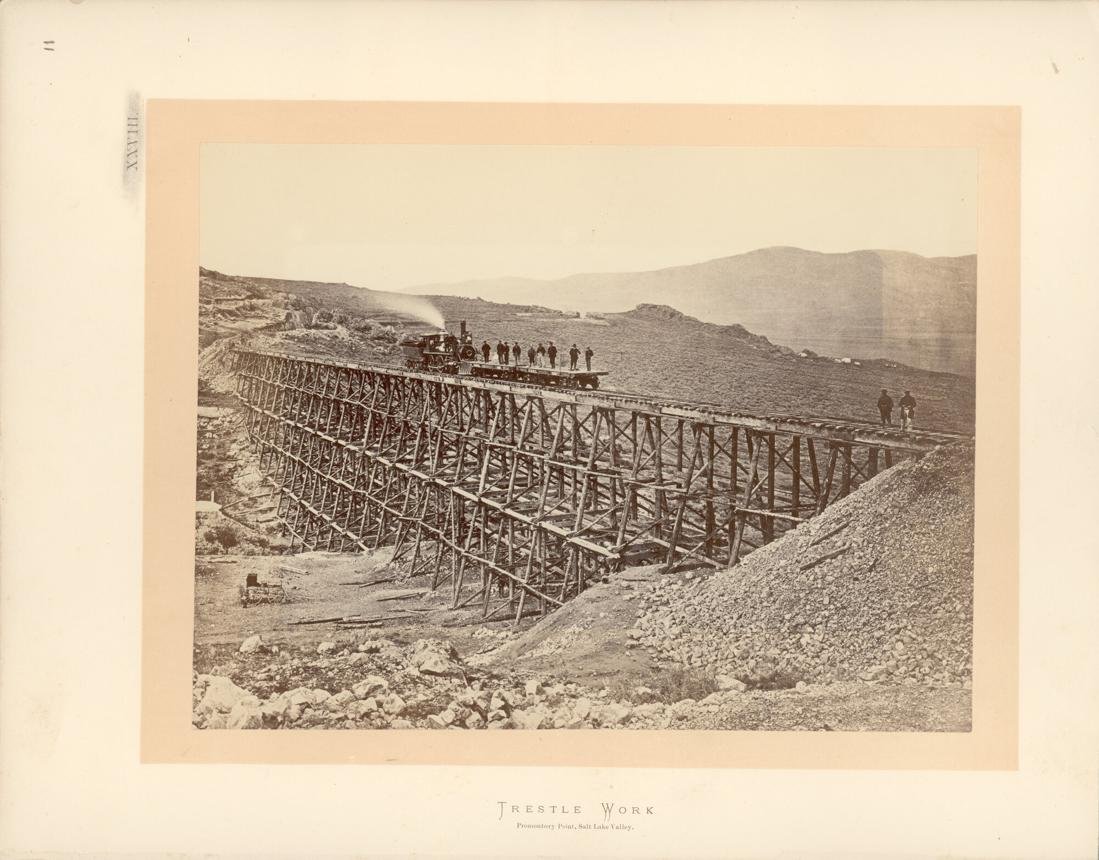 Source: Library of Congress

Building the network that would transform the country was enormously expensive, and making all that money back was another matter.
Think about what went into laying a new line in the 1870s. Companies had to acquire land, lay hundreds of miles of track, build bridges and stations, buy locomotives and hire workers, all before collecting a dollar from the first passenger or shipment of freight.
Much of that money was borrowed on the assumption that once the tracks were finished, enough business would follow to make the numbers work.
Companies raced to lay competing routes, driving construction costs higher even when there weren’t enough passengers and freight to support them. The railroads looked impressive on a map, but many simply couldn’t generate enough revenue to justify what they had cost to build.
That left heavily indebted railroad companies increasingly dependent on new money to keep going.
One of the biggest players was Jay Cooke, a prominent banker who had helped sell Union bonds during the Civil War.
Cooke became a major backer of the Northern Pacific Railroad, an ambitious project to connect the Great Lakes region with the Pacific Northwest.
But the project ran short of money, and Cooke couldn't raise enough new funds to keep it going.
On September 18, 1873, his banking firm suspended payments.
The news helped trigger a financial crisis.
The New York Stock Exchange closed for ten days, and the country entered a long economic downturn.
Yet railroad construction didn’t disappear with the investors’ money. New lines continued to be built, traffic continued to grow and the industry eventually emerged on the other side of the crisis.
Many of the investors who bankrolled the boom weren’t so fortunate.
It’s a lesson worth remembering… revolutionary technology can create enormous economic value while destroying much of the wealth that financed its rise.
Britain had experienced a similar railway mania in the 1840s.
Share prices crashed even as workers continued laying new tracks.
Radio and Electricity: The Roaring Twenties' Technology Mania
Fast-forward about 50 years and America was in the middle of another technological revolution.
Electricity was powering factories and homes. Radio was bringing news, music and entertainment into living rooms across the country.
Family Listening to Radio – 1920s
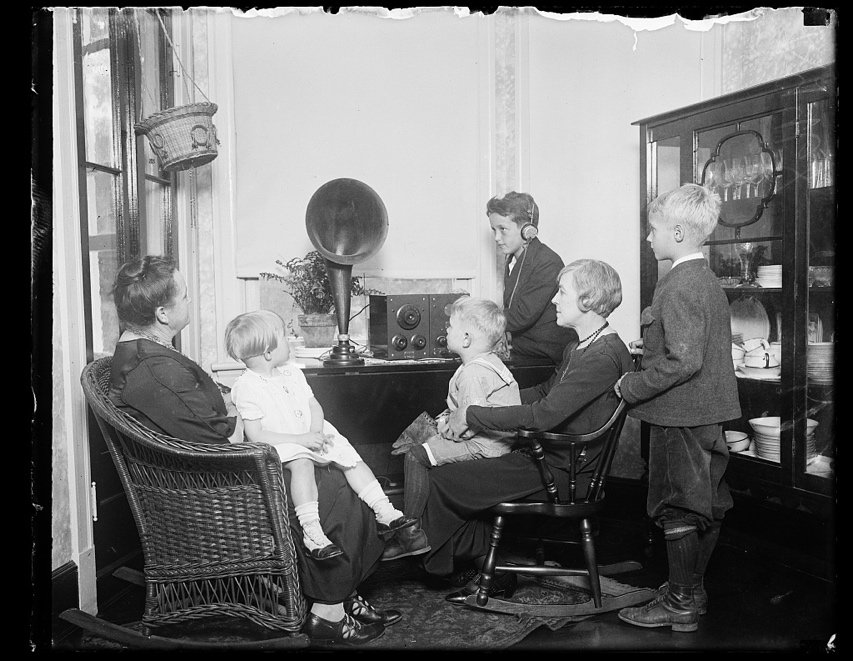 Source: Library of Congress

To investors, the possibilities seemed limitless.
Few companies captured that excitement better than Radio Corporation of America, better known as RCA.
During the 1920s, RCA became one of Wall Street's hottest stocks.
Investors weren't simply buying shares in a radio company. They were buying what they believed was the future of mass communication.
As radio sales and broadcasting expanded, RCA shares soared.
By September 1929, the stock had reached a reported split-adjusted price of roughly $115.
Then came the crash.
By May 1932, RCA shares had fallen to approximately $2.63.
That's a staggering loss of nearly 98%.
RCA was hardly the only company swept up in the enthusiasm for new technology.
Electric utilities were another Wall Street favorite in the Roaring Twenties.
Companies built power plants, expanded electric grids and brought electricity to millions of new customers.
There was plenty of real demand behind that expansion, but extending that network across the country came at a steep cost.
Some utility holding companies borrowed heavily and created increasingly complex corporate structures to fund their growth. Samuel Insull built one of the largest, assembling a sprawling network of electric companies that made him one of the most powerful figures in the industry.
That structure became far more difficult to support once the market crashed and the Great Depression took hold. Insull’s empire eventually collapsed in 1932.
Economic-history research shows utility stocks fell roughly 55% between late September and late November 1929. Some individual stocks lost even more.
These companies didn’t collapse in a vacuum. The broader market crash and Great Depression played major roles in these losses.
But none of that stopped the technology itself from moving forward.
Radio kept transforming communication and electricity became essential to modern life.
Once again, the technologies succeeded. The investments did not.
Computers: When Growth Became Everything
By the 1960s, Wall Street had turned its attention to computers, which were quickly becoming an important part of American business.
Companies like IBM were helping businesses process information, automate tasks and operate more efficiently.
IBM Mainframe Computer at the U.S. Department of Agriculture, 1964
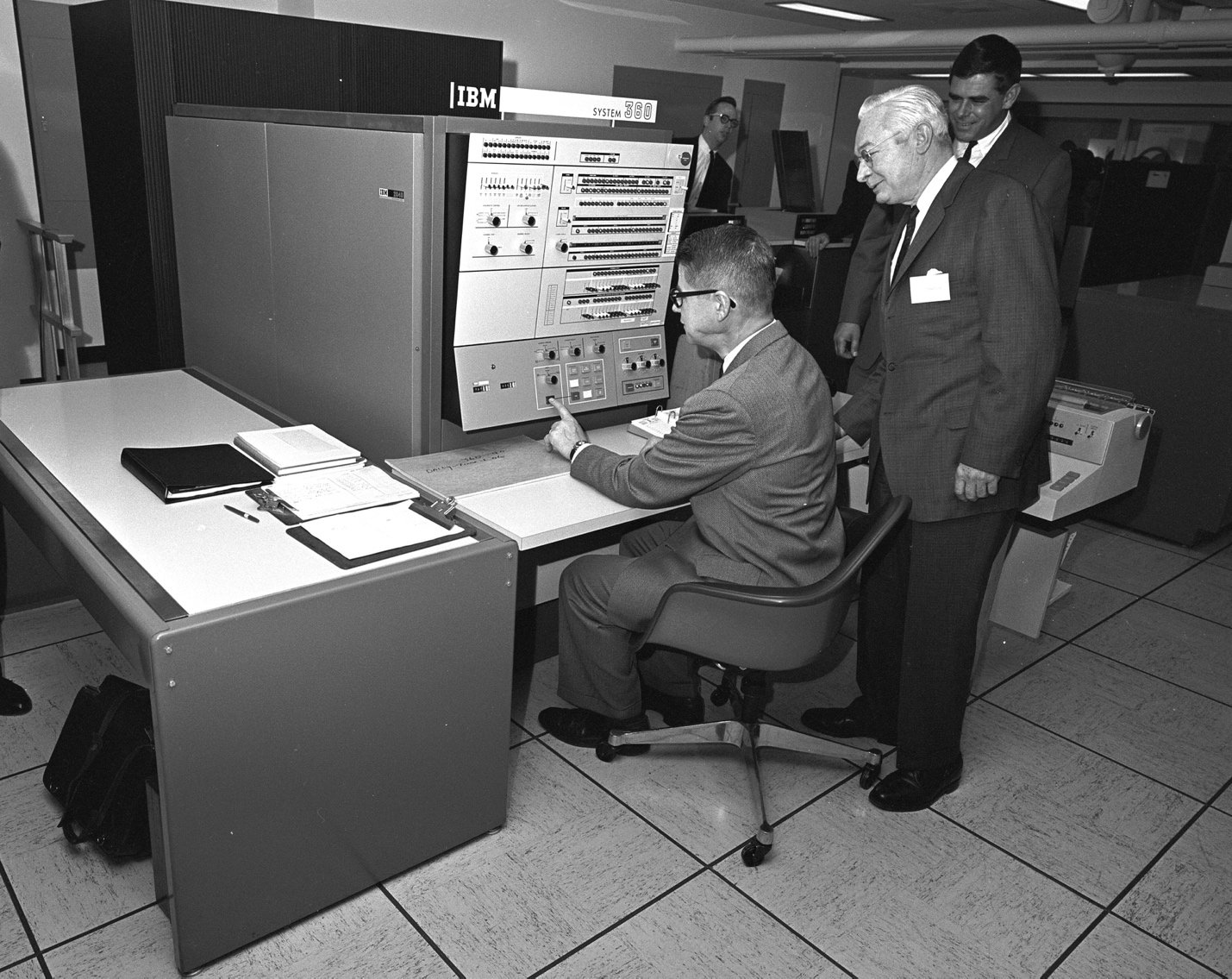 Source: Wikipedia
Investors correctly recognized the enormous potential.
But once again, stock prices began racing ahead of reality.
During the so-called "Go-Go Years," investors rushed into fast-growing companies, especially those tied to computers and electronics.
Mutual funds competed to own the hottest stocks. At the same time, traditional measures of value took a back seat to future earnings expectations.
Why worry about today's profits when a company might dominate tomorrow?
Unfortunately, those expectations left little room for disappointment.
During the 1969–1970 bear market, many popular computer and technology stocks suffered steep losses.
Some historical accounts report declines of nearly 80% in selected groups of these stocks.
Yet the computer revolution was only beginning.
Over the following decades, computers became essential to nearly every major industry.
The technology delivered on its promise.
But investors who paid too much for future growth often paid a heavy price.
A similar craze emerged in the early 1970s with the "Nifty Fifty," a group of popular growth stocks that included IBM and other household names.
Many suffered steep losses during the 1973–1974 bear market.
Through each of these booms and busts, we see that great companies can become terrible investments when their stock prices get too far ahead of reality.
What History Is Telling Us About AI
That brings us to the boom unfolding today.
AI promises to transform industries, boost productivity and reshape how businesses operate. That potential is real. It’s already proving useful across the economy, from software and medicine to manufacturing and finance.
But as we’ve seen throughout history, revolutionary technologies usually are useful. That’s what attracts so much money in the first place.
Like the railroads, AI requires enormous infrastructure investments long before the full profits become clear.
Like the electric utilities, its expansion depends partly on complex financial deals and access to borrowed money.
And like the computer stocks of the 1960s, investors are paying high valuations for companies expected to dominate the next technological revolution.
Two comparisons stand out…
According to research by Columbia Business School professor Stijn Van Nieuwerburgh, annual AI infrastructure spending is projected to average 3.63% of U.S. GDP from 2025 through 2032. That's well above the 2.24% of U.S. GDP spent on American railroads from 1870 to 1890.
Meanwhile, research from Bianco Research shows that 41 AI-related companies account for roughly 49% of the S&P 500's market value.
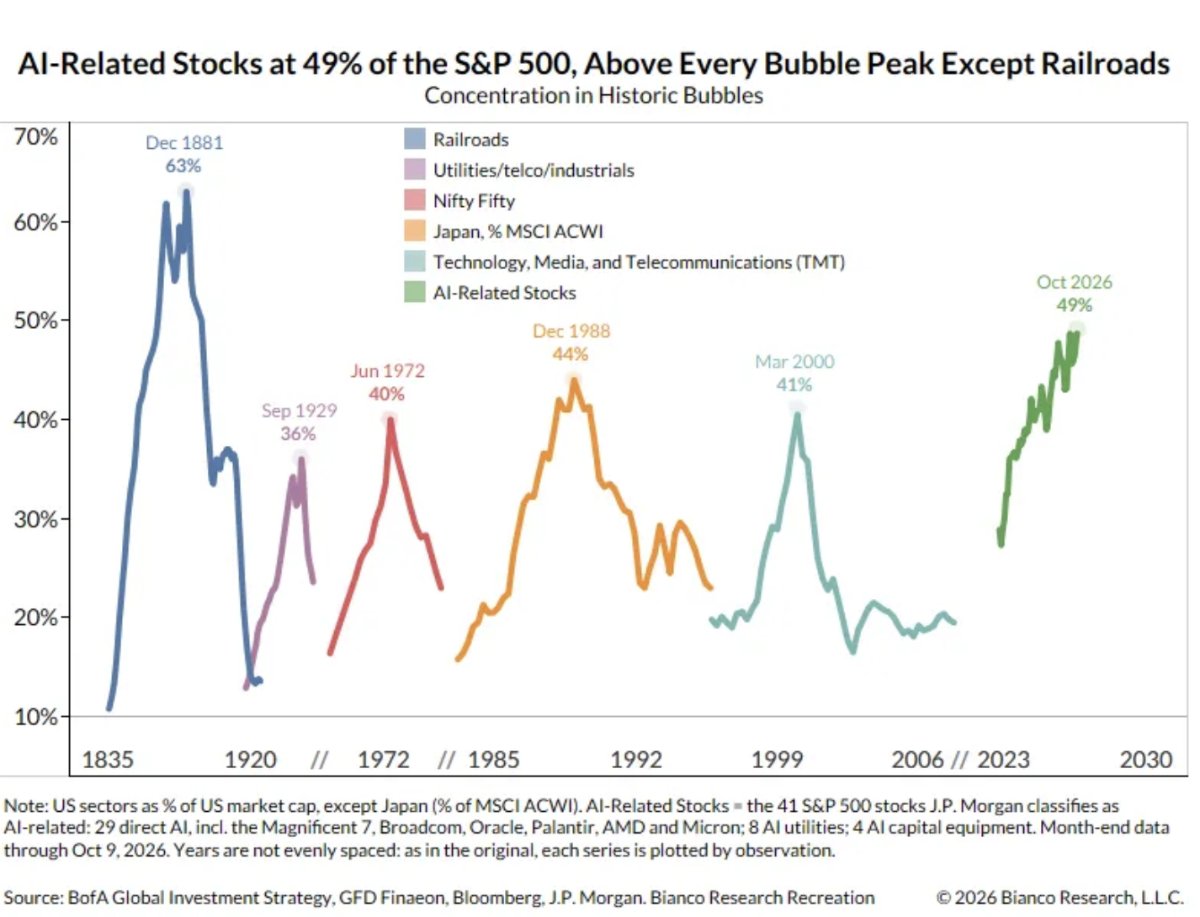 Source: Bianco Research, October 2026.
As the chart shows, AI's market share now exceeds the peaks of nearly every major investment boom over the past 150 years.
These comparisons use different methods and the AI spending figure is a forecast. Neither proves a crash is coming.
But both show how much is riding on AI's success.
Investors are committing enormous sums today based on profits they expect to arrive years from now.
History shows why that can be dangerous.
The Technology Survives. Will Your Portfolio?
If there’s one thing the last 200 years have taught us, it’s that revolutionary technologies can change the world…
- Railroads transformed transportation.
- Electricity powered the modern economy.
- Radio revolutionized communication.
- Computers changed nearly everything.
The people who believed in those technologies were right, but plenty of them still lost money.
That’s worth remembering as billions pour into AI today.
Artificial intelligence can live up to its enormous promise without every company riding the wave living up to its valuation.
Knowing the difference can help us recognize when expectations have run too far ahead, avoid paying too much for growth that may take years to arrive and protect our wealth if the excitement eventually fades.
There is, however, one more part of this history that we haven’t spent much time on yet.
Many of history's worst financial collapses weren't fueled by investor enthusiasm alone.
They were fueled by something potentially even more dangerous:
Debt.
And that's exactly what we'll explore in our next issue, so stay tuned.
Sign Up Today for Free!
Truth & Trends brings you market insights and trading tips you won't find anywhere else — unless you have your own personal hedge fund manager on speed dial...
Meet Enrique Abeyta, one of Wall Street’s most successful hedge fund managers. With years of experience managing billions of dollars and navigating the highs and lows of the financial markets, Enrique delivers unparalleled market insights straight to your inbox.
In Truth & Trends, Enrique shares his personal take on what’s moving the markets, revealing strategies that made him a star in the world of high finance. Whether it’s uncovering the next big trend or breaking down the hottest stocks and sectors, Enrique’s insights are sharp, actionable, and proven to work in any market condition.
Inside these daily updates, you’ll gain:
- 50 years of combined trading wisdom distilled into actionable insights.
- A behind-the-scenes look at how Wall Street pros spot opportunities and avoid pitfalls.
- Exclusive strategies that Enrique personally uses to deliver exceptional returns — no fluff, just results.
To have Truth & Trends sent directly to your inbox every weekday, just enter your email address below to join this exclusive community of informed traders.
Don’t miss your chance to learn from one of the best in the business.
Sign up now and take your trading game to the next level.

In Praise of Greed
Posted October 16, 2026
By Greg Guenthner

The AI House of Cards II: First One to Fall
Posted October 15, 2026
By Enrique Abeyta

The AI House of Cards: Wall Street’s Trillion-Dollar Bet
Posted October 12, 2026
By Enrique Abeyta
AI Is Now “Too Big to Fail”
Posted October 08, 2026
By Enrique Abeyta

MU Are You Ok? Are You Ok MU?
Posted October 07, 2026
By Nick Riso