Posted September 28, 2026

By Enrique Abeyta
The End of AI's "Honeymoon Phase"
We may be at a turning point in the AI boom.
Last week, Oracle sent a “force majeure” notice to the developer of Project Jupiter, the enormous AI data center campus being built in New Mexico.
The goal is to protect Oracle financially if delays prevent the project from coming online in 2028 as planned.
In plain English, force majeure is a contractual protection companies can use when something outside their control prevents them from holding up their end of a deal.
Things like natural disasters, wars, or sudden government actions.
In Oracle’s case, the concern is potential delays tied to securing power for one of the largest AI projects ever attempted.
And “large” barely does Jupiter justice.
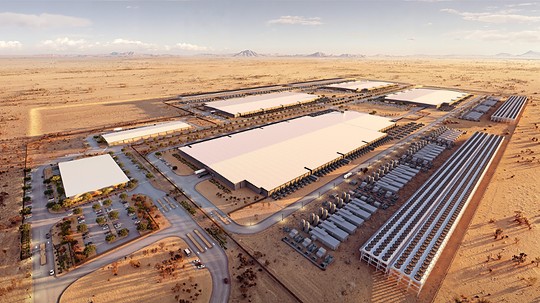
 Project Jupiter rendering. Source: Project Jupiter Together
The campus covers roughly 1,400 acres, about 1,060 football fields.
It's designed to handle 2.2 gigawatts of power, enough electricity to supply roughly 1.8 million average U.S. homes.
Then there's the money. Around $18 billion in loans are tied to the project.
Oracle says Jupiter remains on schedule and that the notice does not mean a delay is coming. Maybe this becomes nothing more than a contractual precaution.
But Project Jupiter is also a good example of how the AI trade is changing.
AI Has Entered Phase Two
Phase One of the AI boom was all about building with what you have.
Big Tech invested heavily to expand existing data centers, while chipmakers ramped up their production.
Now we’ve entered Phase Two, which is all about building what doesn't exist yet.
It involves building enormous data centers from the ground up, along with new power plants and other infrastructure needed to run them.
And this phase also requires much more money.
Even the world's richest companies, once flush with cash, are increasingly tapping debt and outside investors to keep building.
Project Jupiter is the poster child for Phase Two.
Jupiter didn't suddenly become a financial concern this week.
Its roughly $18 billion in loans were recently trading for only $0.89–$0.91 on the dollar, as banks struggled to sell the debt to other investors.
Oracle itself carried about $130 billion in debt as of June and had committed to roughly $260 billion in long-term data center leases.
S&P downgraded its credit rating in July to one notch above junk status.
Oracle's stock has roughly halved since June as its AI spending and debt load came under greater scrutiny.
Then came the “force majeure” notice last week.
Oracle still says that Jupiter remains on schedule. But that's almost what makes this more interesting.
If everything is moving according to plan, why invoke an extraordinary clause designed to protect against potential delays?
Maybe the answer will prove to be harmless. But if there’s smoke, we at least have to look for fire.
And the risk here goes beyond a delay at one data center.
Phase Two of the AI buildout increasingly depends on outside capital. That means lenders and investors have a much bigger role in determining which projects get built — and at what cost.
Financing agreements come with payment schedules, conditions and deadlines.
So when a power plant gets delayed, a permit doesn't arrive or construction falls behind, an engineering problem can become a financial problem.
Jupiter isn’t competing for capital in a vacuum, either.
Hyperscalers, data center developers, chipmakers and frontier AI labs are all chasing enormous amounts of capital at the same time.
Money doesn't suddenly disappear. But capital has a price, and investors have alternatives.
The more lenders demand, the fewer projects make financial sense.
That’s where one troubled project can become more significant.
Suppose another hyperscaler delays a giant data center. Then a major chip order gets cut. Lenders get nervous and demand higher returns before funding the next project.
Higher financing costs weaken the economics. That makes lenders even more cautious.
A physical problem becomes a financial problem. A financial problem becomes a confidence problem.
And suddenly, the cycle can begin running in reverse.
We've Seen This Play Out Before
History is a useful guide for what happens when an investment boom becomes increasingly dependent on financing.
One example comes from the dot-com burst.
Global Crossing was a telecom company that spent billions building a huge network of fiber-optic cables during the internet boom.
And it got the big idea right. The internet really did change the world.
But competitors were laying huge amounts of fiber, too. Capacity surged, prices fell, and the economics weakened.
Then money became harder to find. And in January 2002, Global Crossing filed for bankruptcy protection.
The internet wasn't the problem. The economics of funding its infrastructure buildout were.
Another example comes from the global financial crisis.
Bear Stearns was one of America's largest investment banks, trading securities and relying heavily on financial markets for funding.
In March 2008, Bear told the Federal Reserve it expected to have insufficient funding to meet its obligations the very next day.
It couldn't find private financing, and the Fed helped arrange its emergency sale to JPMorgan.
At the time, Bear could still look like one troubled Wall Street firm. Then Lehman Brothers collapsed six months later.
Bear Stearns wasn't the financial crisis.
But in hindsight, it warned that something underneath Wall Street's financing machine was breaking.
That brings us back to Project Jupiter today.
Is Oracle dealing with an isolated problem… or are investors getting an early glimpse of something bigger?
Right now, we don't know.
Project Jupiter may get built on schedule, and Oracle's force majeure notice may become little more than a footnote.
But the challenge it exposes isn't going away.
Phase Two of the AI boom requires more infrastructure, more outside capital and more things to go right. And as the price tag grows, so do the consequences when they don't.
AI may still change the world. That doesn't mean every data center or financing deal built around it will succeed.
Years from now, we may look back at Project Jupiter as the moment investors realized funding the AI revolution wouldn't be as easy as they thought.
In other words, the honeymoon stage of the AI boom may be over. Now comes the hard part: paying the bills and proving this marriage can last.
Sign Up Today for Free!
Truth & Trends brings you market insights and trading tips you won't find anywhere else — unless you have your own personal hedge fund manager on speed dial...
Meet Enrique Abeyta, one of Wall Street’s most successful hedge fund managers. With years of experience managing billions of dollars and navigating the highs and lows of the financial markets, Enrique delivers unparalleled market insights straight to your inbox.
In Truth & Trends, Enrique shares his personal take on what’s moving the markets, revealing strategies that made him a star in the world of high finance. Whether it’s uncovering the next big trend or breaking down the hottest stocks and sectors, Enrique’s insights are sharp, actionable, and proven to work in any market condition.
Inside these daily updates, you’ll gain:
- 50 years of combined trading wisdom distilled into actionable insights.
- A behind-the-scenes look at how Wall Street pros spot opportunities and avoid pitfalls.
- Exclusive strategies that Enrique personally uses to deliver exceptional returns — no fluff, just results.
To have Truth & Trends sent directly to your inbox every weekday, just enter your email address below to join this exclusive community of informed traders.
Don’t miss your chance to learn from one of the best in the business.
Sign up now and take your trading game to the next level.
Bitcoin’s Breakout Is Just the Beginning
Posted September 25, 2026
By Greg Guenthner

$100 Oil and “the New Normal”
Posted September 24, 2026
By Enrique Abeyta

Coming Soon: Wall Street After Dark
Posted September 21, 2026
By Enrique Abeyta

A Revolution in All the “Wrong” Stocks
Posted September 18, 2026
By Greg Guenthner

How to Hedge Against Killer Robots (You Don’t)
Posted September 17, 2026
By Enrique Abeyta