Posted May 14, 2026

By Enrique Abeyta
The $16 Trillion China Summit
Trump's trip to China to meet with Xi Jinping is easily one of the week's biggest stories.
If you've been following the headlines, then you probably have a sense that it’s all about tariffs, Taiwan, and Iran. All important, to be sure.
But there’s another element to this visit that you shouldn’t ignore.
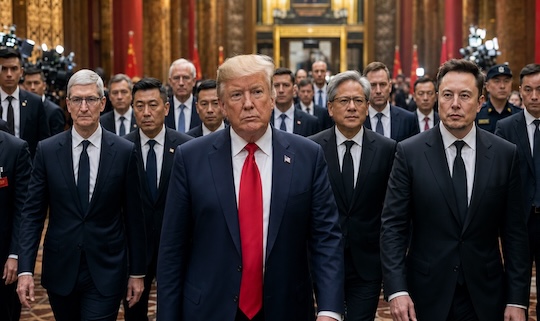
Trump was joined by the biggest names in corporate America, including Tim Cook, Jensen Huang, Elon Musk, and executives from Meta, BlackRock, Goldman Sachs, Boeing, and more.
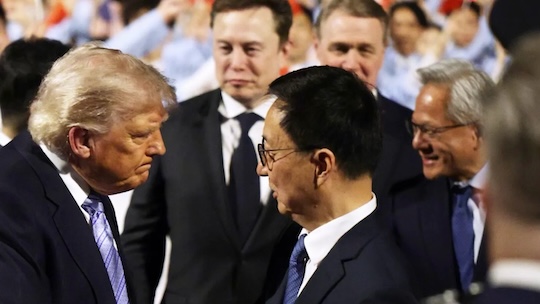
Source: CNBC
These companies represent somewhere between $16 and $18 trillion in combined market value.
That’s about 25%–30% of the total value of the entire U.S. stock market.
The message that sends about the global economy matters more than most people probably realize.
But before I get to that, let’s rewind a bit to put Trump’s visit into context.
When the World’s Largest Economies Meet
Historically, presidential trips to China have always carried enormous significance. When Nixon visited China in 1972, the trip was overwhelmingly geopolitical.
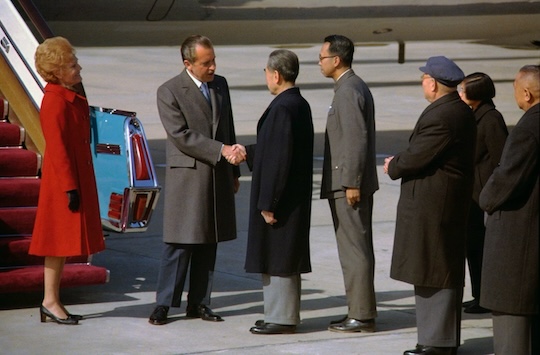
Source: National Archives
China was still economically isolated and barely connected to the global capitalist system. American corporations had little reason to travel with Nixon because there wasn't much business to be done there yet.
The goal was strategic. Nixon wanted to split China away from the Soviet Union and reshape the balance of the Cold War.
In many ways, that trip opened the door to diplomacy between the two countries.
By the time Reagan visited China in 1984, the picture had begun changing.
China was slowly opening under Deng Xiaoping’s reforms, and American businesses were beginning to see opportunity in manufacturing, exports, and long-term economic cooperation.
Still, Reagan’s trip was primarily state-driven rather than corporate-driven.
That changed dramatically under Clinton in the late 1990s.
Clinton’s China visit came during the peak years of globalization optimism.
Corporate America believed China would become the world’s next massive consumer market and manufacturing hub.
Executives from aerospace, industrial, technology, and consumer companies pushed aggressively for deeper integration between the two economies ahead of China's eventual joining of the World Trade Organization.
Back then, the assumption was simple: economic integration would reduce geopolitical conflict.
This trip feels very different.
Today, the U.S. and China openly view each other as strategic rivals.
Taiwan tensions remain elevated. Semiconductor restrictions continue growing. And artificial intelligence has transformed advanced chips into national security assets.
Meanwhile, the Iran conflict and instability in the Strait of Hormuz have reminded the world just how fragile global supply chains remain.
And despite all of that tension, some of the most important CEOs in America still boarded planes to Beijing.
This tells us that even if the relationship between China and the U.S. is strained, it’s far from broken.
Let’s Talk About the Stakes
The headlines surrounding the summit have focused heavily on tariffs and trade. But behind closed doors, one of the most important topics is Iran.
China is one of Iran's most important economic lifelines. It purchases large quantities of Iranian oil and wields significant diplomatic influence throughout the region.
At the same time, China desperately needs stability in the Middle East because it remains heavily dependent on imported energy flowing through the Strait of Hormuz.
That creates a fascinating overlap between U.S. and Chinese interests.
Neither country benefits from a prolonged energy shock. Neither side wants runaway oil prices, shipping disruptions, or another wave of global inflation that could push the world economy toward recession.
That overlap may be more important for markets than the tariff headlines themselves.
For months, investors have worried about a worst-case scenario where oil prices spike, inflation reaccelerates, supply chains tighten, and the Fed is forced to keep interest rates higher for longer.
Markets can usually handle bad news. What they struggle with is uncertainty. And for much of this year, uncertainty has dominated the narrative.
Investors have spent months worrying about the same chain reaction. Higher oil prices, sticky inflation, tight supply chains, and a Fed forced to keep rates elevated.
But if this summit produces signs of stabilization, many of those fears could begin fading simultaneously.
For equities, especially growth stocks, that’s a far more constructive backdrop than the market has dealt with most of this year.
Investors could suddenly begin pricing in lower energy costs, normalized shipping routes, reduced inflation pressure, improved corporate margins, stronger consumer spending, and more stable global supply chains.
Markets could also regain confidence that AI infrastructure spending will continue uninterrupted. Interest rates eventually move lower down the road as well.
That combination could fuel another powerful leg higher for the market.
And it would likely reinforce leadership in the exact areas already driving this bull market — AI infrastructure, semiconductors, and mega-cap tech.
Speaking of the AI trade, it’s worth remembering that the AI boom isn’t just about software.
It relies on semiconductors, data centers, networking equipment, energy infrastructure, cooling systems, and one of the most complex manufacturing ecosystems ever created.
The U.S. dominates many parts of the AI stack. China dominates or heavily influences others.
Neither side can realistically unwind that relationship overnight without creating massive economic disruption.
That’s why it matters that these CEOs were in the room at all.
Nvidia sits at the center of the global AI compute race. Apple oversees one of the most sophisticated supply chains in human history. Tesla operates one of the world's most important EV factories in Shanghai.
These companies now sit at the center of the modern economic system.
That’s why this summit may matter less as a diplomatic event and more as an acknowledgment that neither side can afford serious economic disruption during the AI race.
The biggest takeaway from Trump’s visit may be this:
Despite years of headlines about “decoupling,” the global economy remains deeply intertwined — especially around AI, semiconductors, energy, and manufacturing.
And that may be the real message markets should take away from Beijing.
The U.S. and China are still strategic rivals. But neither side appears willing to risk breaking the economic system powering the AI boom.
Sign Up Today for Free!
Truth & Trends brings you market insights and trading tips you won't find anywhere else — unless you have your own personal hedge fund manager on speed dial...
Meet Enrique Abeyta, one of Wall Street’s most successful hedge fund managers. With years of experience managing billions of dollars and navigating the highs and lows of the financial markets, Enrique delivers unparalleled market insights straight to your inbox.
In Truth & Trends, Enrique shares his personal take on what’s moving the markets, revealing strategies that made him a star in the world of high finance. Whether it’s uncovering the next big trend or breaking down the hottest stocks and sectors, Enrique’s insights are sharp, actionable, and proven to work in any market condition.
Inside these daily updates, you’ll gain:
- 50 years of combined trading wisdom distilled into actionable insights.
- A behind-the-scenes look at how Wall Street pros spot opportunities and avoid pitfalls.
- Exclusive strategies that Enrique personally uses to deliver exceptional returns — no fluff, just results.
To have Truth & Trends sent directly to your inbox every weekday, just enter your email address below to join this exclusive community of informed traders.
Don’t miss your chance to learn from one of the best in the business.
Sign up now and take your trading game to the next level.

The Tell-Tape Heart
Posted May 13, 2026
By Nick Riso
All-Time Highs... in THIS Economy?
Posted May 11, 2026
By Enrique Abeyta

The "Killer Bees" Are Swarming Again
Posted May 08, 2026
By Greg Guenthner

The MU-mentum Trap: When Good Trades Go Bad
Posted May 07, 2026
By Enrique Abeyta

Coming Soon: The YOLO Market, Unleashed
Posted May 01, 2026
By Greg Guenthner
