Posted March 06, 2025

By Enrique Abeyta
Take the Bull by the Horns
This market pullback is making investors nervous.
The S&P 500 posted its worst day of 2025 on Monday, right after finishing its worst week of the year the Friday before.
But if history tells us anything, it’s that pullbacks like this during a bull market are buying opportunities — not reasons to panic.
Earlier this week, I wrote to you about why you should be buying this dip. Today, I’ll give you more specific instructions on how exactly to do it.
But first, let’s put this correction into context…
This Pullback Is No Reason to Panic
Below is a chart of the S&P 500 since the beginning of the current bull market, with corrections highlighted in red.
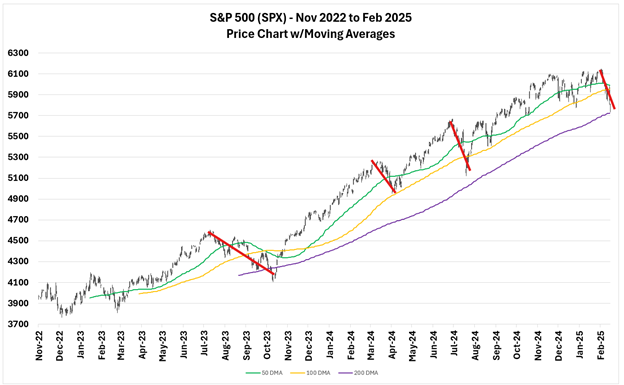
There have been four major selloffs in the S&P 500 between 5%–10% during this period, with the most recent selloff at about the midpoint of that range.
While a mid-single-digit drawdown is not abnormal for the overall index, many stocks have suffered far worse.
During the most recent selloff, sellers have hit the market leaders the hardest. This has been difficult for many investors as they own these stocks.
As painful as this pullback has been, you will see in the chart that it’s fairly ordinary compared to what we have seen so far. It’s also very typical of a normal bull market.
In fact, several pullbacks of 5%–10% define a bull market and present tremendous opportunities for investors. (Read that line again!)
If you are running a trading portfolio, you should focus on the individual positions with an understanding of where the overall stock market sits in its upward channel.
As long as we remain in a bull market, pullbacks like this are a great time to buy quality stocks to take advantage of any temporary weakness.
This brings me to my next point about how you want to allocate your capital as you buy the dip.
Positioning Yourself for Success
I get questions all the time from readers about position sizing. Properly sizing your positions to your risk tolerances and goals is an important first step in trading.
It is also a personal decision, as each investor brings a unique situation. So there’s no “one-size-fits-all” answer I can give.
However, I do have general guidelines that can govern how you build your portfolio. These are good to know right now as we experience a correction in an otherwise strong bull market.
Ideally, your trading portfolio should be 25%–50% invested during stock market highs.
In our trading service The Maverick, for example, we will average around 15 to 20 positions at any one time.
(Note that I say average, because sometimes we may have less than a half dozen, and at other times we might load up closer to 30 positions.)
While each one is an individual idea, they will often move with the overall stock market. So we will often take profits as the market moves higher and the number of positions will come down.
With the stock market pressing to new highs and extended from the 50-day moving average as it was a couple of months ago, we would be on the lower end of the number of positions — maybe five to 10 trades, or 25%–50% invested.
On the flip side, we will increase our positions as more opportunities present themselves while the stock market sells off.
With the stock market around a rising long-term moving average, we’ll maintain exposure in the 40%–75% range.
Imagine positioning yourself at the higher end of this range as the stock market comes down to its 100-day moving average.
Buy the Dip Like a Wall Street Veteran
The approach becomes a bit different only after the S&P 500 goes through the 100-day moving average.
At this stage, we become even more patient. The remaining 25% of your trading portfolio would then be divided into five pieces.
I would put the first piece (5%) to work halfway between the 100-day and 200-day moving average and the second piece (another 5%) at the 200-day moving average.
You would want to keep the final three pieces in reserve in case the selloff gets crazy.
In this case, we stop looking at the moving averages and look for 5% downward moves in the S&P 500. For every 5% down, allocate another 5% of the portfolio.
So if the index is down 20% or more, we would be fully invested. Importantly, this is with the 50-day and 100-day moving averages still above the 200-day moving average.
(Read that last line again. It’s important to understand these guidelines are within the context of a bull market!)
This strategy will pay off handsomely many times during the course of a bull market — perhaps dozens of times.
There is one unfortunate downside to the strategy: there will be ONE time it costs you a lot of money.
When the 50-day and 100-day moving averages finally move below the 200-day moving average, you want to cut your losses and reduce exposure by at least 50%.
This move will likely be very painful and result in a big realized loss.
The goal, though, is that the many successful trading gains you have booked in the preceding multi-year bull market will more than offset that loss.
Of course, every individual investor should size their positions to their risk tolerances.
But this is a good road map for how to take advantage of the dips in a bull market.
Sign Up Today for Free!
Truth & Trends brings you market insights and trading tips you won't find anywhere else — unless you have your own personal hedge fund manager on speed dial...
Meet Enrique Abeyta, one of Wall Street’s most successful hedge fund managers. With years of experience managing billions of dollars and navigating the highs and lows of the financial markets, Enrique delivers unparalleled market insights straight to your inbox.
In Truth & Trends, Enrique shares his personal take on what’s moving the markets, revealing strategies that made him a star in the world of high finance. Whether it’s uncovering the next big trend or breaking down the hottest stocks and sectors, Enrique’s insights are sharp, actionable, and proven to work in any market condition.
Inside these daily updates, you’ll gain:
- 50 years of combined trading wisdom distilled into actionable insights.
- A behind-the-scenes look at how Wall Street pros spot opportunities and avoid pitfalls.
- Exclusive strategies that Enrique personally uses to deliver exceptional returns — no fluff, just results.
To have Truth & Trends sent directly to your inbox every weekday, just enter your email address below to join this exclusive community of informed traders.
Don’t miss your chance to learn from one of the best in the business.
Sign up now and take your trading game to the next level.

The AI House of Cards: Wall Street’s Trillion-Dollar Bet
Posted October 12, 2026
By Enrique Abeyta

AI Is Now “Too Big to Fail”
Posted October 08, 2026
By Enrique Abeyta

MU Are You Ok? Are You Ok MU?
Posted October 07, 2026
By Nick Riso

Micron Could Get Cut in Half. Here’s Why.
Posted October 05, 2026
By Enrique Abeyta

The AI “Mega-Theme” Nobody’s Talking About Yet
Posted October 02, 2026
By Greg Guenthner