Posted May 28, 2026

By Enrique Abeyta
SpaceX IPO: When EXACTLY to Buy
There are few names in today’s market more important than SpaceX.
The company redefined rocket launches, made reusable rockets real, and is building Starlink, the most important satellite internet network on Earth.
That’s exactly why the SpaceX IPO has become a market obsession.
It’s everywhere you look, and many investors are treating the upcoming IPO like a guaranteed path to instant riches.
But that’s not the right way to think about it.
When it comes to mega-hyped IPOs like SpaceX, investors can make bad decisions because they get caught up in the excitement.
The reality is that many people don’t fully understand how these offerings actually work or who benefits most from the initial pricing.
And they definitely don’t understand how dangerous momentum and scarcity can become when demand dramatically exceeds available shares.
So today, I’m going to break it all down. I’ll explain why you won’t want to buy shares of SpaceX as soon as you’re able.
And I’ll even tell you when the best buying opportunities for this stock could emerge.
The Problem With an IPO Everyone Wants
To understand why this setup could become dangerous, you first need to understand what makes SpaceX unique.
Unlike many traditional IPO candidates, SpaceX already has an enormous private-market valuation.
Institutional investors, venture capital firms, sovereign wealth funds, insiders, and early employees have been buying and selling shares privately for years.
That means a huge amount of the company is already spoken for.
When SpaceX goes public, only a relatively small percentage of total shares are likely to trade initially. That’s known as the public float.
And small floats combined with enormous public demand can create explosive price action.
We’ve seen this movie before.
When companies become cultural phenomena before their IPOs, the opening trade often has less to do with valuation and more with psychology.
Investors stop asking what the company is worth and start asking how quickly they can get exposure before everyone else does.
That’s when rationality goes out the window.
To see how this ultimately plays out, let’s take a walk through the graveyard of other highly anticipated IPOs.
Start with Robinhood.
The stock exploded higher after its IPO enthusiasm phase before suffering massive declines as growth slowed and speculative trading activity cooled.
Or look at Rivian as another example.
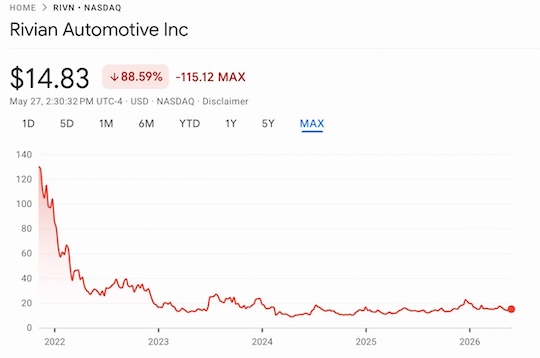
At one point, Rivian briefly became one of the most valuable automakers on Earth despite producing only a fraction of the vehicles of legacy competitors.
The excitement was there, but the stock eventually collapsed by more than 80% from peak levels.
The same thing happened with Coinbase during the crypto mania. Investors rushed in at near-peak enthusiasm, only to see the stock get crushed during the crypto winter that followed.
Even legendary IPOs weren’t immune.
Facebook had one of the most anticipated IPOs in history back in 2012.
And yet, after going public, the stock struggled for months as concerns mounted about mobile monetization and valuation.
Investors who chased the initial frenzy endured painful volatility before the company eventually matured into the powerhouse we know today.
The point here isn’t that these were bad companies. Some of them turned into great long-term investments.
It’s that great companies and great IPO entries are not the same thing. And investors who fail to understand that distinction often pay a steep price.
Now here’s where the SpaceX setup gets especially interesting.
The SpaceX Lockup Schedule Changes Everything
IPOs come with a lock-up period, which usually lasts between 90 and 180 days after a company goes public.
Insiders like founders, employees, and venture backers are prohibited from selling their shares during this window.
The idea is to prevent a flood of insider selling from swamping the newly public stock before it finds its footing.
A lot of investors assume this works like a single massive event. Insiders are frozen, the clock runs out, and then everyone can sell at once.
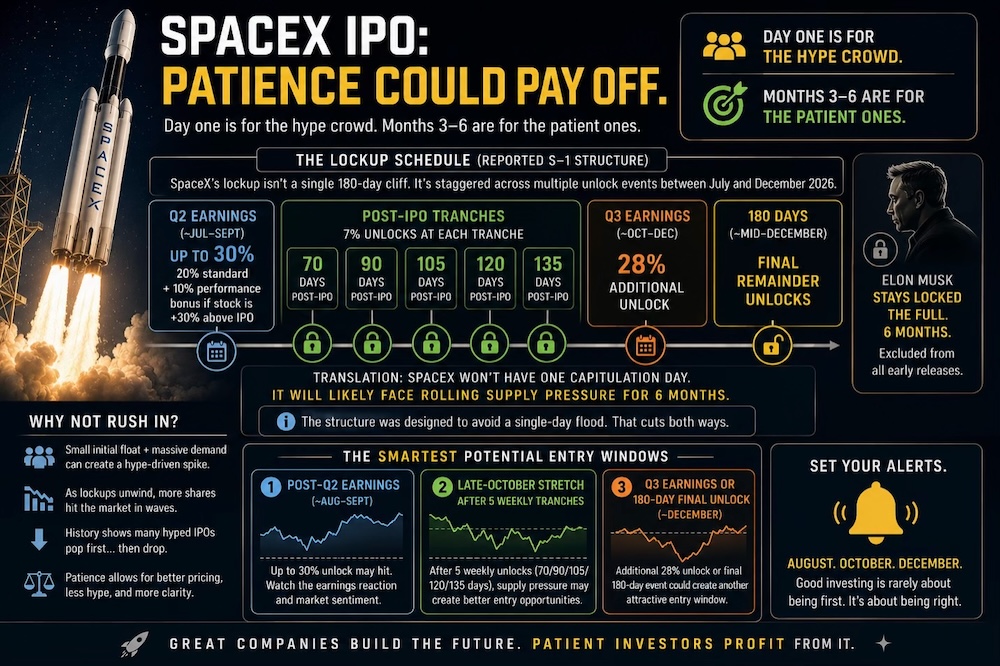
But according to details circulating from the reported SpaceX S-1 structure, that's not how this IPO may work at all.
Instead of a single 180-day unlock, the share releases are staggered across multiple dates from roughly July to December of 2026.
That’s hugely important.
Under the reported structure, up to 30% of insider shares could unlock around Q2 earnings season during the July-to-September timeframe.
Roughly 20% would represent the standard release. In comparison, another 10% performance tranche could potentially unlock if the stock trades at least 30% above the IPO price.
Then comes an even more fascinating stretch.
Additional 7% unlock tranches are reportedly scheduled around days 70, 90, 105, 120, and 135 after the IPO.
In other words, instead of one massive wave of supply hitting the market, SpaceX could face rolling supply pressure almost weekly during parts of the fall.
Then, around Q3 earnings season, another 28% tranche may unlock before the final remaining shares become eligible around the traditional 180-day mark near mid-December.
And notably, Elon Musk himself reportedly remains locked up for the full six months and excluded from the earlier releases.
That structure tells you something very important.
SpaceX may not experience one giant capitulation event. Instead, it could experience a six-month digestion phase.
The initial IPO frenzy could still be enormous. Retail traders and momentum funds pile in. Before long, investors stop thinking about valuation entirely.
But every single lockup tranche potentially introduces more supply into the market.
That matters because markets are ultimately governed by supply and demand.
In the early days of a blockbuster IPO, demand massively overwhelms available shares. That imbalance can send stocks vertical.
But as insider shares gradually unlock, the equation changes.
Supply starts catching up, which is often where the emotional phase cools off.
We saw versions of this dynamic play out repeatedly after the IPOs of companies like Uber, Snowflake, and Rivian.
Early euphoria eventually collided with the reality that insiders, venture firms, and employees often want liquidity too.
And that can create meaningful pressure on the stock price.
Why The Smart Money Waits on the Sidelines
This is where patience becomes a strategy.
Personally, I believe SpaceX is one of the most important companies of this generation.
The company sits at the center of space infrastructure, satellite communications, national defense, launch technology, and, potentially, future global internet architecture.
But believing in a company in the long term doesn't automatically mean buying it at any price on any day.
Those are two completely different decisions.
If this reported lockup structure proves accurate, the most interesting potential entry points may not happen during opening week at all.
They may happen later, possibly after the Q2 earnings reaction during the August-to-September window.
Possibly after the repeated weekly unlock tranches, pressuring the stock during late October.
Or potentially around Q3 earnings season and the final 180-day unlock near December, when the market has finally absorbed most of the insider supply.
That’s the part many investors fail to appreciate.
Day one is often driven by hype. Months three through six are often driven by price discovery.

Now here’s another fascinating part…
There's a decent chance many investors will eventually own SpaceX shares, whether they buy them intentionally or not.
Why?
Because if current discussions around index inclusion and benchmark treatment move forward, SpaceX could become embedded across passive investment products and major indexes.
In other words, investors buying index funds or retirement accounts may indirectly gain exposure anyway. But that’s a much bigger story for another day.
For now, just know that this IPO isn’t just another stock offering. It’s shaping up to become the biggest market event of the entire year.
And these kinds of events often lead to emotional decision-making.
That’s exactly why discipline matters so much heading into the SpaceX IPO.
Because sometimes the smartest move in investing isn’t getting in first. It’s waiting for everyone else to calm down first.
Sign Up Today for Free!
Truth & Trends brings you market insights and trading tips you won't find anywhere else — unless you have your own personal hedge fund manager on speed dial...
Meet Enrique Abeyta, one of Wall Street’s most successful hedge fund managers. With years of experience managing billions of dollars and navigating the highs and lows of the financial markets, Enrique delivers unparalleled market insights straight to your inbox.
In Truth & Trends, Enrique shares his personal take on what’s moving the markets, revealing strategies that made him a star in the world of high finance. Whether it’s uncovering the next big trend or breaking down the hottest stocks and sectors, Enrique’s insights are sharp, actionable, and proven to work in any market condition.
Inside these daily updates, you’ll gain:
- 50 years of combined trading wisdom distilled into actionable insights.
- A behind-the-scenes look at how Wall Street pros spot opportunities and avoid pitfalls.
- Exclusive strategies that Enrique personally uses to deliver exceptional returns — no fluff, just results.
To have Truth & Trends sent directly to your inbox every weekday, just enter your email address below to join this exclusive community of informed traders.
Don’t miss your chance to learn from one of the best in the business.
Sign up now and take your trading game to the next level.

The 0DTE Club Just Got Bigger
Posted August 21, 2026
By Nick Riso
Want to Invest Like a Venture Capitalist? Now You Can
Posted August 20, 2026
By Enrique Abeyta

3 Stocks of Tomorrow Nobody's Talking About Today
Posted August 17, 2026
By Enrique Abeyta

Melt-Up Mania Is in the Air
Posted August 14, 2026
By Greg Guenthner

33,575 Cracks Beneath the Bull Market
Posted August 13, 2026
By Enrique Abeyta