
Posted August 03, 2026

By Enrique Abeyta
Signs of '99: Is This the End?
South Korea’s stock market, one of the hottest in the world, turned ice cold last Wednesday.
It may not seem relevant at first, especially if you don’t own Korean stocks or follow the Korea Composite Stock Price Index (KOSPI).
But there's a very good reason why you should care about what just happened.
Over the past year, South Korea has become one of the world's biggest beneficiaries of the AI boom.
As enthusiasm surrounding AI accelerated, so did investor optimism.
Then after nearly a month of weakness in AI and semiconductor stocks, a wave of selling pressure hit last week.
It wiped billions of dollars from South Korea's technology sector and sent the KOSPI to one of its sharpest declines in years.
At one point Wednesday, the Korean index plunged nearly 13% to below 5,300 and triggered a circuit breaker for a second straight day.
The index managed to recover slightly and ended regular trading “only” down 6%.
Still, the index was down an astounding 44% at Wednesday's low from its all-time high just the previous month.
So, why should you care?
Because history has a way of reminding us that important changes in market behavior don't always begin on Wall Street.
Sometimes the first clues appear in places most investors aren't watching.
That doesn't mean every overseas selloff predicts trouble in the U.S. In fact, most don't.
But when speculation, borrowed money, and forced selling begin interacting in unusual ways, experienced investors pay attention — even if it's happening halfway around the world.
A Case Study in Market Psychology
South Korea has been one of the biggest beneficiaries of the global AI boom. Companies tied to advanced memory chips and AI became market darlings.
Meanwhile, newly launched leveraged ETFs gave retail investors an easy way to amplify their bets on those same stocks.
For a while, the strategy seemed almost unstoppable. Then sentiment changed.
AI and semiconductor stocks had already been selling off for several weeks, both in South Korea and here in the U.S.
Last Wednesday, however, that orderly pullback accelerated into something very different.
As prices fell, investors who had borrowed money to increase their exposure were forced to sell into an already declining market.
Those sales pushed prices even lower, triggering additional liquidation and creating the kind of self-reinforcing cycle that leverage often produces.
Notice what didn't change.
AI didn't suddenly become less important. Demand for advanced semiconductors didn't disappear overnight.
And the long-term outlook for many of these companies remained largely intact.
What changed was investor positioning.
When too many investors crowd into the same trade using borrowed money, even healthy corrections can become far more severe than fundamentals alone would justify.
This isn't the first time investors have been surprised by developments outside the U.S.
In 1997, the collapse of Thailand's currency exposed financial weaknesses that quickly spread throughout Asia and eventually rippled across global markets.
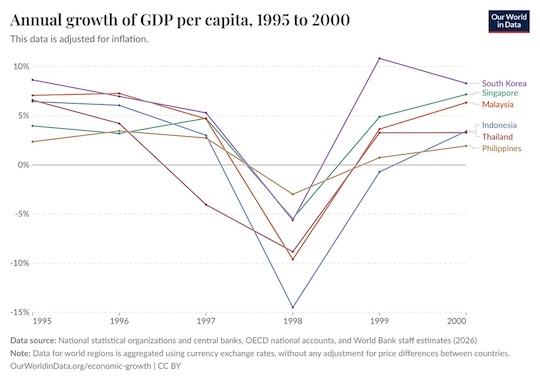 Source: Our World in Data
A year later, the failure of Long-Term Capital Management demonstrated how excessive leverage could transform manageable losses into a much broader financial crisis.
By 1999, new investment products, abundant optimism, and the belief that technology stocks could only continue rising had fueled one of the greatest speculative booms in market history.
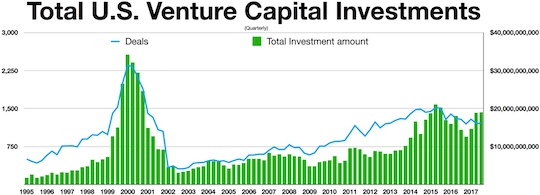 Source: PwC
None of those episodes perfectly mirrors today's environment, and I’m not suggesting we're about to relive them.
But they all reinforce the same lesson: changes in investor behavior often become visible before they become obvious.
That's why professional investors pay attention when unusual things begin happening outside our own borders.
They're looking for evidence that the market's character may be changing.
Leverage Leads to Crises
There's an important difference between an ordinary market correction and one driven by forced selling.
Markets fluctuate every day as investors react to earnings, economic data, interest-rate expectations, and geopolitical events. It’s all a normal part of investing.
Borrowed money changes the equation.
Investors using leverage don't always have the luxury of waiting for markets to recover.
Once prices decline far enough, they're often required to reduce positions regardless of what they believe those investments are actually worth.
Selling becomes disconnected from fundamentals and begins feeding on itself.
That's precisely what unfolded in South Korea.
It's also important to remember that last Wednesday didn't occur in isolation. AI and semiconductor stocks had already been correcting in both South Korea and the U.S.
Looking back, last Wednesday may ultimately prove to have been the crescendo of that selling pressure as excessive speculation was flushed from the system.
Or it may simply become another chapter in a correction that hasn't yet run its course.
At this point, the evidence isn't conclusive.
Interestingly, the story didn't end on Wednesday.
The next day, U.S. AI and semiconductor stocks rebounded sharply, recovering a meaningful portion of their recent losses.
On Friday, Korea’s KOSPI staged a rally for the ages, rising almost 18% in a single trading session.
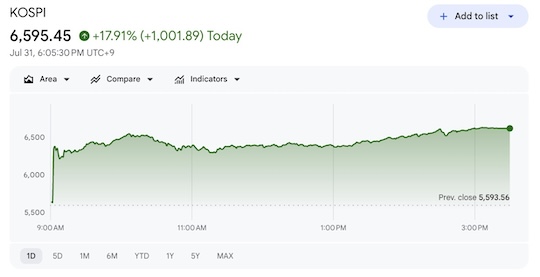
Propelled by Thursday's recovery and Korea's overnight surge, U.S. markets opened strong on Friday morning. Still, they were showing only modest gains by the afternoon.
Whether this rally ultimately proves to be the beginning of the next advance, or merely the kind of relief rally that often follows an intense wave of liquidation, is too early to know.
As if that wasn’t enough news, another major financial development was competing for headlines simultaneously.
On Thursday, a story broke that AI researcher Leopold Aschenbrenner's Situational Awareness hedge fund was forced to sell its publicly traded stock holdings after suffering steep losses.
While the circumstances differed from those in South Korea, the underlying dynamic was remarkably similar.
Whether it's an individual investor using leveraged ETFs or an institutional manager overseeing billions of dollars, borrowed money has a way of turning temporary declines into forced selling.
That doesn't mean we're witnessing another 1999 or that the long-term AI story has suddenly fallen apart.
It simply reminds us that periods of extraordinary optimism often attract extraordinary leverage. When that leverage begins to unwind, even temporarily, successful investors pay attention.
The Takeaway
Could last week's events ultimately prove to be nothing more than a healthy reset after one of the strongest AI-driven rallies in recent memory?
Absolutely.
In fact, the late-week rebound may eventually suggest that the market needed to flush out excessive speculation before moving higher.
It's equally possible that the rebound was only temporary and that the correction has further to run.
Right now, no one knows. That's why we won't rush to conclusions based on one dramatic week of trading.
Instead, we'll continue doing what we've always done.
Follow the evidence, separate meaningful signals from short-term market noise, and help you understand what matters and what doesn't as this story unfolds.
Because successful investing isn't about reacting to every headline.
It's about recognizing when the market begins telling a different story.
Sign Up Today for Free!
Truth & Trends brings you market insights and trading tips you won't find anywhere else — unless you have your own personal hedge fund manager on speed dial...
Meet Enrique Abeyta, one of Wall Street’s most successful hedge fund managers. With years of experience managing billions of dollars and navigating the highs and lows of the financial markets, Enrique delivers unparalleled market insights straight to your inbox.
In Truth & Trends, Enrique shares his personal take on what’s moving the markets, revealing strategies that made him a star in the world of high finance. Whether it’s uncovering the next big trend or breaking down the hottest stocks and sectors, Enrique’s insights are sharp, actionable, and proven to work in any market condition.
Inside these daily updates, you’ll gain:
- 50 years of combined trading wisdom distilled into actionable insights.
- A behind-the-scenes look at how Wall Street pros spot opportunities and avoid pitfalls.
- Exclusive strategies that Enrique personally uses to deliver exceptional returns — no fluff, just results.
To have Truth & Trends sent directly to your inbox every weekday, just enter your email address below to join this exclusive community of informed traders.
Don’t miss your chance to learn from one of the best in the business.
Sign up now and take your trading game to the next level.
The Last Face You See
Posted July 31, 2026
By Greg Guenthner

Micron: Don't Tip the Raft!
Posted July 30, 2026
By Enrique Abeyta

Debunked: The Margin Debt "Crash Signal"
Posted July 27, 2026
By Enrique Abeyta

Buy, Sell, or Hold: Every Mag 7 Stock
Posted July 24, 2026
By Greg Guenthner

The Iran Endgame, Revisited
Posted July 23, 2026
By Enrique Abeyta