Posted October 29, 2026

By Enrique Abeyta
NVIDIA: The Biggest Stock Massacre in History
Are you sitting down?
You should be.
Because what I’m about to tell you will sound crazy at first.
Maybe even impossible.
But by the time I’m done, I think you’ll see it the way I do.
I believe NVIDIA is about to lose investors more money over the next three years than any stock in human history.
And before you click away thinking, “Good thing I don’t own NVIDIA”… You almost certainly already do.
The chipmaker makes up nearly 8% of the entire S&P 500.
That's one company out of 500.
And it’s more than 8% of the Nasdaq-100, the index behind QQQ, one of the most popular funds on the planet.
So, if you own an index fund… a 401(k)… an IRA… a target-date fund… You have money riding on NVIDIA right now.
Maybe a lot of it. Whether you know it or not.
Millions of Americans are in the exact same position. Their retirements are chained to the fate of a single stock.
And Wall Street is walking them straight into a trap.
NVIDIA's $1 Trillion Problem
Over the past three fiscal years, NVIDIA generated about $407 billion in total revenue.
Now Wall Street expects the company to generate roughly $1.1 trillion in combined sales during fiscal 2027 and 2028.
That's nearly three times the revenue NVIDIA earned in the previous three years combined.
And the forecasts get even more ambitious.
By fiscal 2029, analysts expect annual sales to approach $900 billion. Some believe NVIDIA could reach $1 trillion.
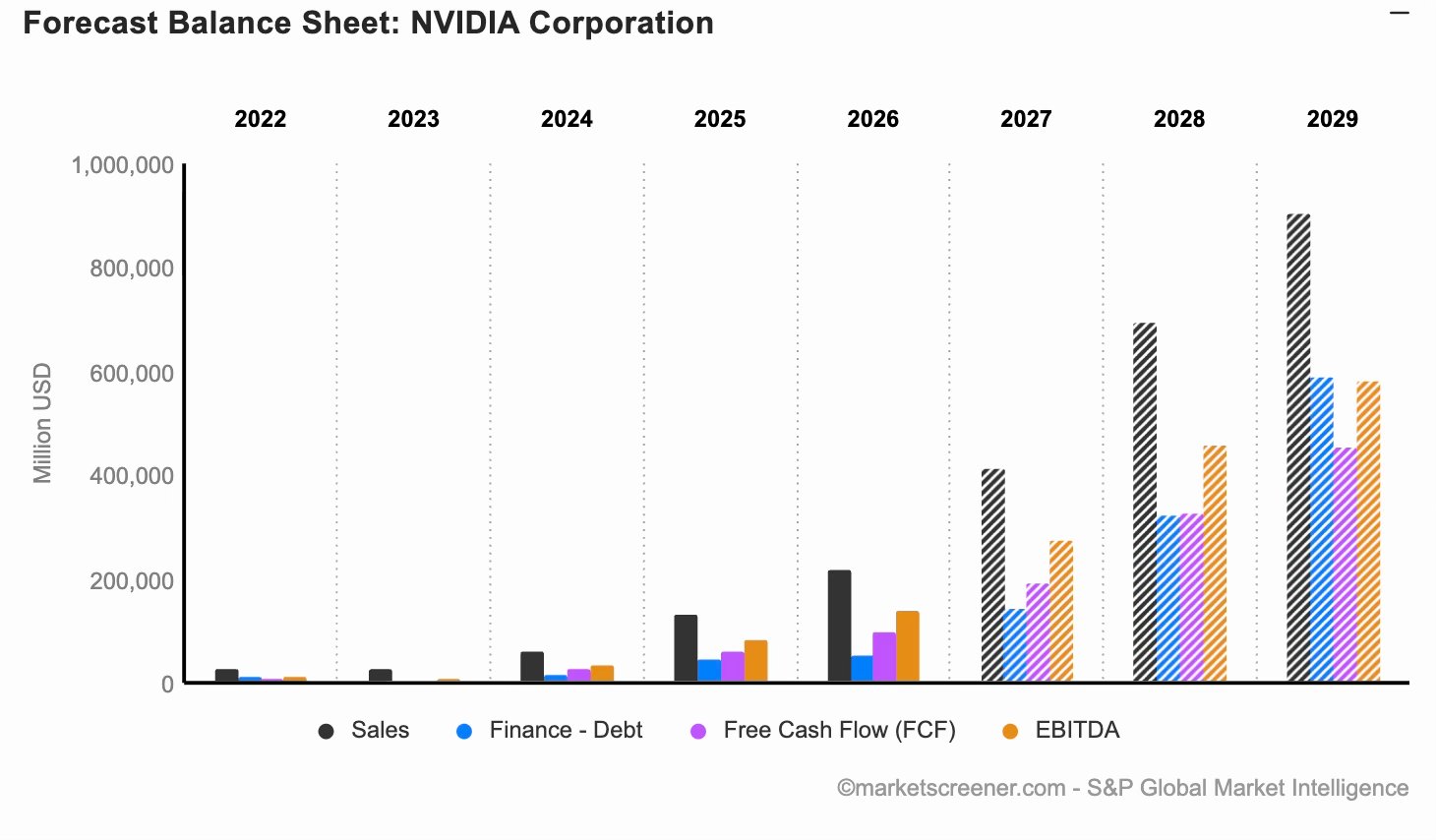 Source: MarketScreener (Hatched bars show estimates).
But where will all that money come from?
Most of NVIDIA's growth depends on companies spending vast sums to build and equip AI data centers.
Yet projects face power shortages, delays, and rising costs. And some customers are developing their own chips.
Wall Street is making two enormous bets: that customers can fund this spending on schedule, and that NVIDIA will capture the lion's share.
I think both assumptions are becoming harder to defend.
Billions in Chips With Nowhere to Plug Them in
On Oct. 20, Business Insider reported that Amazon planned to receive about $5 billion in NVIDIA server racks, followed by roughly $3 billion more each month.
But some Amazon data centers don't have enough electricity to run the equipment. So Amazon is storing completed systems in warehouses until those sites are ready.
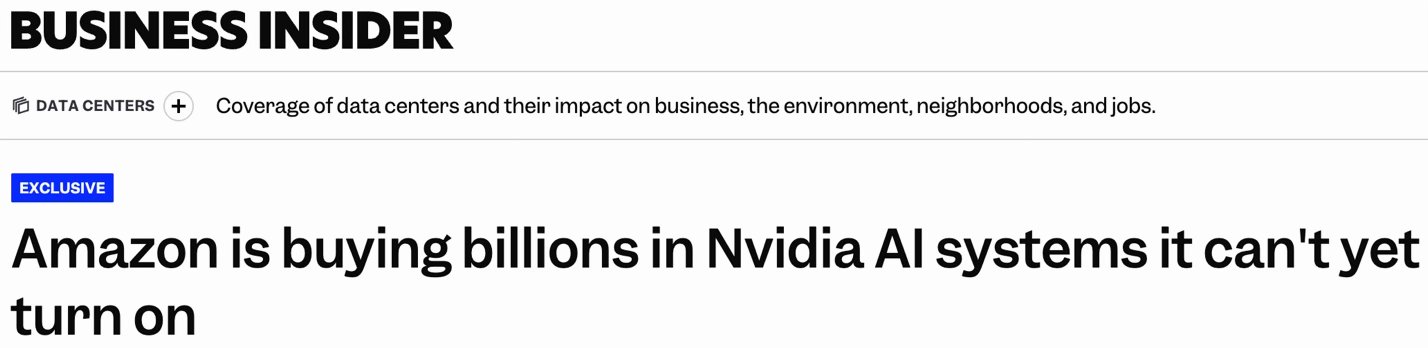 Source: Business Insider
Amazon calls this “Early Rack Receipt” and says it's normal practice. Not all the equipment is sitting idle.
But here's the risk: NVIDIA can sell billions of dollars in chips long before customers can put them to work.
If Amazon's warehouses keep filling while its data centers wait for electricity, why would it continue ordering at the same pace?
Amazon isn't alone.
Microsoft recently walked away from a planned data center in England run by NVIDIA-backed Nscale.
The power grid reportedly wouldn't be ready until the 2030s.
Oracle and OpenAI also dropped plans to expand their Stargate data-center site in Texas earlier this year.
These changes don't prove NVIDIA lost chip orders. Projects could move or change.
But they show how easily ambitious spending plans can slip behind schedule.
And that's a major problem for NVIDIA's forecasts.
The Money Is Getting More Expensive
Even if the power problems are solved, another question remains.
How will NVIDIA's customers pay for all these chips?
Oracle plans to raise up to $50 billion through debt and equity-related financing.
Meta expects to spend $135 billion to $145 billion on AI infrastructure this year and is exploring new ways to raise capital.
Meanwhile, yields on some CoreWeave bonds recently approached 16%.
That's an extraordinary borrowing cost for a company whose growth depends on building more data centers.
As financing costs rise, companies may have little choice but to delay projects or cut spending.
And there's another concern.
Some AI infrastructure debt is being placed in special-purpose companies and financed through loans or securities tied to data centers and equipment.
In some cases, even NVIDIA chips serve as collateral.
The structure isn't identical to the mortgage-backed securities that helped fuel the 2008 financial crisis.
But the growing web of borrowers, lenders, and investors should sound familiar.
If one major borrower runs into trouble, the damage could spread well beyond that company.
NVIDIA Knows the Risk
Here's what makes this story especially striking.
NVIDIA warns about this very problem in its own SEC filings.
In its latest quarterly report, the company states:
“Customers may postpone purchasing new architectures due to the lack of availability of data center infrastructure to deploy our products.”
And NVIDIA has already made huge bets on future demand.
As of July 26, it had $279 billion in manufacturing and supply commitments, up from $119 billion just one quarter earlier.
These are NVIDIA's commitments to suppliers, not firm customer orders.
But they show how much the company is counting on future sales.
If customers change their plans, NVIDIA could face extra inventory, higher costs, and pressure on profit margins.
It doesn't need to lose its customers for this to happen. It just needs them to buy less than Wall Street expects.
The King Has New Challengers
Some of NVIDIA's biggest customers are finding other ways to power AI.
On Oct. 27, Oracle announced plans to offer Google's custom AI chips, known as TPUs, starting in 2027.
Oracle builds and operates data centers for customers including OpenAI. Its cloud customers will soon have another option beyond NVIDIA.
Oracle is still expanding its NVIDIA business. But the new deal signals change.
Reports on Oct. 28 also indicated that OpenAI plans to buy Google's AI chips.
OpenAI is also working with Broadcom on custom chips.
Amazon has its own Trainium chips. China's Huawei is building rivals. SpaceX and Tesla are also pursuing plans to make their own chips.
NVIDIA still has a powerful advantage in CUDA, the software platform developers use to build and run programs on its GPUs.
That makes it difficult for many existing customers to switch away from NVIDIA.
But Google and Amazon don't need to beat NVIDIA at its own game. They can offer customers an entirely different way to run AI.
None of these efforts will replace NVIDIA overnight.
But consider the timing.
Customers may slow orders while they work through chips they've already bought. And when they start buying again, some of that money could go elsewhere.
NVIDIA could remain the world's top AI chipmaker while winning a smaller share of future spending.
What If Wall Street Is Wrong?
Let's return to NVIDIA's revenue forecasts.
Wall Street expects the company to generate roughly $1.1 trillion in combined sales during fiscal 2027 and 2028.
But what if customers can't keep spending at that pace?
What if power shortages delay more data centers, rising borrowing costs force companies to scale back, and some of their chip budgets shift to competitors?
Instead of $1.1 trillion, imagine NVIDIA generates just $600 billion over those two years.
That would still be an extraordinary business.
But it would mean roughly $500 billion less revenue than Wall Street expects, a shortfall of about 45%.
Now, I'm painting an extreme picture here.
But I'd argue that Wall Street's revenue forecasts are also extreme.
And here's what concerns me most.
NVIDIA might not need to miss those forecasts by anything close to 45% for its stock to suffer serious damage.
Even a much smaller shortfall, paired with weaker guidance, could force analysts to cut future earnings estimates.
Investors might also decide NVIDIA no longer deserves the premium valuation they've assigned to its shares.
Under those circumstances, would a 30% decline in NVIDIA's stock really be unreasonable?
I don't think so.
At a market value of roughly $5.25 trillion, that would erase about $1.6 trillion in shareholder wealth.
But given NVIDIA's enormous market value, it wouldn't take a collapse in its business for shareholders to suffer historic losses.
And the consequences won’t stop there.
With so much of the AI boom tied to NVIDIA's success, a sharp drop in its stock could shake confidence in the entire trade.
Which brings us to the biggest risk of all.
The Biggest Card in the House
NVIDIA sits at the center of a vast network of AI companies, investors, and lenders.
Some firms buy NVIDIA chips while also receiving funding or other financial support from NVIDIA.
The company has even agreed to buy computing power from certain AI cloud firms under specified conditions, helping support their expansion plans.
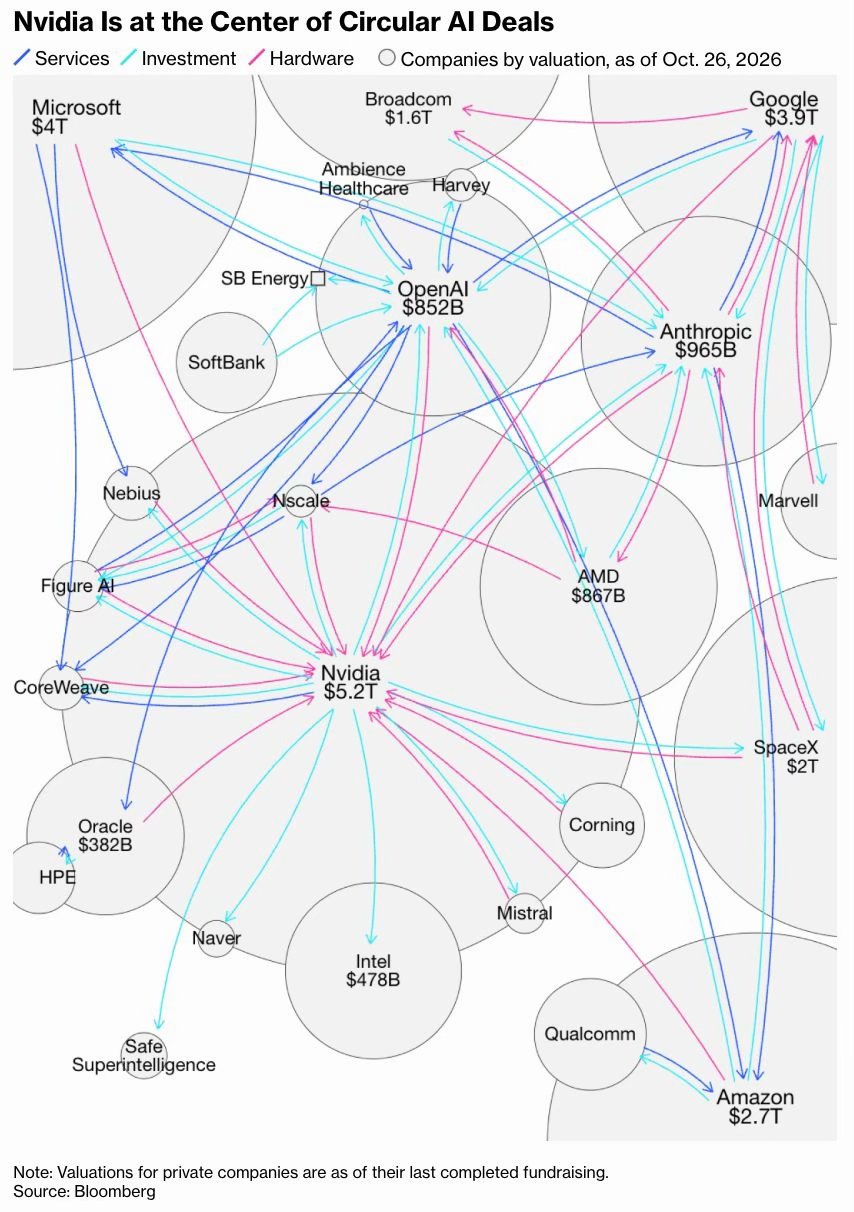 Source: Bloomberg
There's a certain irony in this chart.
Given everything we've just discussed about a possible AI bubble, it's a fitting image.
The biggest bubble in the chart belongs to the company whose success is helping hold the entire AI boom together.
These relationships help fuel the AI boom.
But if chip orders slow, investors may begin questioning whether heavily indebted data-center operators can earn enough to repay their loans.
NVIDIA could also become less willing to fund the firms buying its products.
A slowdown at NVIDIA could put pressure on the same companies that have helped drive its growth.
When the AI King Falls
NVIDIA could remain the world's leading AI chipmaker for years.
But Wall Street has set expectations so high that even this extraordinary company may struggle to meet them.
Its customers face growing financial pressure, data center projects are falling behind schedule, and competition is heating up.
That's why I believe NVIDIA is headed for a historic destruction of shareholder wealth over the next three years.
And remember, you don't need to own NVIDIA directly to get caught in the fallout.
Its shares are a major part of the S&P 500 and Nasdaq-100, putting millions of retirement accounts at risk.
Remember, NVIDIA doesn't have to lose its crown for my prediction to come true. It only has to disappoint Wall Street.
Sign Up Today for Free!
Truth & Trends brings you market insights and trading tips you won't find anywhere else — unless you have your own personal hedge fund manager on speed dial...
Meet Enrique Abeyta, one of Wall Street’s most successful hedge fund managers. With years of experience managing billions of dollars and navigating the highs and lows of the financial markets, Enrique delivers unparalleled market insights straight to your inbox.
In Truth & Trends, Enrique shares his personal take on what’s moving the markets, revealing strategies that made him a star in the world of high finance. Whether it’s uncovering the next big trend or breaking down the hottest stocks and sectors, Enrique’s insights are sharp, actionable, and proven to work in any market condition.
Inside these daily updates, you’ll gain:
- 50 years of combined trading wisdom distilled into actionable insights.
- A behind-the-scenes look at how Wall Street pros spot opportunities and avoid pitfalls.
- Exclusive strategies that Enrique personally uses to deliver exceptional returns — no fluff, just results.
To have Truth & Trends sent directly to your inbox every weekday, just enter your email address below to join this exclusive community of informed traders.
Don’t miss your chance to learn from one of the best in the business.
Sign up now and take your trading game to the next level.

5 Ways to Play Amazon's Earnings (I Made My Bet)
Posted October 28, 2026
By Zach Scheidt

The Calendar Turns Bullish
Posted October 27, 2026
By JC Parets

6 Stages of a Credit Bubble: From Mania to Meltdown
Posted October 26, 2026
By Enrique Abeyta

You’re Not Crazy. This Market Action Stinks!
Posted October 23, 2026
By Greg Guenthner

The Tesla-SpaceX Merger: 3 Stocks That Could Win Big
Posted October 22, 2026
By Enrique Abeyta