Posted November 09, 2026

By Enrique Abeyta
November 5: The Day the AI-pocalypse Began
Wall Street just got a taste of the AI apocalypse I've been warning you about.
On Thursday, the Nasdaq 100 plunged 6.4%, its worst day since the COVID crash, wiping out roughly $2.5 trillion in market value.
The S&P 500 sank 4.4%, and the Dow lost more than 1,800 points.
It was an ugly session all around. But stocks at the heart of the AI boom took the worst damage.
The Philadelphia Semiconductor Index collapsed more than 12%, while Nvidia, the undisputed king of AI, lost more than 9%.
Now here's what should really concern you…
That was NOT the AI crash I've been warning about. Not even close.
I believe it was just a preview.
My Warning Played Out in Real Time
As the selloff unfolded, I happened to be in Nashville delivering a speech about the very subject.
I took the stage at the Paradigm Shift Summit on Thursday morning to present A Survivor's Guide to the Coming AI Apocalypse.
It started with a prediction…
I expect that Nvidia will lose investors more money over the next three years than any stock in history.
And whether you own Nvidia shares directly or not, you likely have exposure through index funds or retirement accounts.
That’s exactly why Nvidia is such an important stock.
The fact is that its massive market value rests on expectations that AI spending will continue to grow at a breathtaking pace.
I've explained in recent issues why I believe those expectations are far too high.
The industry's biggest customers are stockpiling chips, exploring cheaper alternatives, and making spending commitments that may never turn into completed projects.
And now there's another major threat.
American voters are turning against the AI buildout.
That backlash became a major concern for Wall Street during Thursday's historic selloff.
Just two days earlier, American voters delivered a clear message to the AI industry: Not in my backyard.
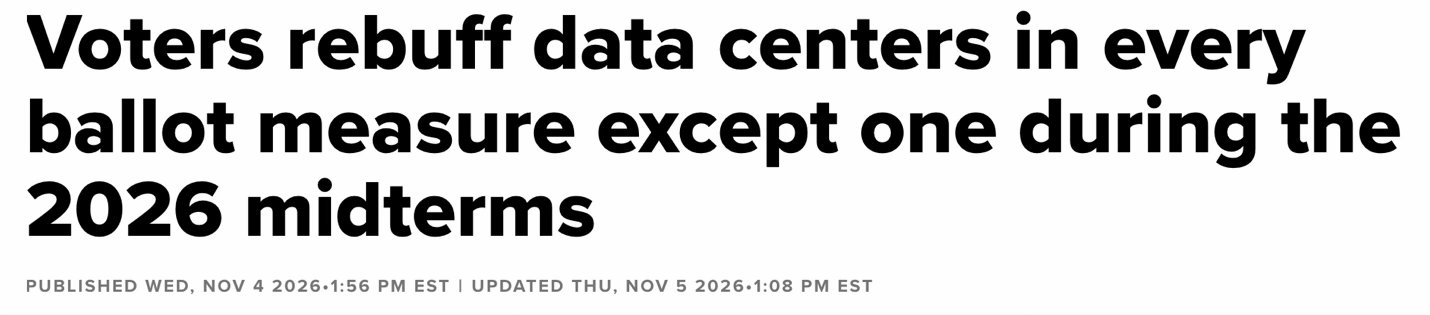 Source: CNBC
According to CNBC, voters faced 41 data center-related ballot measures across 10 states on Tuesday.
In nearly every contest with results available, they supported restrictions or rejected efforts to make development easier.
Only one community, in North Dakota, voted against new restrictions.
The backlash went far beyond local ballot measures. It helped reshape some of America's biggest political races.
In Texas, Democrat Gina Hinojosa defeated three-term Republican Governor Greg Abbott after criticizing his support for the state's massive data center expansion.
In Ohio, Democrat Sherrod Brown defeated Republican Senator Jon Husted, whom he attacked as "the face of data centers."
Ohio also elected Democrat Amy Acton as governor.
She supports a conditional moratorium on data centers that would require developers to cover their full utility costs and use union labor.
That's especially significant because OpenAI is planning an enormous data center campus in Ohio, with a potential total cost exceeding $500 billion.
This backlash crosses party lines.
According to CNBC polling, 56% of voters said data centers were a crucial or major factor in their election decisions.
For investors, that means the AI industry's massive expansion plans now face political resistance at every level of government.
And that brings me back to the central warning I delivered in Nashville…
A Real Revolution, and a Very Real Bubble
Much of my presentation covered topics I've explored in depth in recent editions of Truth & Trends.
We've examined the AI industry's historic spending boom, its growing reliance on debt, and the circular financing deals linking many of its biggest players.
Rather than repeat all that research, I want to share the central message I delivered to investors in Nashville.
The AI revolution is real. But the AI bubble is also real.
The internet changed the world. That didn't stop the Nasdaq from losing nearly 80% of its value when the dot-com bubble burst.
AI could prove just as important as the internet. But that doesn't mean every dollar being spent on it will earn a return.
In my presentation, I described the process in four stages: innovation, excitement, misallocation, and losses.
I believe we're now deep into the misallocation stage, when companies spend far more than the market can support.
And Tuesday's election results could make that problem much worse.
The world's largest technology companies are pouring hundreds of billions of dollars into chips, servers, power systems, and data centers.
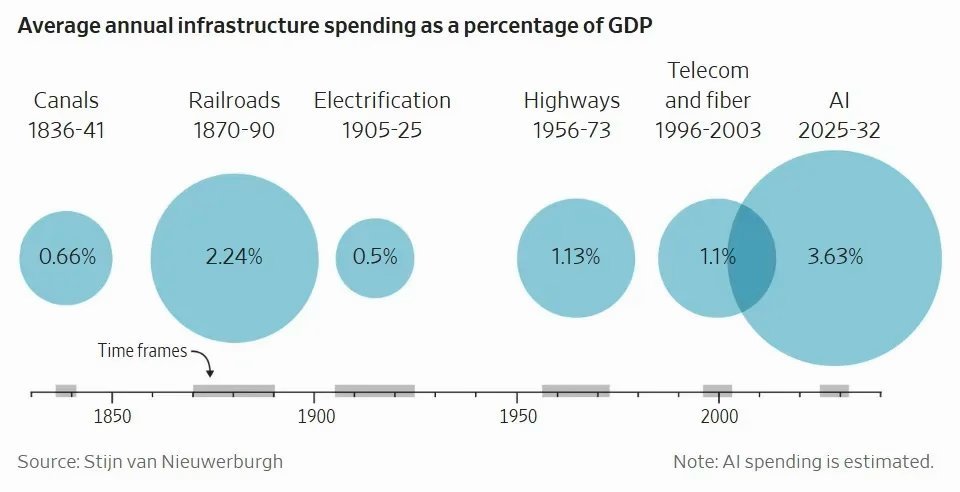
As this chart shows, the AI spending boom could dwarf even America's railroad and telecom buildouts as a share of the economy.
And much of that spending assumes demand for AI services will keep growing fast enough to justify the expense.
But Tuesday's election results threaten to throw a wrench into those plans.
New governors could impose tougher rules on data center construction.
Local governments could block projects, while utilities and regulators could force developers to shoulder more of the costs.
And building a data center isn't like downloading a new app. These projects require years of planning, huge amounts of electricity, and cooperation from local communities.
So, Wall Street has priced in a massive AI buildout, but voters may have just made that buildout much harder to deliver.
If construction slows, chip orders could be postponed, Nvidia's sales forecasts could fall, and companies that borrowed heavily to fund expansion could find themselves under pressure.
That's where the financing becomes especially dangerous.
As we've discussed before, some AI companies are using complex deals and off-balance-sheet arrangements to fund their expansion.
Others are investing in businesses that turn around and buy their products.
These arrangements can fuel rapid growth when everything goes according to plan.
But if spending slows, the financial strain could spread quickly.
I believe that's how a slowdown in AI spending could turn into a much larger financial crisis.
How to Survive & Thrive During the AI Crash
During my presentation, I showed what happened when the internet and housing bubbles burst.
The lesson wasn't that history will repeat itself exactly.
It's that great new technologies don't protect investors from paying terrible prices for stocks.
And when too much money has been borrowed against overly rosy expectations, the losses can be devastating.
You may be wondering why I've spent so much time writing about the AI bubble lately.
It's simple.
After more than 30 years on Wall Street, I believe we're facing one of the biggest financial risks of my career. And I want to help you protect the wealth you've worked so hard to build.
But don't mistake me for a bear.
I traded successfully through the dot-com bust, the 2008 financial crisis, and the COVID crash.
And I believe the coming AI downturn will offer some extraordinary opportunities — for investors who are prepared.
In future issues, I'll share the strategies I've used not only to survive market crashes, but to thrive during them.
I'll also keep you informed about the warning signs I'm watching and the opportunities I see developing.
For now, remember that the biggest danger isn't missing the next AI rally. It's being unprepared when the bubble finally bursts.
And if my “AI House of Cards” thesis is right, the biggest losses are still ahead.
Sign Up Today for Free!
Truth & Trends brings you market insights and trading tips you won't find anywhere else — unless you have your own personal hedge fund manager on speed dial...
Meet Enrique Abeyta, one of Wall Street’s most successful hedge fund managers. With years of experience managing billions of dollars and navigating the highs and lows of the financial markets, Enrique delivers unparalleled market insights straight to your inbox.
In Truth & Trends, Enrique shares his personal take on what’s moving the markets, revealing strategies that made him a star in the world of high finance. Whether it’s uncovering the next big trend or breaking down the hottest stocks and sectors, Enrique’s insights are sharp, actionable, and proven to work in any market condition.
Inside these daily updates, you’ll gain:
- 50 years of combined trading wisdom distilled into actionable insights.
- A behind-the-scenes look at how Wall Street pros spot opportunities and avoid pitfalls.
- Exclusive strategies that Enrique personally uses to deliver exceptional returns — no fluff, just results.
To have Truth & Trends sent directly to your inbox every weekday, just enter your email address below to join this exclusive community of informed traders.
Don’t miss your chance to learn from one of the best in the business.
Sign up now and take your trading game to the next level.
Big Tech Wants Inside Your Head
Posted November 06, 2026
By Greg Guenthner
OpenAI Is the Next Bear Stearns
Posted November 05, 2026
By Enrique Abeyta
IBM: The "Lose-Lose" AI Trade
Posted November 04, 2026
By Zach Scheidt

The Big Split Behind This Year's Market
Posted November 03, 2026
By JC Parets
The Election Is Coming! Sell Everything! (Just Kidding)
Posted November 02, 2026
By Enrique Abeyta