
Posted July 30, 2026

By Enrique Abeyta
Micron: Don't Tip the Raft!
It’s been a rough couple of weeks in the market.
Stocks that were the best performers not long ago have quickly become the worst.
The “smart” money is telling you about how great these companies are at a fundamental level. And yet, your portfolio is showing losses.
It’s frustrating, to say the least.
So I want to help explain what exactly is happening and what to do about it.
Start with one of the most important rules of investing: we are buying stocks, not companies.
You’re technically buying an ownership stake in that business. But it’s very different from buying a private business.
When you buy a stock, you don’t have a say in how the company is run or have access to its cash flow.
In the long term, the value of a stock will track the economic success of the company.
In the short term, though, they can diverge tremendously — both to the upside and the downside.
The result is that stock prices are highly influenced by human emotion.
And few trades show that better right now than Micron, one of the hottest names in the market over the past few months.
Here's the best way to picture what's happening…
The Danger of Crowded Trades
Imagine you’re on a raft going down a river. As a native Arizonan, I’m picturing a whitewater raft going down the Colorado River in the Grand Canyon.

The river is flowing nicely, the raft is steady, and everyone’s having a great time.
The canyon walls make it so one side of the raft is shady and cold, while the other side is sunny and warm.
As the raft continues down the river, more folks move from the shady side to the sunny side. Eventually, most people are all on one side of the raft.
Now the raft is imbalanced, and hitting even a small rapid can cause problems — even throwing some folks into the water!
The conditions didn’t change at all. Instead, the issue is that too many people crowded onto one side of the boat.
That’s exactly how human psychology works with investing.
The river and the weather are like the stock market. A nice day is the bull market. The raft is your bets on companies.
Just like in the raft analogy, things can get dicey when too many investors crowd into a stock, even if the underlying conditions haven’t changed.
Let’s look at a real-world example.
One of the hottest areas of the stock market has been semiconductors, specifically companies that manufacture memory chips.
One of the most successful of the bunch has been Micron Technology Inc. (MU).
The stock’s recent rally coincided with rising earnings estimates. When Wall Street analysts raise estimates for a company, the stock usually follows.
Here’s the chart showing consensus estimates for fiscal year 2027 earnings per share (EPS) for Micron (in blue) and the stock price (in white).
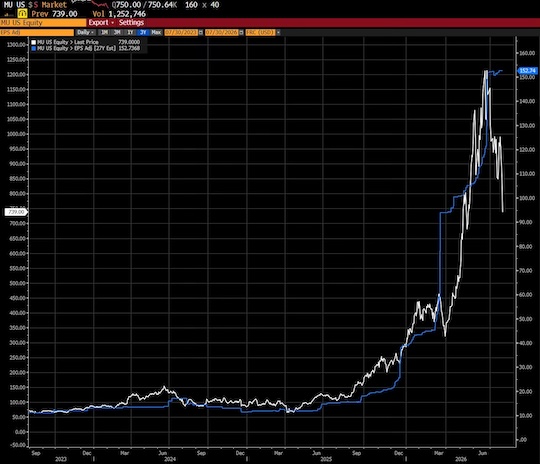
Since the start of 2026, EPS estimates have gone from roughly $20 per share to over $150. That’s amazing!
The stock price followed right along. Shares exploded from $250 per share to over $1,200 per share in early June.
Look closely at the chart, and you’ll see the stock’s sharp pullback. Shares fell more than 40% in a month.
What happened? Well, nothing happened to the fundamentals.
Micron is still positioned as a global leader in memory chips. AI spending is robust and continues to grow. The company even reported blowout results at the end of June.
And the stock has been crushed anyway.
What to Do With Micron Now
Remember, we’re buying stocks, not companies. A stock’s move in the short term isn’t necessarily a reflection of the fundamentals.
In this case, the issue was that too many investors crowded onto one side of the raft. Micron reached overbought levels that it had never seen before.
How do we know that? There are two good indicators.
The first is a technical indicator called the relative strength index (RSI).
In simple terms, RSI measures speed and magnitude of a security's recent price changes. It can tell you when a stock is overbought or oversold.
When the RSI goes above 70, it means that a stock has been running hot and is now vulnerable to a pullback.
In other words, we know there are too many folks on the sunny side of the raft, and the journey could get rocky soon.
The second measure is the distance from the moving averages. I usually look at the 50-day, 100-day, and 200-day moving averages.
When the stock price is very extended from these moving averages, it shows a high-level enthusiasm. Again, a very crowded raft.
Here’s the chart of the stock price of MU over the past year along with the moving averages (the pink, green, and yellow lines) and the RSI on the bottom.
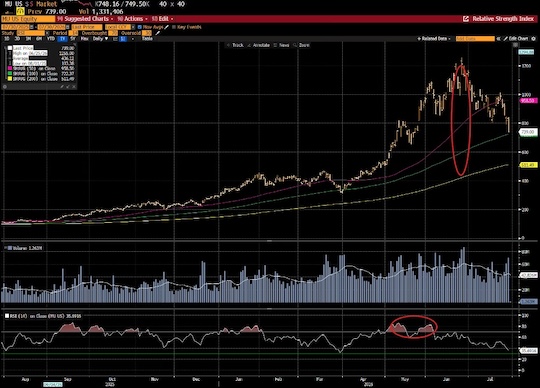
The red circle on the bottom shows when MU hit overbought levels, and the circle on top shows how extended MU was from its 200-day moving average.
If you looked back at the 30-year history of the stock’s price, that distance ranked in the 100th percentile of distance from that average. That means it had never been higher.
You’ll also notice that RSI readings were high right around the same time.
Both were warning signs that the trade had become too crowded.
When it happened, I started cautioning readers to be very careful and to take profits while the stock was trading at extreme levels.
I also said to ignore what the “smart” money was saying about the fundamentals. Instead, focus on what the stock’s price is telling you.
Of course, that’s all in the past. So what do you do now?
My advice is to hold tight.
The great fundamentals are real. Micron is a great company, and AI spending will continue to increase.
Based on recent price levels, I think you’re likely to make money on the stock. But I wouldn’t go out an buy it today.
Getting the raft back to balance usually doesn’t happen quickly, especially when there are still a lot of folks on one side.
I think Micron could visit the levels from its breakout back in May. That’s $600 per share, or a 30% drop from where it’s at today.
My advice would be to wait until the stock has gone higher for at least a month before buying.
That’s your signal that the coast is clear and it’ll be a much smoother ride down the river.
Sign Up Today for Free!
Truth & Trends brings you market insights and trading tips you won't find anywhere else — unless you have your own personal hedge fund manager on speed dial...
Meet Enrique Abeyta, one of Wall Street’s most successful hedge fund managers. With years of experience managing billions of dollars and navigating the highs and lows of the financial markets, Enrique delivers unparalleled market insights straight to your inbox.
In Truth & Trends, Enrique shares his personal take on what’s moving the markets, revealing strategies that made him a star in the world of high finance. Whether it’s uncovering the next big trend or breaking down the hottest stocks and sectors, Enrique’s insights are sharp, actionable, and proven to work in any market condition.
Inside these daily updates, you’ll gain:
- 50 years of combined trading wisdom distilled into actionable insights.
- A behind-the-scenes look at how Wall Street pros spot opportunities and avoid pitfalls.
- Exclusive strategies that Enrique personally uses to deliver exceptional returns — no fluff, just results.
To have Truth & Trends sent directly to your inbox every weekday, just enter your email address below to join this exclusive community of informed traders.
Don’t miss your chance to learn from one of the best in the business.
Sign up now and take your trading game to the next level.

A Revolution in All the “Wrong” Stocks
Posted September 18, 2026
By Greg Guenthner

How to Hedge Against Killer Robots (You Don’t)
Posted September 17, 2026
By Enrique Abeyta

Unusual Airplanes
Posted September 16, 2026
By Nick Riso

Forget the Rate Hike Question for a Minute
Posted September 14, 2026
By Enrique Abeyta

The 4 “Insider” Documents Wall Street Reads Before You Do
Posted September 13, 2026
By Nick Riso
