
Posted July 09, 2026

By Enrique Abeyta
Mark Twain Was Right About Your Newsfeed
Mark Twain famously wrote that "There are three kinds of lies: lies, damned lies, and statistics."
Over a century has passed since then, and the phrase has only gotten more relevant.
We are bombarded with information day in and day out. The latest polls, viral infographics, and new studies making the rounds online.
Most people see stats like these — or worse, just a headline interpreting them — and assume it represents the truth.
I can’t say I blame them.
Numbers are incredibly persuasive. Presented without context, they can convince intelligent people to believe almost anything.
But we’re all better off when we think critically about what we see.
That’s what inspired me to start a new recurring series I’m calling Lies, Damned Lies, and Statistics.
In each installment, we'll examine popular statistics, charts, and widely accepted "facts" that deserve a second look.
My goal isn’t to make you distrust statistics. It's to help you understand them better.
Let’s start with a common factoid that proves just how easily numbers can distort our perceptions.
Are Humans Really Living Longer?
You've probably heard that people today live much longer than ever before.
At first glance, the data seems to support this. Average life expectancy has climbed dramatically over the past hundred years or so.
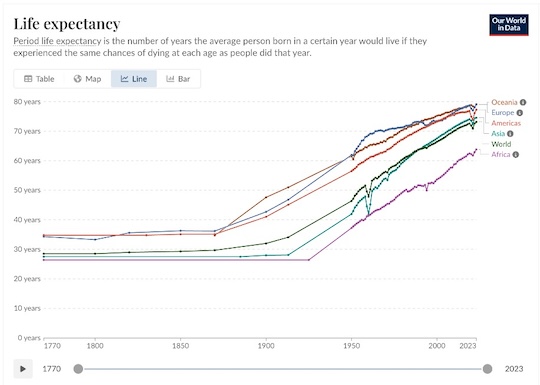 Life Expectancy From Birth (1770–2023). Source: Our World in Data
In 1770, the life expectancy in the Americas was around 35 years. By 1970, it was 63 years. Today, it’s about 70 years.
Case closed, right? We must be living longer than our ancestors. Well, that’s not exactly true.
Before modern medicine, infants and young children died at much higher rates. This pulled down the average for the overall population.
But life expectancy is a statistical construct. And it doesn’t say anything about our actual life spans.
Think about it this way…
Of the people who signed the Declaration of Independence, the average age was 44 years old. That’s nine years above the life expectancy for the time.
Was this some sort of statistical anomaly? Of course not.
They weren’t “old men” by any standard, past or present. (Ok, 70-year-old Benjamin Franklin may be an exception. But he lived for another 14 years!)
People have reached their seventies, eighties, and even nineties for basically all of recorded human history.
It’s just that more people are living into old age than ever before, not that we’re living significantly longer.
That’s just one example of how our interpretations can be wrong, even if we’re looking at accurate statistics.
Here’s another example.
A Political Earthquake That Barely Registers
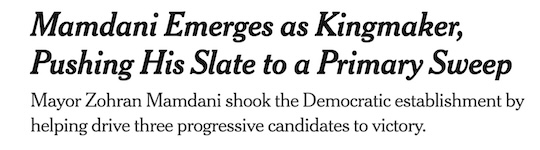
After a series of congressional primaries in New York City, The New York Times declared:
 Source: The New York Times
The headline paints the picture of a political movement rapidly reshaping the Democratic Party. And it’s based in fact.
Candidates backed by Mamdani did win several closely watched Democratic primaries. But let's step back and think about the actual statistic for a second.
We’re looking at primary election results, not public opinion.
According to publicly available election data, only about 17% of registered voters participated in New York City's June congressional primaries.
In other words, roughly 83% of registered voters did not cast a ballot!
The primary tells us which candidates were preferred by the relatively small percentage of voters who participated.
It doesn’t tell us what the millions of registered voters who stayed home believe.
Of course, that doesn't diminish the results. The winners earned their victories under the election rules.
But it does remind us to be careful about the conclusions we draw from statistics.
Perhaps the Biggest Investing Myth of All
Investors make this same mistake all the time.
Consider the endless debate between value investing and growth investing.
You'll often hear that value investors outperform because growth stocks are too risky and volatile.
The evidence usually comes in the form of charts featuring companies like Coca-Cola.
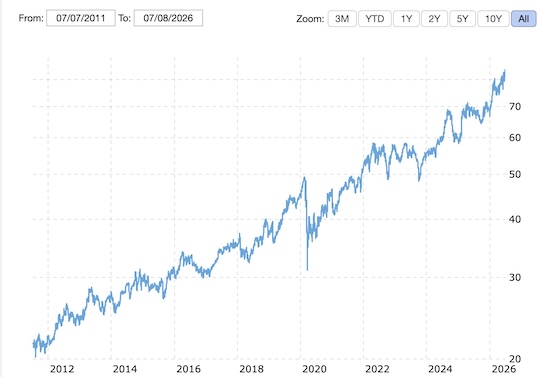
Today, Coca-Cola looks like the definition of a mature value company. But zoom out just a bit, and things look different.
The stock’s price performance over the last 15 years looks like that of a pretty decent growth stock.
Coca-Cola - 15 Year Stock Price History | KO
 Source: Macrotrends
In fact, for long stretches of its history, Coca-Cola was exactly what we'd now call a growth stock.
Sales exploded, earnings surged, and the business expanded across the globe.
Only after decades of success did it become the blue-chip giant we know it as today.
You could say the same thing about Walmart, Microsoft, Apple, Amazon, and countless other legendary companies.
Many of history's greatest "value" stocks first became great because they spent years growing rapidly.
Context matters. It always does.
The Truth Behind the Numbers
Statistics are among the most powerful tools ever created.
Used honestly, they help us understand the world. Used carelessly (or worse), they can just as easily distort it.
That's why you should never base an opinion on a single chart, headline, or percentage.
The next time you see a statistic that seems a little too convincing, pause for a moment and think about it critically.
Ask what’s actually being measured…
Ask what's missing…
Ask who collected the data…
And ask who benefits if you believe the conclusion.
Because oftentimes, the truth isn't hiding in the number itself. It's in the question nobody thought to ask.
Sign Up Today for Free!
Truth & Trends brings you market insights and trading tips you won't find anywhere else — unless you have your own personal hedge fund manager on speed dial...
Meet Enrique Abeyta, one of Wall Street’s most successful hedge fund managers. With years of experience managing billions of dollars and navigating the highs and lows of the financial markets, Enrique delivers unparalleled market insights straight to your inbox.
In Truth & Trends, Enrique shares his personal take on what’s moving the markets, revealing strategies that made him a star in the world of high finance. Whether it’s uncovering the next big trend or breaking down the hottest stocks and sectors, Enrique’s insights are sharp, actionable, and proven to work in any market condition.
Inside these daily updates, you’ll gain:
- 50 years of combined trading wisdom distilled into actionable insights.
- A behind-the-scenes look at how Wall Street pros spot opportunities and avoid pitfalls.
- Exclusive strategies that Enrique personally uses to deliver exceptional returns — no fluff, just results.
To have Truth & Trends sent directly to your inbox every weekday, just enter your email address below to join this exclusive community of informed traders.
Don’t miss your chance to learn from one of the best in the business.
Sign up now and take your trading game to the next level.

Six Months In: My 2026 Report Card
Posted July 06, 2026
By Enrique Abeyta

The S-E-T System for Finding Breakout Stocks
Posted July 03, 2026
By Greg Guenthner

6,019 Reasons to Be a Proud American
Posted July 02, 2026
By Enrique Abeyta

The Kid Who Worked the Drive-Thru Last Year Is Building Gigasats Today
Posted July 01, 2026
By Ray Blanco

The AI Arms Race Just Got Literal
Posted June 29, 2026
By Enrique Abeyta
