
Posted October 16, 2026

By Greg Guenthner
In Praise of Greed
The sheer panic created by a swift market crash can turn even the most rational among us into doomsday preachers.
We’ve all witnessed plenty of meltdowns in our lifetimes — the crash of ‘87, the grinding dot-com unwind, the Bear Stearns failure leading into the Great Financial Crisis, COVID, the post-COVID trading bust and on and on the list goes…
The crises are different, but every time, we act irrationally during these periods when the market is in flux.
That’s why one of Warren Buffett’s most famous bits of stock market advice resonates so deeply with investors:
Be fearful when others are greedy, and greedy when others are fearful.
When the going gets tough, the stock market pressure cooker can lead to terrible decisions that negatively impact your wealth for years to come.
Yet Buffett promises a better way forward. If we can only snap out of the market’s trance at these extremes, we too can bank life-changing returns.
Here’s something most investors don’t think about often enough:
Selling out at the lows isn’t the biggest market fear we’ll ever face. The truth is, most of us are terrified of buying the top.
We see the S&P or the Nasdaq post a huge, multi-year rally, and that little voice in the back of our head starts warning us that it all could fall apart at any minute. The easy money has been made. We missed it! So, we sit back and wait for a correction that could take months — or even years — to materialize.
If you find yourself struggling with the emotional side of these trading extremes, you aren’t alone.
Thankfully, some math geeks quantified these market extremes, then tested Buffett’s advice against the data.
What they found was surprising. Not only was Buffett wrong, his folksy advice could end up costing you a fortune – especially when the averages are pushing to new highs like they are this month.
Let’s dive in…
A Tale of Two Extremes
To test Buffett’s wisdom in real-world market conditions, we’re going to need a measuring stick for investor emotions.
This is where the CNN Fear and Greed Index comes into play.
If you aren’t familiar with CNN’s Fear and Greed Index, it’s simply a gauge of the emotions driving the market at any given point in time. The gauge runs from 0-100, with zero being “extreme fear” and 100 signifying “extreme greed”. You can learn more about the factors that make up the score here.
As I’m writing this note, the index sits firmly in “fear” territory at 38. During more tumultuous market events, such as the depths of the 2008 financial crisis, it has dropped below 1 – well into “extreme fear” territory.
So, what would happen if we were to go back to just before the financial crisis and take Buffett’s adage to heart?
The analysts at Quanterlab attempted to answer this exact question by recreating the Fear and Greed Index from scratch and tracking the hypothetical results.
Here’s what they found:
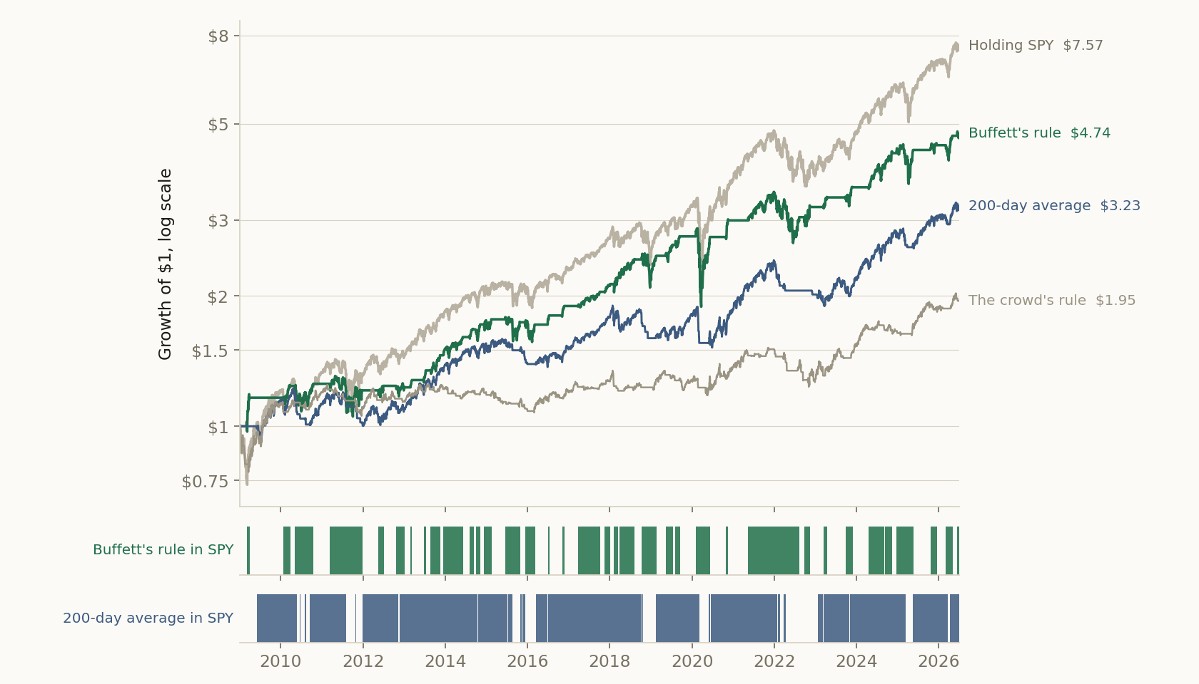
If we traded like Uncle Warren from the 2009 low to today (that’s buying extreme fear and selling extreme greed), we would have turned $1 into $4.74.
On the surface, this isn’t a terrible result. There’s just one problem: buying and holding the S&P would have easily bested the Buffett rule. Hanging tough with a buy-and-hold strategy would have turned $1 into $7.57.
Quanterlab compared other strategies, as well. Along with Buffett’s rule, they modeled a “crowd rule” that follows the herd: buying greed and selling fear (which likely accurately mirrors investors’ herding behavior in the real world). Unsurprisingly, this was the worst performing model in the above graph.
Then there’s the 200-day average rule, which acts as a simple trend following strategy where you only own the index when it’s above its 200-day moving average. Not only did this strategy underperform buy-and-hold over the study’s timeframe, it also lagged the Buffett rule.
Fixing Warren’s “Mistake”
So, where did Warren go wrong?
In fairness to the Oracle, I don’t think blindly following the Buffett rule as laid out in this study accurately interprets his investing style. As the Quanterlab analysts note, Buffett admits his holding strategy is essentially forever, I doubt he would be systematically unloading all his positions during periods of extreme greed.
With that in mind, a modified Buffett strategy would be effective for longer-term minded investors. Initiate and add to positions during periods of extreme fear, then continue to hold through the more bubbly years. By doing less and buying when the herd won’t, you’re well on your way to maximizing returns.
But when it comes to more active trading styles, you’re going to need to learn how to buy when others are fearful and greedy.
The entire point of trading is to beat buy-and-hold returns. If your active trading strategy isn’t compounding more than the S&P, you’re just wasting your time. That means you likely won’t get ahead by sitting on the sidelines during the boom times.
The numbers back up this assumption. Quanterlab analysts note that the year immediately following an extreme greed reading is actually the strongest period of their testing timeframe. If you are strictly following the Buffett rule and selling as soon as the market indicates it’s getting frothy, you’re likely missing out on the strongest period of returns near the finale of the bull market cycle.
Look back to any major bull market and you will see this period of extreme acceleration toward the final year of the bull (1986-87 and the 1999 dot-com climax come to mind).
Over the past year, we’ve discussed the possibility that the artificial intelligence bull is potentially charging toward a similar “climax year” that has the potential to deliver outlandish returns as we’ve seen in these other historic bull cycles. And today, we’re even closer to a potential lift-off point for such a move.
If we do experience a major market acceleration in the next six to nine months (or sooner), I expect we’ll hit extreme greed readings and continue higher.
If this is the case, you won’t want to cash out and sit on the sidelines. Not yet!
Active traders like us will need to stay focused and prepare to take advantage of the bubbly conditions. Don’t sell too early and miss out on all the action!
Sign Up Today for Free!
Truth & Trends brings you market insights and trading tips you won't find anywhere else — unless you have your own personal hedge fund manager on speed dial...
Meet Enrique Abeyta, one of Wall Street’s most successful hedge fund managers. With years of experience managing billions of dollars and navigating the highs and lows of the financial markets, Enrique delivers unparalleled market insights straight to your inbox.
In Truth & Trends, Enrique shares his personal take on what’s moving the markets, revealing strategies that made him a star in the world of high finance. Whether it’s uncovering the next big trend or breaking down the hottest stocks and sectors, Enrique’s insights are sharp, actionable, and proven to work in any market condition.
Inside these daily updates, you’ll gain:
- 50 years of combined trading wisdom distilled into actionable insights.
- A behind-the-scenes look at how Wall Street pros spot opportunities and avoid pitfalls.
- Exclusive strategies that Enrique personally uses to deliver exceptional returns — no fluff, just results.
To have Truth & Trends sent directly to your inbox every weekday, just enter your email address below to join this exclusive community of informed traders.
Don’t miss your chance to learn from one of the best in the business.
Sign up now and take your trading game to the next level.

The AI House of Cards II: First One to Fall
Posted October 15, 2026
By Enrique Abeyta

The AI House of Cards: Wall Street’s Trillion-Dollar Bet
Posted October 12, 2026
By Enrique Abeyta
AI Is Now “Too Big to Fail”
Posted October 08, 2026
By Enrique Abeyta

MU Are You Ok? Are You Ok MU?
Posted October 07, 2026
By Nick Riso
Micron Could Get Cut in Half. Here’s Why.
Posted October 05, 2026
By Enrique Abeyta