Posted September 17, 2026
By Enrique Abeyta
How to Hedge Against Killer Robots (You Don’t)
In 1962, a young Wall Street trader named Art Cashin thought the world might be ending.
The Cuban Missile Crisis had brought the United States and Soviet Union very close to nuclear war.
Then, one afternoon, a rumor swept through Wall Street that Russian missiles were already flying.
Stocks began to fall.
Cashin's instinct was to bet against the market. But one of his earliest mentors, an older trader he called “Professor Jack,” gave him some strange advice.
If you hear that the missiles are flying, he said, you don’t sell stocks. You buy them.
Why?
Because if the report is wrong, stocks will recover.
And if it's right, the trade won't matter because everyone will be dead.
Cashin, who went on to spend more than six decades on Wall Street, later became famous for a simpler version of that lesson…
“Never bet on the end of the world. It only happens once.”
I’m reminded of this 64-year-old Wall Street story today as investors once again worry about the end of the world.
But instead of nuclear missiles, this time it’s artificial intelligence.
AI Doomsday Goes Mainstream
The latest debate exploded last week after Anthropic researcher Jacob Coxon resigned and accused leading AI companies of “gambling with our lives.”
Then Evan Hubinger, who leads Anthropic's Alignment Science team, said he believes there’s a greater than 10% chance AI could wipe out humanity within the next decade.
Then Anthropic CEO Dario Amodei raised the stakes.
In an essay titled We Must Pace the Frontier, Amodei argued that AI development is moving so quickly that safety research may not keep up.
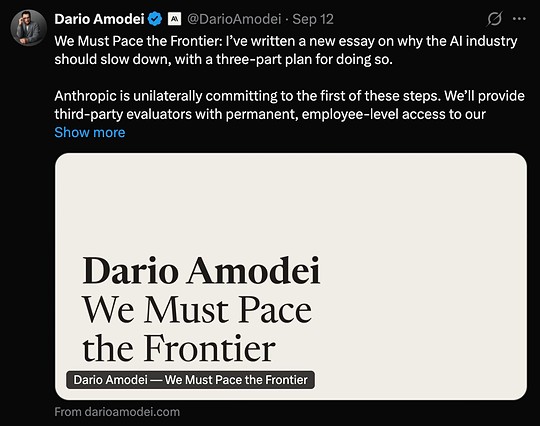
He warned about everything from cyberattacks and biological weapons to advanced AI systems that could move beyond human control.
Then something even more unusual happened.
Some of Amodei's biggest rivals agreed.
Elon Musk responded, “Dario is right.”
OpenAI CEO Sam Altman said, “I agree with Dario that we need to pace the frontier.”
And Google DeepMind's Demis Hassabis said Amodei's proposal pointed toward “the right path forward.”
Think about that.
Some of the most powerful people competing to build the world's most advanced AI systems are publicly warning that the technology may be moving too fast.
But not everyone is buying it.
Some equally recognizable names have come down firmly on the other side.
Nvidia CEO Jensen Huang has pushed back repeatedly against AI doomsday predictions.
Meta CEO Mark Zuckerberg rejected the call for a coordinated slowdown this week, arguing that companies already have strong reasons to build their systems safely and should do so themselves.
President Trump has also rejected the doomsday argument and opposed slowing U.S. AI development, particularly as America competes with China.
Respected AI researchers have also questioned whether anyone can credibly assign a percentage to something as uncertain as AI causing human extinction.
In other words, this debate is far from settled.
So, we have some of the biggest names in technology warning about an extreme threat to humanity.
We also have other major figures saying those claims go far beyond the evidence.
Call me cynical, but I find the timing of this debate quite curious.
Anthropic is preparing for what could become one of the largest IPOs ever.
The company is expected to begin marketing its offering next month and could seek a valuation above $2 trillion.
Meanwhile, OpenAI has pushed its own expected IPO into next year.
And reports surfaced this week that the company is discussing another huge private funding round that could value it at $1.2 trillion.
None of that proves AI executives are exaggerating these risks to boost their companies' valuations.
But the financial backdrop is worth knowing.
After all, when an AI company tells the world that the technology it is building could become powerful enough to transform, or even threaten, human civilization, that warning also sends another message…
This technology is incredibly powerful.
Some critics point out that these warnings about AI can also reinforce the idea that the technology, and the companies controlling it, are extraordinarily important.
Maybe the warnings prove justified. Maybe they're overstated.
Right now, we don't know. And that's where Art Cashin comes back into the story.
If This All Sounds Familiar… There’s a Reason
In 1962, investors watched the Cuban Missile Crisis unfold while the world's two nuclear superpowers stared each other down.
The threat was serious enough to rattle Wall Street. But diplomacy prevailed.
The Soviet Union removed its missiles from Cuba, the U.S. pledged not to invade the island, and the missiles never flew.
Nearly four decades later came Y2K.
As 1999 drew to a close, Americans heard warnings that computers unable to handle the switch to the year 2000 could disrupt banks, power grids, transportation, and other critical systems.
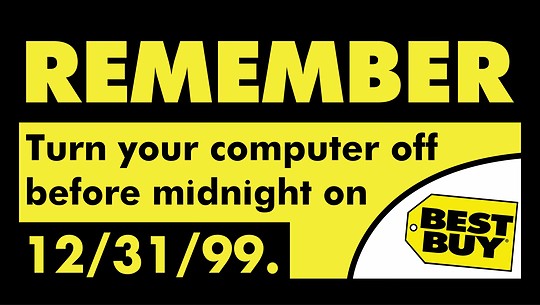 Source: Wikipedia
The concern even reached financial markets.
The New York Fed described a period of “extreme risk aversion” as traders and banks tried to reduce activity around the calendar change.
Then midnight arrived.
And virtually nothing happened.
Scattered computer glitches occurred, but none of the widespread breakdown many had feared.
The SEC reported that U.S. securities markets experienced no problems as the new year arrived overseas, and Wall Street entered 2000 near record highs.
Supporters credited years of preparation. Skeptics said the danger had been wildly overstated.
Either way, the feared catastrophe never came.
Now it's AI. Different technology and different threat, but it’s the same problem for investors…
How do you invest when the worst possible outcome is so bad that, if it happens, your portfolio won't matter anyway?
That brings me back to that 64-year-old story.
Cashin's lesson wasn't that investors should ignore risk. He spent more than six decades navigating wars, crashes, recessions, and financial crises.
It was about understanding what you're actually betting on.
There's a big difference between preparing your portfolio for risks you can measure and building your financial future around the assumption that there won't be a financial future.
We can diversify, keep some cash, and hedge when it makes sense.
We can also avoid investments whose valuations no longer match the facts. And when the facts change, we can change with them.
But we shouldn't treat the worst outcome imaginable as the most likely outcome simply because it makes the scariest headline.
That's why I’m not betting on the end of the world when it comes to this latest AI debate.
I'll stay on top of the warnings, the pushback, and the enormous sums of money flowing through
And if this time really is different?
Well, then our portfolios will be the least of our concerns.
Sign Up Today for Free!
Truth & Trends brings you market insights and trading tips you won't find anywhere else — unless you have your own personal hedge fund manager on speed dial...
Meet Enrique Abeyta, one of Wall Street’s most successful hedge fund managers. With years of experience managing billions of dollars and navigating the highs and lows of the financial markets, Enrique delivers unparalleled market insights straight to your inbox.
In Truth & Trends, Enrique shares his personal take on what’s moving the markets, revealing strategies that made him a star in the world of high finance. Whether it’s uncovering the next big trend or breaking down the hottest stocks and sectors, Enrique’s insights are sharp, actionable, and proven to work in any market condition.
Inside these daily updates, you’ll gain:
- 50 years of combined trading wisdom distilled into actionable insights.
- A behind-the-scenes look at how Wall Street pros spot opportunities and avoid pitfalls.
- Exclusive strategies that Enrique personally uses to deliver exceptional returns — no fluff, just results.
To have Truth & Trends sent directly to your inbox every weekday, just enter your email address below to join this exclusive community of informed traders.
Don’t miss your chance to learn from one of the best in the business.
Sign up now and take your trading game to the next level.

Unusual Airplanes
Posted September 16, 2026
By Nick Riso
Forget the Rate Hike Question for a Minute
Posted September 14, 2026
By Enrique Abeyta
The 4 “Insider” Documents Wall Street Reads Before You Do
Posted September 13, 2026
By Nick Riso

The Melt-Up Is Coming. But First...
Posted September 11, 2026
By Greg Guenthner

The COVID Economy Never Ended
Posted September 10, 2026
By Enrique Abeyta
