Posted October 01, 2026

By Enrique Abeyta
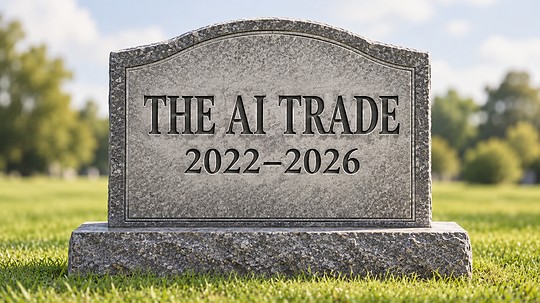
Here Lies the AI Trade (2022-2026)
The AI trade is dead.
No, I don’t mean that the technology is going away or the AI bubble is going to burst tomorrow.
I’m talking about the AI trade.
That moment in time when you could buy just about any AI-related stock and watch it go up. I believe that era is over.
Now, I understand if you’re skeptical.
After all, companies are still spending massive amounts of money on AI. It doesn’t exactly feel like anything has changed.
But the evidence is piling up fast.
So today, I want to make the case that the AI trade as we know it is dead.
Exhibit A: The Numbers Don’t Add Up
Let’s start with Anthropic, the AI company expected to IPO later this year at a valuation north of $2 trillion.
According to figures in its leaked IPO prospectus, Anthropic’s 2025 revenue came in at $4.6 billion and operating losses exceeded $8 billion.
The company also has an almost unbelievable $518 billion in future cloud, computing, and infrastructure commitments.
That’s more than 112x Anthropic’s entire 2025 revenue. And much of these commitments can't simply be canceled if business slows.
Yet Anthropic could reportedly seek a valuation above $2 trillion.
That would instantly make this five-year-old startup one of the most valuable companies on Earth. Worth more than Walmart and Berkshire Hathaway.
Now let me ask you this…
If I handed you those numbers without telling you the company’s name or what it did, would you want to own it at a $2 trillion valuation?
Common sense will tell you those numbers don’t seem right.
Exhibit B: Wall Street Is Starting to Push Back
The problem extends beyond Anthropic. Just look at Oracle.
Its massive AI buildout has pushed borrowing and spending sharply higher. S&P downgraded Oracle in July, leaving its credit rating just one notch above junk.
Meanwhile, $18 billion of loans tied to its Project Jupiter data center recently traded for just 89 to 91 cents on the dollar as banks struggled to sell the debt.
The project has also faced power delays that are affecting financing discussions for other AI data centers.
Other AI companies are running into problems too.
OpenAI spent much of this year moving toward what could have been one of history’s biggest IPOs. Now Sam Altman says it won’t happen this year amid concerns about AI safety.
SB Energy, a SoftBank Group-backed data center firm, delayed its IPO as investors questioned its valuation and OpenAI exposure.
And this week, data-center infrastructure company Accelevation priced its IPO below its expected range, then fell in its Nasdaq debut.
One problem means little. Several across the AI ecosystem start to look like evidence.
Meanwhile, Goldman Sachs estimates AI-related borrowing by low-rated companies has surged to $88 billion this year.
That’s up from just $20 billion in leveraged-finance issuance during the first 11 months of 2025.
Reuters reports that lenders are now becoming more selective and demanding higher yields.
With the 10-year Treasury recently yielding around 5%, why take the added risk of financing an AI project unless you’re paid substantially more?
The problem isn’t simply whether there’s enough money to finance the AI boom. It’s whether investors still want to lend it.
Exhibit C: The Money Is Going Around in Circles
“Big Short” investor Steve Eisman recently warned on his podcast that “off-balance-sheet techniques are back with a vengeance” in the AI boom.
That does not mean AI is Enron.
But Eisman points specifically to the return of special-purpose vehicles and off-balance-sheet financing.
And the web goes further.
Amazon and Google are Anthropic investors. They're also suppliers, distributors, and competitors.
Their cloud platforms handled 47% of Anthropic’s 2025 revenue.
And then there’s the matter of “circular financing,” which goes something like this…
Anthropic and OpenAI spend billions on computing power, feeding revenue and backlog to the hyperscalers.
That drives demand for Nvidia chips, Micron memory, data centers, and new power generation. And behind much of it sits another layer of debt.
It works beautifully as long as money keeps moving through the circle.
But what happens when it stops?
That’s when an Anthropic or OpenAI problem travels backward through the entire AI supply chain.
Exhibit D: Good Technology Can Still Be a Bad Trade
We saw a version of this 25 years ago with the dot-com boom.
Investors were right that the internet would change the world. But then they made a costly mistake.
They treated that certainty as a license to pay almost any price to get in on the boom.
At the height of dot-com euphoria, AOL’s $165 billion merger with Time Warner seemed to confirm that the “new economy” had arrived.
Then the Nasdaq collapsed 77%.
And it wasn’t just flimsy internet startups. Cisco, one of the companies building the internet's backbone, lost roughly 80% of its value.
Intel, a current AI stock darling, fell more than 80%.
Billions also poured into fiber networks that eventually became incredibly useful, just not quickly enough to justify what investors paid to build them.
The internet wasn’t a fad. Cisco wasn’t a fake company, and Intel wasn’t selling vaporware.
Investors were right about the technology. But they were wrong about the trade.
AI could follow the same pattern.
You’ve probably heard these points before. The circular financing, the unrealistic valuations, the dot-com parallels.
Now let’s get back to why this is all starting to matter now.
Exhibit E: The Cracks Are Starting to Show
The broad stock market isn’t far from all-time highs. But look under the hood, and it’s a much uglier picture.
As the chart below shows, the share of S&P 500 stocks trading above their 50- and 200-day moving averages has plunged since late August.
S&P 500 Market Breadth
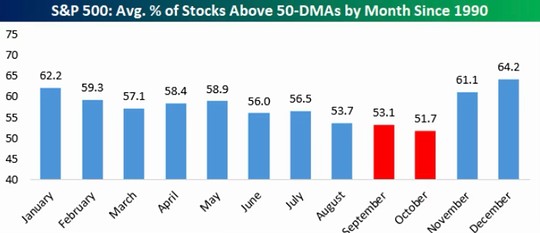 Source: Bespoke Investment Group/MarketWatch
By the end of September, fewer than 25% of S&P 500 stocks were trading above their 50-day moving average, while fewer than 45% were above their 200-day.
In plain English, roughly three out of every four S&P 500 stocks fell during September.
Yet the headline index barely budged.
That tells us a handful of enormous companies are doing an extraordinary amount of work holding this market up. And many of them sit directly in the path of the AI trade.
If frontier labs suddenly cut their expected compute needs, what happens to Nvidia, Micron and Oracle?
What happens to neoclouds, data-center operators and utilities building new power generation?
To be clear, I’m not saying those stocks will collapse tomorrow. I’m saying investors can no longer assume the AI spending cycle goes straight up forever.
Closing Arguments
Artificial intelligence may be here to stay, but the AI trade is a thing of the past.
Gone are the days when you could buy any AI stock — completely ignore price, debt, and cash flow — and assume somebody else will eventually pay more.
That doesn’t mean you should sell every AI stock you own, though.
It simply means the evidence has changed, and so should the way you invest.
From here, I'll be watching credit markets, AI spending, and the frontier labs closely.
If the money begins drying up, the effects could travel through chips, memory, data centers, power, and ultimately the broader market.
AI may continue changing the world for decades. But as far as I’m concerned, the AI trade is dead.
I rest my case.
Sign Up Today for Free!
Truth & Trends brings you market insights and trading tips you won't find anywhere else — unless you have your own personal hedge fund manager on speed dial...
Meet Enrique Abeyta, one of Wall Street’s most successful hedge fund managers. With years of experience managing billions of dollars and navigating the highs and lows of the financial markets, Enrique delivers unparalleled market insights straight to your inbox.
In Truth & Trends, Enrique shares his personal take on what’s moving the markets, revealing strategies that made him a star in the world of high finance. Whether it’s uncovering the next big trend or breaking down the hottest stocks and sectors, Enrique’s insights are sharp, actionable, and proven to work in any market condition.
Inside these daily updates, you’ll gain:
- 50 years of combined trading wisdom distilled into actionable insights.
- A behind-the-scenes look at how Wall Street pros spot opportunities and avoid pitfalls.
- Exclusive strategies that Enrique personally uses to deliver exceptional returns — no fluff, just results.
To have Truth & Trends sent directly to your inbox every weekday, just enter your email address below to join this exclusive community of informed traders.
Don’t miss your chance to learn from one of the best in the business.
Sign up now and take your trading game to the next level.

The End of AI's "Honeymoon Phase"
Posted September 28, 2026
By Enrique Abeyta
Bitcoin’s Breakout Is Just the Beginning
Posted September 25, 2026
By Greg Guenthner

$100 Oil and “the New Normal”
Posted September 24, 2026
By Enrique Abeyta
Coming Soon: Wall Street After Dark
Posted September 21, 2026
By Enrique Abeyta

A Revolution in All the “Wrong” Stocks
Posted September 18, 2026
By Greg Guenthner