Posted November 19, 2026

By Enrique Abeyta
Ghosts of '08 and the Warnings Ignored
The 2008 financial crisis wiped out trillions of dollars in wealth.
It destroyed millions of jobs and brought the global financial system to the brink of collapse.
During the crisis, the S&P 500 plunged nearly 57%.
More than 8.5 million American jobs disappeared. And millions of homeowners watched their biggest investment lose value.
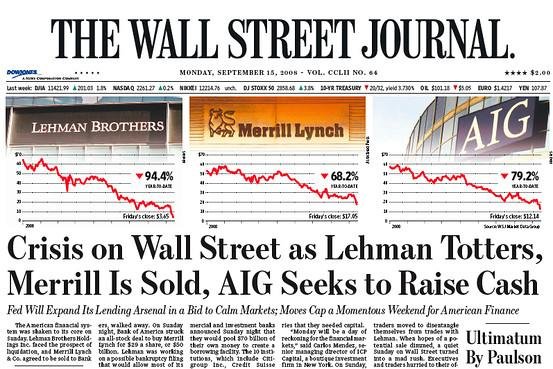 Front Page of The Wall Street Journal: September 15, 2008. Source: The Wall Street Journal
Yet here's something many people may not realize.
The warning signs were flashing long before Wall Street collapsed.
Housing prices were falling. Major lenders were going bankrupt. And some of Wall Street's biggest names were struggling to stay afloat.
Still, few understood just how bad things were about to get.
Last week, we explored the dot-com crash and the lessons it holds for today's AI boom.
This week, we're turning to an even more devastating chapter in financial history: the Great Financial Crisis.
Because if the internet bubble taught us what happens when a market frenzy collapses, the 2008 crisis reveals something potentially far more dangerous.
What happens when the debt financing a boom begins to unravel?
With hundreds of billions of dollars flowing into AI infrastructure, every investor should be asking this question.
How America Built a Housing Bubble
Our story begins in the early 2000s, shortly after the dot-com bubble burst.
The U.S. economy was struggling, and the Federal Reserve began cutting interest rates to help revive growth.
By June 2003, the Fed's benchmark rate had fallen to just 1%.
Borrowing became cheaper, and Americans were eager to take advantage.
For many, that meant buying a home.
Housing prices were rising, mortgage lending was booming, and real estate seemed like one of the safest investments around.
After all, people needed places to live. And if home prices kept climbing, homeowners could always sell or refinance.
But as the boom gathered steam, lenders began relaxing their standards.
Borrowers with poor credit could qualify for mortgages. Some loans required little proof of income, while others offered low initial payments that would rise sharply after a few years.
These risky loans helped fuel a surge in subprime lending.
Much of this lending depended on one assumption: Home prices would keep rising, allowing borrowers to refinance or sell before trouble arrived.
For a while, it worked.
Rising prices encouraged more lending, bringing more buyers into the market and pushing prices even higher.
The housing boom was becoming dangerously dependent on home prices continuing to rise.
Wall Street Turns Mortgages Into a Money Machine
Wall Street had found a way to turn the lending boom into an enormous business.
Instead of keeping mortgages on their books, lenders could sell them to financial firms.
Those firms bundled thousands of loans together and sold investments backed by homeowners' monthly payments.
These were called mortgage-backed securities.
Many carried high credit ratings, making them seem safe to banks, pension funds, and investors worldwide.
Wall Street also created more complex investments from mortgage debt.
And here's where things became especially dangerous.
Many financial firms used borrowed money to buy investments that were already backed by borrowed money.
As long as homeowners made their payments, the system generated huge profits.
But debt magnifies losses just as easily as gains.
If mortgage securities fell in value, lenders could demand that investment firms provide more cash.
And if those firms couldn't raise the money, they might be forced to sell their holdings at a loss.
Those sales could drive prices lower, putting other firms under pressure.
A housing downturn could now threaten institutions that had never made a single home loan.
And that's exactly what happened.
The Warning Signs Arrive
The first major cracks appeared long before the crisis dominated the headlines.
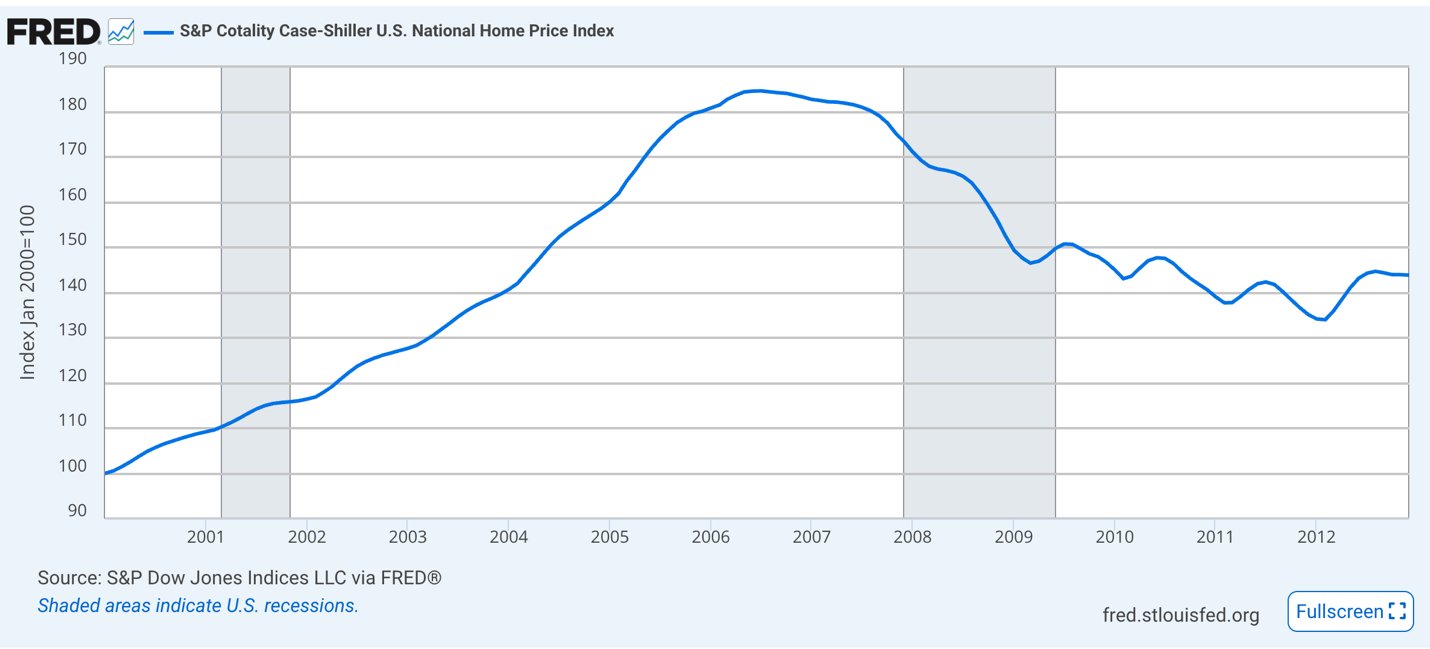
National home prices peaked in July 2006, according to the S&P Case-Shiller index.
As prices began falling, homeowners who had counted on refinancing found themselves trapped.
Some owed more than their homes were worth. Others couldn't afford higher payments when their initial mortgage terms expired.
Defaults began to rise.
The graphic below is the S&P Case-Shiller National Home Price Index, showing the housing boom, its July 2006 peak, and subsequent decline.
 Source: Federal Reserve Bank of St. Louis
Notice that home prices peaked in 2006, more than two years before Lehman Brothers collapsed.
Then the trouble reached Wall Street.
In April 2007, New Century Financial, a major subprime lender, filed for bankruptcy.
That summer, two mortgage-linked hedge funds run by Bear Stearns suffered severe losses.
And on August 9, 2007, French banking giant BNP Paribas suspended withdrawals from three investment funds because it couldn't reliably value some of their holdings.
Think about what that meant.
Trouble that began with American homeowners was now affecting investment funds thousands of miles away.
Yet the worst of the crisis was still more than a year away.
In March 2008, Bear Stearns itself ran into trouble.
The investment bank depended heavily on short-term borrowing. When lenders and trading partners lost confidence, it struggled to find enough cash to meet its obligations.
With emergency support from the Federal Reserve, JPMorgan Chase agreed to acquire the failing firm.
The rescue prevented a sudden Bear Stearns bankruptcy.
But it also delivered an unmistakable warning: Even a Wall Street giant could collapse when its funding dried up.
And Bear Stearns wouldn't be the last.
September 2008: The Financial System Breaks
By September, the crisis was spiraling out of control.
On September 7, the government took control of mortgage giants Fannie Mae and Freddie Mac.
Eight days later, Lehman Brothers filed for bankruptcy.
It was one of the largest corporate bankruptcies in American history.
Lehman had deep ties to financial firms worldwide. Its failure left trading partners scrambling to determine whether they would get their money back.
Confidence in the financial system plunged.
The following day, September 16, the Federal Reserve announced an emergency $85 billion credit facility to rescue insurance giant AIG.
That same day, the Reserve Primary Fund, a major money-market fund, reported that its shares had fallen below the $1 value investors expected.
Even investments widely viewed as safe places to hold cash were under pressure.
Then, on September 25, Washington Mutual failed.
With roughly $307 billion in assets, it became the largest bank failure in U.S. history.
Banks grew afraid to lend, while businesses struggled to obtain the credit they needed to operate.
What began as a housing downturn had become a global financial panic.
By March 9, 2009, the S&P 500 had lost 56.8% of its value from its October 2007 closing peak.
Retirement accounts had been devastated, and the wider economy was suffering.
The Rescue and the Long Road Back
With the financial system near collapse, Washington launched an extraordinary rescue effort.
In October 2008, Congress authorized up to $700 billion under the Troubled Asset Relief Program, or TARP.
The government injected capital into banks, while the Federal Reserve cut interest rates toward zero and launched emergency lending programs.
The Fed also began buying mortgage-related securities to support lending and stabilize financial markets.
These efforts helped restore confidence, but the damage was immense.
The Great Recession lasted 18 months and ended in June 2009.
S&P 500, October 2002-March 2009
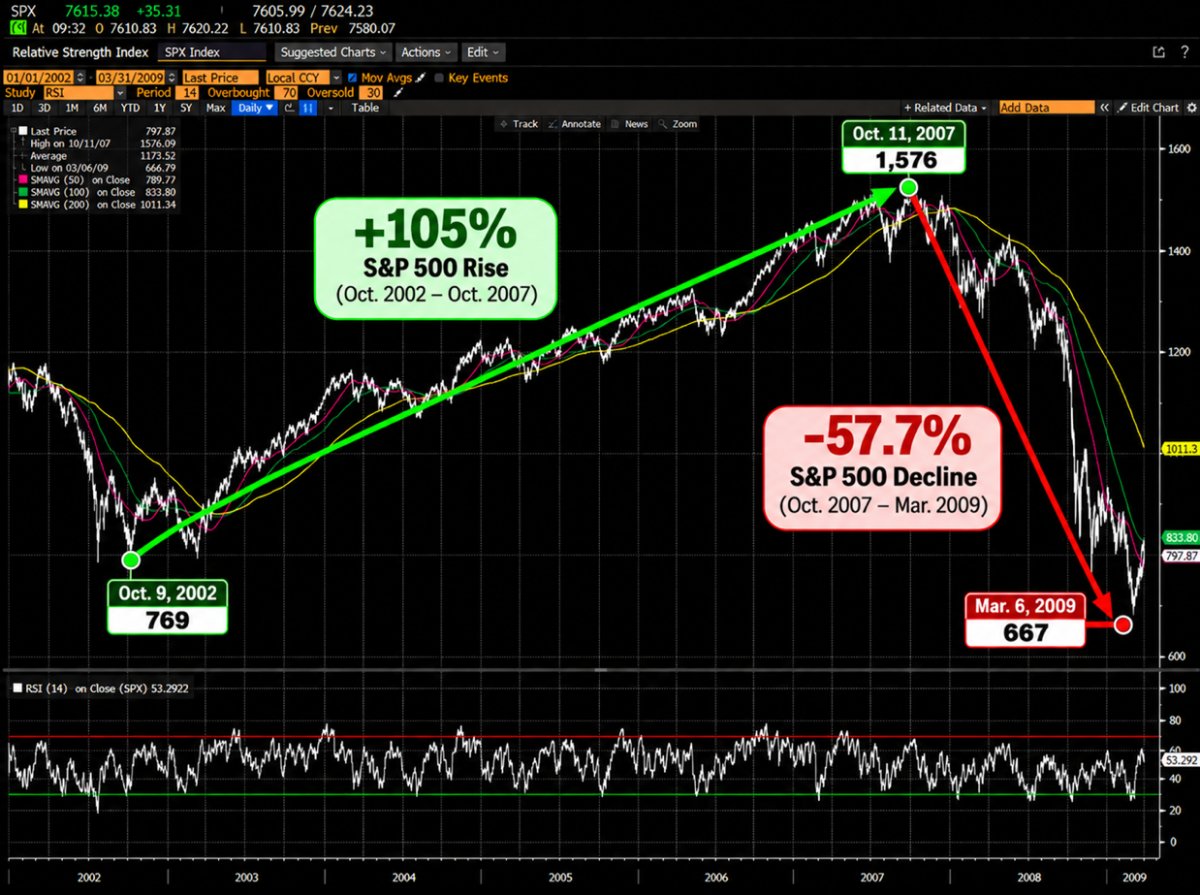 Source: Bloomberg
Unemployment kept rising after the stock market had bottomed, reaching 10% that October.
Homeowners faced an even longer recovery. National home prices fell 27.4% from their 2006 peak before reaching their low in February 2012.
The S&P 500 didn't regain its October 2007 closing high until March 2013.
The Great Financial Crisis was truly one of the worst events U.S. markets have experienced in recent history.
But here's a crucial lesson from the GFC:
The investors who protected their capital before the crash were in a far better position to take advantage of the recovery.
Those who were forced to sell during the panic often missed the opportunities that followed.
What the Financial Crisis Can Teach Us About AI
So, what does the collapse of America's housing bubble have to do with today's AI boom?
The two are very different.
The housing bubble was built around mortgages and rising property values.
Today's AI boom is driven by a technology that could transform the global economy.
And many of the largest technology companies financing AI have far stronger balance sheets than the firms that failed in 2008.
But the GFC reveals a danger that goes beyond falling stock prices.
What happens when an investment boom depends on debt that borrowers can no longer afford to repay?
Consider the vast sums being spent on AI data centers, chips, and power infrastructure.
And increasingly, that spending is being financed with borrowed money.
As the Federal Reserve chart below shows, annual debt issuance tied to advanced computing infrastructure has surged in recent years.
Debt Issuance for Advanced Computing Infrastructure, 2022-2026
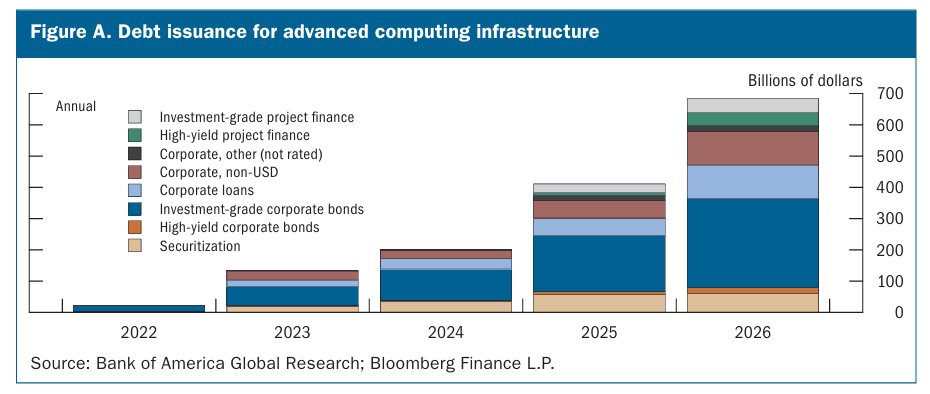 Source: Federal Reserve, Financial Stability Report, November 2026
Some projects rely on borrowed money and forecasts of AI demand that may take years to prove accurate.
But what happens if demand falls short?
A heavily indebted data-center operator might struggle to repay its loans or secure new financing.
Its lenders could face losses, while suppliers that depend on its spending might suddenly see orders disappear.
If enough projects run into trouble, the damage could spread beyond the original investors.
That's the risk the GFC teaches us to examine.
Not every AI company faces the same danger. And failed investments wouldn't necessarily trigger another global financial crisis.
For that to happen, losses would need to threaten lenders and other parts of the financial system.
But the warning signs are worth watching.
Are borrowers taking on more debt than their expected cash flow can support?
Are major projects relying on fresh loans to stay afloat?
And are losses beginning to spread from struggling businesses to the institutions financing them?
Why Do I Keep Writing About This?
You might be wondering why I've spent so much time examining the dot-com crash, the Great Financial Crisis, and the warning signs emerging in today's AI boom.
It's because I believe investors are facing another dangerous turning point.
And my goal isn't simply to predict when the market will fall. It's to help you recognize the risks before they become obvious to everyone else.
By the time a financial crisis becomes obvious, much of the damage may already be done.
The warning signs of 2008 were there for anyone willing to look. The trouble was that too many investors ignored them until it was too late.
And I'm determined to make sure you don't make the same mistake.
Sign Up Today for Free!
Truth & Trends brings you market insights and trading tips you won't find anywhere else — unless you have your own personal hedge fund manager on speed dial...
Meet Enrique Abeyta, one of Wall Street’s most successful hedge fund managers. With years of experience managing billions of dollars and navigating the highs and lows of the financial markets, Enrique delivers unparalleled market insights straight to your inbox.
In Truth & Trends, Enrique shares his personal take on what’s moving the markets, revealing strategies that made him a star in the world of high finance. Whether it’s uncovering the next big trend or breaking down the hottest stocks and sectors, Enrique’s insights are sharp, actionable, and proven to work in any market condition.
Inside these daily updates, you’ll gain:
- 50 years of combined trading wisdom distilled into actionable insights.
- A behind-the-scenes look at how Wall Street pros spot opportunities and avoid pitfalls.
- Exclusive strategies that Enrique personally uses to deliver exceptional returns — no fluff, just results.
To have Truth & Trends sent directly to your inbox every weekday, just enter your email address below to join this exclusive community of informed traders.
Don’t miss your chance to learn from one of the best in the business.
Sign up now and take your trading game to the next level.

The "Touch-and-Go" Trade: How to Turn One Win Into Two
Posted November 18, 2026
By Zach Scheidt
The Financial Crisis Everybody Sees… Except Banks
Posted November 17, 2026
By JC Parets
BUY NVIDIA Before Earnings Tonight!
Posted November 17, 2026
By Enrique Abeyta
Anthropic IPO: It’s a Trap!
Posted November 16, 2026
By Enrique Abeyta

The Chocolate Factory Economy
Posted November 15, 2026
By Nick Riso