
Posted March 23, 2026

By Enrique Abeyta
Ghost of the 1970s Is Back — Or Is It?
Let me start by saying one thing clearly.
War is abhorrent. As a human being, I do not support it in theory or in practice.
There is nothing abstract about the human cost, and there is nothing worth celebrating in escalation.
But war is a reality. And with the ongoing conflict in Iran, it’s not something you can ignore.
My job here isn’t to debate politics.
It’s to help you think clearly and act intelligently when things feel chaotic.
And if there’s one thing I’ve learned over three decades of trading through crises, it’s this…
The initial reaction is almost always driven by fear — and almost always disconnected from the full picture.
Right now is no different.
Flashback to the 1970s Oil Crisis
If you’ve been watching financial media over the past few weeks, you’ve probably noticed a familiar tone creeping back in.
Oil shock.
Energy crisis.
Stagflation.
Economic collapse.
For many seasoned investors, this feels like déjà vu.
The 1970s oil crisis left a deep scar on market psychology, and every geopolitical flare-up in the Middle East seems to trigger those same reflexes.
But here’s the problem.
The world today is not the world of the 1970s. Gasoline prices will go up, but there won’t be any rationing or mile-long lines at the pump, at least not in the U.S.
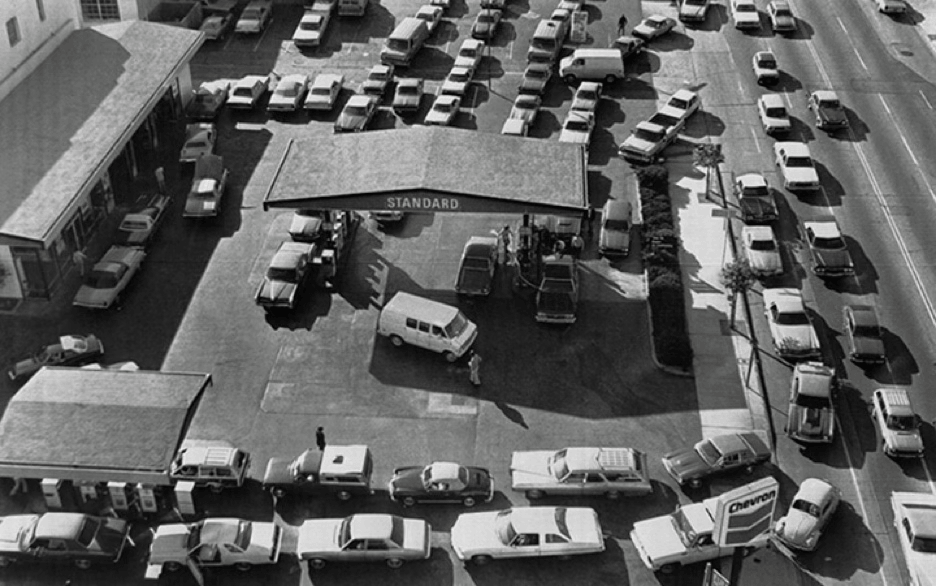
Source: Federal Reserve History
The U.S. was heavily dependent on foreign oil back then.
Supply disruptions from OPEC had an immediate and devastating impact on the economy. Energy prices surged, inflation spiraled, and growth stalled.
Today, that entire equation has changed.
And if you don’t understand that shift, you’re going to misread what’s happening in markets right now.
Over the past 15 years, the United States has undergone one of the most important and underappreciated transformations in modern economic history.
We went from dependence… to dominance.
Thanks to the shale revolution, advancements in drilling technology, and massive infrastructure investment, the U.S. is now a net exporter of total petroleum.
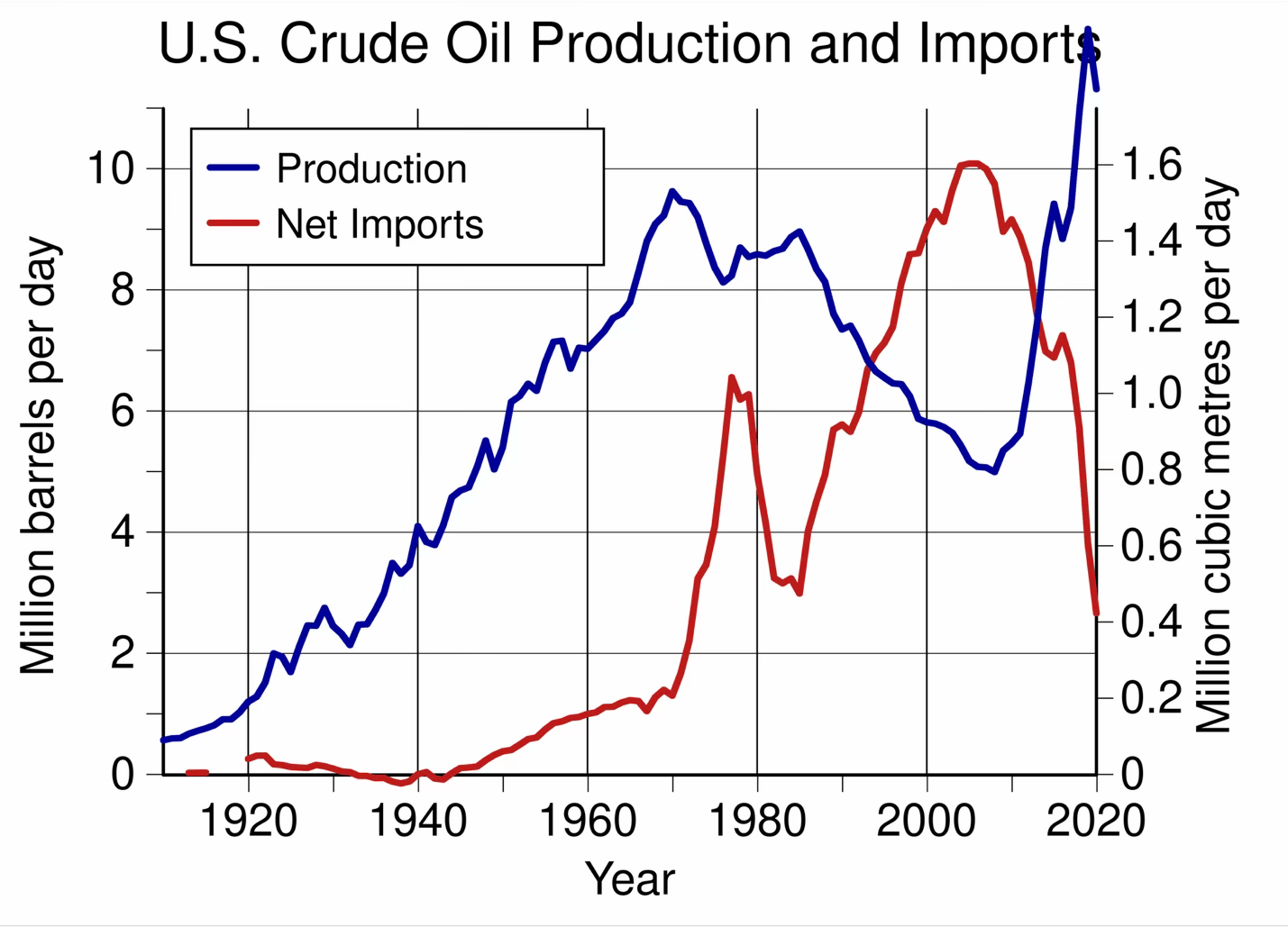
Source: Energy Information Administration
The same is true for natural gas, where America has become a global powerhouse, supplying allies across Europe and beyond.
Helium? Another strategic resource where the U.S. plays a leading role.
And where the U.S. does have gaps, like fertilizers, our neighbors help fill them. Canada, for example, is a major exporter, helping stabilize supply across North America.
This matters more than anything you’re hearing on cable news.
Yes, prices can spike. But supply, at least in the Americas, is not the issue it once was.
Why Prices Are Rising Anyway
If North America is so well-positioned, you might be wondering why oil, natural gas, and fertilizer prices are moving higher.
The answer is simple: markets price globally.
Even with an abundant supply, disruptions in the Middle East still affect global flows.
Shipping routes tighten. Risk premiums expand. Traders bid up prices in anticipation of shortages elsewhere.
That doesn’t mean we’re running out of energy.
It means the rest of the world might be. And in a globally connected market, that difference matters.
But here’s the key distinction most investors miss…
A price spike is not the same as a supply crisis.
In the 1970s, the U.S. faced both. Today, we are primarily dealing with the former.
This shift, from vulnerability to relative self-sufficiency, changes everything about how this story plays out.
In regions like Europe and parts of Asia, energy shocks can still translate into real economic stress.
These economies remain more dependent on imports, and disruptions hit closer to home.
A stark example. The economic powerhouse South Korea imports 100% of its oil and over 99% of its natural gas.
They have almost zero domestic production of either, yet their economy is heavily dependent upon these energy sources.
While that’s an extreme example, the graphic below highlights that it’s not unique.
In fact, over 50 countries worldwide import more than 50% of their energy as fossil fuels.
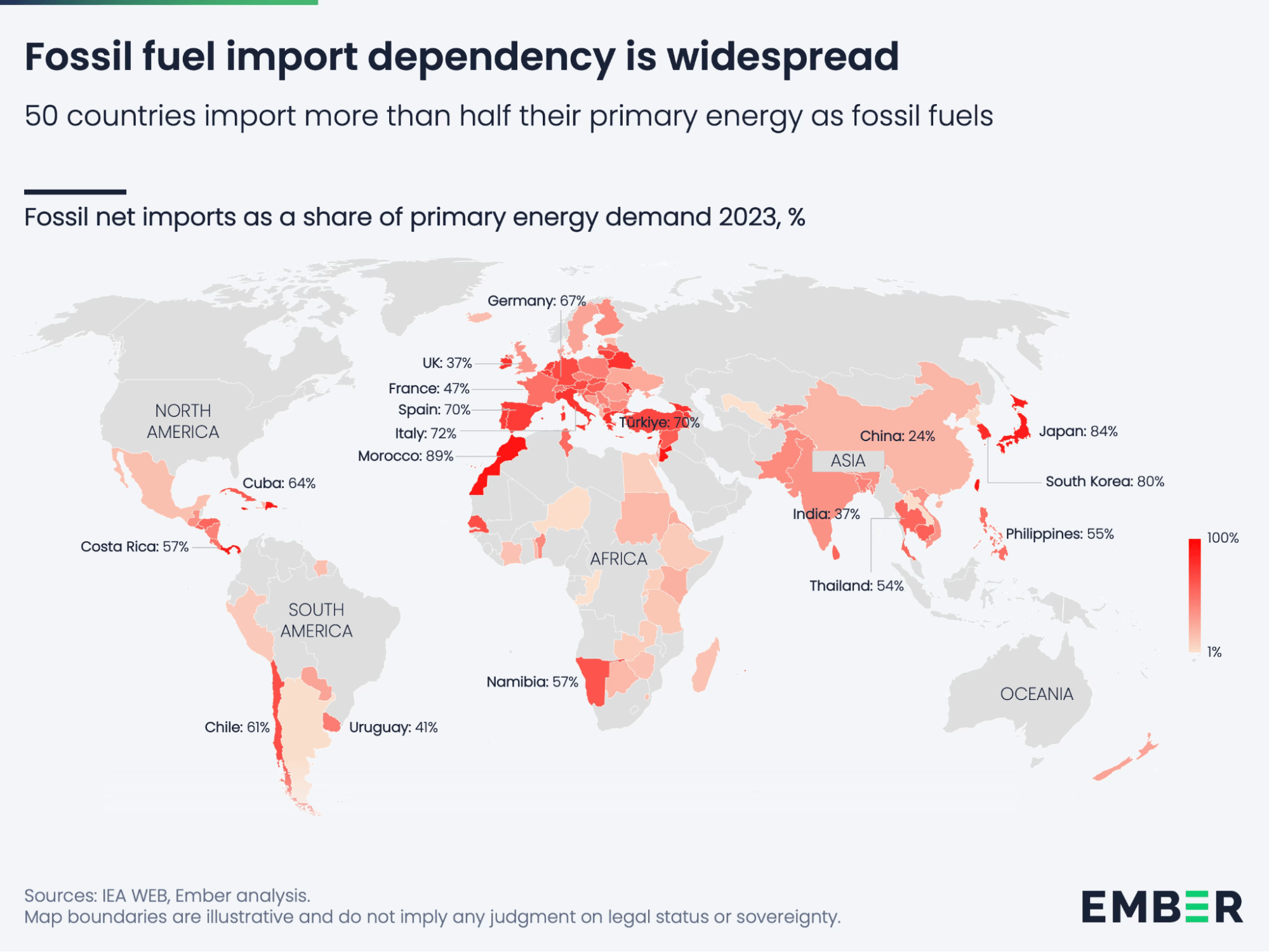
Source: Emer Energy
But in North America, especially the U.S. and Canada, the dynamic is different.
Higher prices don’t just represent a cost. They also represent an opportunity.
Domestic producers benefit. Export revenues increase. Capital flows toward energy infrastructure and related industries.
And over time, that can act as a stabilizing force for the broader economy.
In other words, what was once purely a negative shock can now carry elements of a positive feedback loop.
That doesn’t mean there won’t be volatility. But volatility and crisis are not the same thing.
What This Means for You
Every major geopolitical event brings a wave of commentary. Some of it is thoughtful, but much of it is not.
Right now, there are plenty of voices leaning into worst-case scenarios, drawing straight lines from today’s headlines to the darkest chapters of economic history.
That kind of thinking is understandable. But it’s not always helpful.
Markets don’t reward emotional reactions. They reward clear thinking, context, and perspective.
And the context today is fundamentally different than it was 50 years ago.
We have more domestic production. More diversified supply chains. More technological flexibility. And more strategic awareness of energy security than at any point in modern history.
Those factors don’t eliminate risk. But they do change the outcome.
So where does that leave us?
First, it means taking a step back.
The headlines are loud. The price movements are real. But the market's underlying structure matters more than the daily noise.
Second, it means recognizing that not all regions or sectors will be impacted equally. What looks like a crisis in one part of the world may look like an opportunity in another.
And third, it means remembering that markets have a long history of overreacting in the short term… and recalibrating over time.
It’s easy to get caught up in the moment. But as investors, our job is to zoom out and separate what feels urgent from what actually matters.
Right now, what matters is this:
The U.S. and North America more broadly are in a far stronger position than during past energy crises.
We have the resources, the infrastructure, and the strategic depth to navigate this environment.
That doesn’t make the situation good. It just means it’s manageable.
So, while others may be shouting about shortages, collapse, and stagflation, it’s worth pausing, taking a breath, and looking at the full picture.
Because when you do, you realize something important.
We’ve been here before. And this time, we’re better prepared.
Sign Up Today for Free!
Truth & Trends brings you market insights and trading tips you won't find anywhere else — unless you have your own personal hedge fund manager on speed dial...
Meet Enrique Abeyta, one of Wall Street’s most successful hedge fund managers. With years of experience managing billions of dollars and navigating the highs and lows of the financial markets, Enrique delivers unparalleled market insights straight to your inbox.
In Truth & Trends, Enrique shares his personal take on what’s moving the markets, revealing strategies that made him a star in the world of high finance. Whether it’s uncovering the next big trend or breaking down the hottest stocks and sectors, Enrique’s insights are sharp, actionable, and proven to work in any market condition.
Inside these daily updates, you’ll gain:
- 50 years of combined trading wisdom distilled into actionable insights.
- A behind-the-scenes look at how Wall Street pros spot opportunities and avoid pitfalls.
- Exclusive strategies that Enrique personally uses to deliver exceptional returns — no fluff, just results.
To have Truth & Trends sent directly to your inbox every weekday, just enter your email address below to join this exclusive community of informed traders.
Don’t miss your chance to learn from one of the best in the business.
Sign up now and take your trading game to the next level.
My Ultimate Trading Challenge “Cheat Sheet”
Posted March 20, 2026
By Greg Guenthner

Everyone Zigged… and the Market Zagged
Posted March 19, 2026
By Enrique Abeyta

My Last Day at Lehman Brothers
Posted March 16, 2026
By Enrique Abeyta

If You Only Look at One Chart Today… Make It This One
Posted March 13, 2026
By Greg Guenthner

Dispatch From 2028: Everything Got Weirder
Posted March 12, 2026
By Enrique Abeyta
