
Posted June 18, 2026

By Enrique Abeyta
Get Ready for $40 Oil
For decades, we have been conditioned to believe one simple rule.
When conflict breaks out in the Middle East, oil prices skyrocket.
It happened during the Arab Oil Embargo, the Gulf War, and the Iraq War.
The idea is simple. Conflict disrupts supply, supply shortages drive prices higher, and consumers pay more at the pump.
Case closed. Except something strange just happened that raises questions…
If there was ever a scenario that should have sent oil soaring toward $150 per barrel or beyond, the war with Iran should have been it.
But even as the conflict waged on and the Strait of Hormuz was closed — disrupting roughly one-fifth of the world's oil flow — oil never got there.
Yes, prices were elevated. Anyone who drives knows that all too well.
But crude oil prices were far below where many expected even before it looked like the U.S. and Iran were anywhere close to a peace deal.
So what if the market is already pricing in a world none of us are ready for… one where oil trades at $40 a barrel?
A Different Kind of Energy Revolution
This week, I read an interesting piece from the top-notch energy and power analysis firm Doomberg that challenged many of the assumptions we have about oil markets.
While I don't necessarily agree with every conclusion, one idea stood out.
The world may have become far more resilient to oil shocks than most people realize. And it has to do with China.
For decades, China has been viewed as one of the world's greatest energy vulnerabilities. The country consumes enormous amounts of oil but produces relatively little of it domestically.
Conventional wisdom suggested that any major disruption to global oil supplies would hit China especially hard.
Instead, something remarkable appears to have happened.
During the recent conflict, China's crude oil imports reportedly fell dramatically. Yet there were no visible signs of economic paralysis.
Factories continued operating, consumers kept traveling, and store shelves remained stocked.
The economic disaster many expected never materialized. Why?
Because China spent the last 20 years preparing for exactly this scenario.
While much of the world focused on maximizing efficiency, China focused on maximizing flexibility.
The country invested heavily in electric vehicles, liquefied natural gas infrastructure, refining capacity, coal-to-liquids technology, strategic petroleum reserves, and alternative energy systems.
Much of that investment was criticized as wasteful at the time. Today, it looks a lot more like an insurance policy.
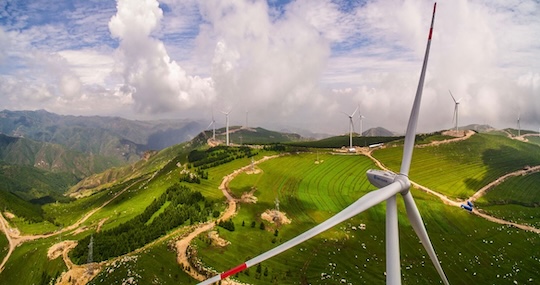 Wind Farm in China. Source: Wikimedia Commons
Think about what happens when an airline loses one aircraft.
If it only owns one plane, the business stops. But if it owns one hundred planes, the disruption becomes manageable.
China appears to have built its entire energy system around this principle.
The result is a country capable of switching between different energy sources. When oil becomes expensive or difficult to obtain, other options step in to fill part of the gap.
That may sound like a subtle distinction. But it isn't.
Historically, oil demand was relatively inflexible. Consumers needed gasoline. Factories needed diesel. Airlines needed jet fuel. There were few substitutes available.
Today, many of those assumptions are beginning to break down.
Millions of Chinese drivers now operate electric vehicles. Industrial facilities have greater fuel flexibility. Natural gas infrastructure continues to expand. Battery technology continues to improve.
Every time one of those alternatives gains market share, oil loses a little bit of its pricing power. And that's where the story becomes interesting.
America's Energy Insurance Policy
China isn't the only country that emerged from this crisis looking different. The U.S. did too.
Twenty years ago, a major disruption in Middle Eastern oil supplies would have created genuine fears about America's ability to secure enough energy to power its economy.
Today, those fears are far less pronounced.
Thanks largely to the shale revolution, the U.S. has become one of the world's dominant energy producers.
American oil production now exceeds that of both Saudi Arabia and Russia, while domestic natural gas production has surged to record levels.
At the same time, the U.S. has transformed from a major energy importer into one of the world's leading exporters of crude oil, liquefied natural gas (LNG), and natural gas liquids.
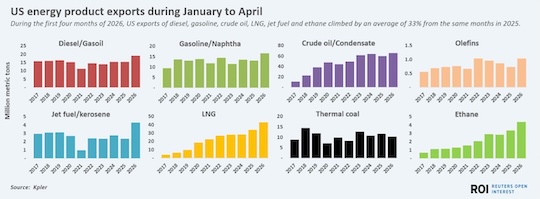 Source: Hydrocarbon Processing
The country also maintains a vast network of pipelines, storage facilities, refineries, and strategic reserves designed to cushion temporary disruptions.
That shift is easy to overlook because many Americans still think about energy through the lens of the 1970s oil embargo or the import dependence of the early 2000s.
But today's energy landscape looks very different.
During the recent crisis, the U.S. wasn’t scrambling to secure foreign supplies. In many cases, it was helping supply the rest of the world.
That doesn't mean Americans are immune to higher prices.
Oil remains a globally traded commodity, and events overseas can still impact what drivers pay at the pump.
But there is an important distinction between paying more for energy and worrying about whether energy will be available at all.
During previous oil crises, supply itself was often the concern. During this one, supply for the United States was never seriously in doubt.
Perhaps even more important is what comes next.
While America hasn’t embraced electric vehicles, battery storage, alternative fuels, and industrial fuel-switching technologies to the same degree as China, it’s hardly starting from zero.
Every major oil shock creates new incentives for governments, businesses, and consumers to invest in flexibility. The lesson of this crisis is unlikely to be forgotten.
In many ways, the U.S. may now be following the same path China started years ago: building an energy system that’s less dependent on any single fuel source and therefore more resilient to future disruptions.
The Last Oil Bull Market?
One of the most dangerous phrases in investing is, "The market is wrong."
Sometimes the market is wrong. Most of the time, however, the market knows something many investors have not yet understood.
If a major Middle Eastern conflict, shipping disruptions, sanctions, and threats to global energy infrastructure failed to produce $150 oil, we should at least ask why.
Maybe the answer is that global energy systems are far more adaptable than they were 20 years ago.
Maybe the answer is that China has become the world's largest shock absorber. And maybe America's shale revolution changed the rules of the game.
Or maybe the answer is something simpler…
What if oil just isn't as scarce as we think?
For years, energy analysts have warned that the world would eventually run out of hydrocarbons.
Yet every decade seems to bring new discoveries, improved extraction methods, better transportation systems, and technological breakthroughs that increase available supply.
Thanks largely to the shale revolution, the U.S. became the world's largest oil producer. Canada continues expanding production. South America remains underdeveloped. Offshore discoveries continue to emerge worldwide.
The supply side keeps growing, and technology is reducing demand growth. That combination matters a lot.
This doesn't mean oil is going away. Far from it.
Oil remains one of the most important commodities in the global economy. The world still consumes roughly 100 million barrels every single day.
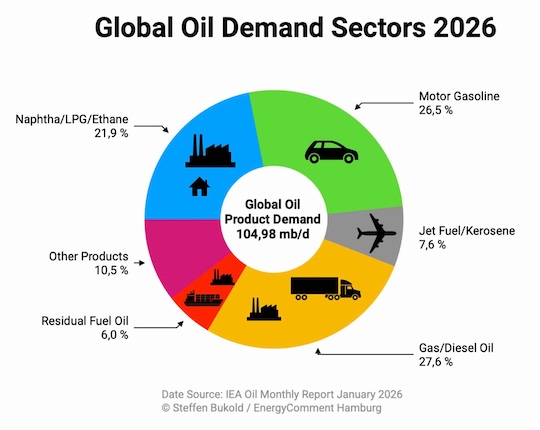 Source: EnergyComment
But we need to remember something important: prices are determined at the margin.
If technology can reduce demand by just a few million barrels per day while new production adds a few million barrels per day, the balance shifts dramatically.
Suddenly, markets that once looked tight begin looking oversupplied. Every geopolitical crisis produces smaller and smaller price spikes. And the next energy shock doesn't send oil to $200.
Now Back to the $40 Oil Prediction
At Truth & Trends, we’re always searching for ideas that sound ridiculous today but may look obvious in hindsight.
So here's one for you…
I believe there’s a real possibility that crude oil trades below $40 per barrel within the next three years.
And under the right conditions, it may even trade with a $30 handle. Yes, you read that right.
That sounds absurd at first glance. Oil traded above $120 just a few years ago, and many analysts still believe triple-digit prices are inevitable.
Even today, most forecasts assume oil prices remain structurally elevated for years to come.
But history is full of examples where technological change completely altered the economics of an industry.
The internet changed media…
Streaming changed television…
Smartphones changed communication…
Artificial intelligence is changing software…
What if energy is next?
What if China's massive investments in energy flexibility represent the first glimpse of a world where hydrocarbons become increasingly interchangeable, abundant, and difficult to price at a premium?
What if America's shale revolution and growing energy exports represent the other side of that same equation?
For the first time in modern history, the world's largest energy importer and one of the world's largest energy producers may both be moving toward a future where oil matters a little less than it once did.
If that happens, the biggest surprise of the next decade won't be that oil went higher. It will be how much lower it ultimately went.
Most investors are still preparing for the next oil shortage. The market may already be preparing for the next oil glut.
And if that's true, oil trading at $40 may not be nearly as crazy as it sounds today.
Sign Up Today for Free!
Truth & Trends brings you market insights and trading tips you won't find anywhere else — unless you have your own personal hedge fund manager on speed dial...
Meet Enrique Abeyta, one of Wall Street’s most successful hedge fund managers. With years of experience managing billions of dollars and navigating the highs and lows of the financial markets, Enrique delivers unparalleled market insights straight to your inbox.
In Truth & Trends, Enrique shares his personal take on what’s moving the markets, revealing strategies that made him a star in the world of high finance. Whether it’s uncovering the next big trend or breaking down the hottest stocks and sectors, Enrique’s insights are sharp, actionable, and proven to work in any market condition.
Inside these daily updates, you’ll gain:
- 50 years of combined trading wisdom distilled into actionable insights.
- A behind-the-scenes look at how Wall Street pros spot opportunities and avoid pitfalls.
- Exclusive strategies that Enrique personally uses to deliver exceptional returns — no fluff, just results.
To have Truth & Trends sent directly to your inbox every weekday, just enter your email address below to join this exclusive community of informed traders.
Don’t miss your chance to learn from one of the best in the business.
Sign up now and take your trading game to the next level.

The Melt-Up Case Makes Itself
Posted June 15, 2026
By Enrique Abeyta

The SpaceX Hangover Trade
Posted June 12, 2026
By Greg Guenthner

TOMORROW: Unleash the Cash Flood
Posted June 11, 2026
By Enrique Abeyta
Friday's Violent Sell-Off (It Changes Nothing)
Posted June 08, 2026
By Enrique Abeyta

Bitcoin Is Boring
Posted June 05, 2026
By Greg Guenthner
