![[FREE Ticker] The Drone Stock Flying Under the Radar](http://images.ctfassets.net/vha3zb1lo47k/4W07St4xpKIDLKq0DvYo8P/11022d004c3fb333478fb356d6f21467/TTR-issue-062526-featured-2391619205.jpg)
Posted June 25, 2026

By Enrique Abeyta
[FREE Ticker] The Drone Stock Flying Under the Radar
You've probably heard the term asymmetric warfare before.
It describes a conflict where two sides are so mismatched in size, resources, or tactics that conventional military logic breaks down.
Drone warfare has become one of the clearest examples of this concept we've seen in years. And we've watched it unfold in two very different conflicts.
In Ukraine, inexpensive drones have been destroying military equipment worth hundreds of times more than the drones themselves.
More recently, during the conflict with Iran, American and allied forces used Patriot interceptors (costing roughly $4 million apiece) to help defend against waves of inexpensive attack drones that cost only a tiny fraction of that.
The economics of warfare are clearly changing.
Recently, I found myself going down a rabbit hole on drones — and of course, the investment angle.
The obvious place to look is the companies building the drones. That's where many investors have been focusing their attention.
But the more I dug into the story, the more I found myself gravitating toward a different corner of the market…
The companies that are trying to stop them.
It struck me that the investment opportunity might be just as asymmetric as the battlefield itself.
While everyone is focused on the offensive side of the equation, there are plenty of names on the defensive side that also stand to benefit from this trend.
One in particular kept showing up during my research. I'll tell you about it in a moment.
But first, it helps to understand just how seriously Washington is taking this problem.
The Pentagon Has a Serious Problem
We tend to think about military power in terms of expensive platforms.
Nations competed to build larger aircraft carriers, more advanced fighter jets, more capable missile systems, and increasingly sophisticated tanks.
But now that model is being challenged.
A swarm of inexpensive drones can force militaries to launch interceptors that cost hundreds of thousands or even millions of dollars each.
Eventually, the math stops working.
That's why the Pentagon wants to give more resources to programs that can stop these drones.
Initiatives known as Counter-Unmanned Aircraft Systems (C-UAS) have become a major priority across the U.S. military.
These programs are designed to detect, track, identify, and defeat hostile drones before they can threaten troops, bases, ships, airports, power plants, or critical infrastructure.
The challenge is far greater than most people realize.
Many modern drones can fly low, move fast, operate autonomously, and avoid traditional radar systems. Some are specifically designed to reduce their electronic signature.
Others can operate in coordinated groups, overwhelming conventional defenses through sheer numbers.
This is why the next generation of drone defense looks very different from traditional air defense.
It relies less on missiles and more on software. Less on brute force and more on intelligence. And less on kinetic destruction and more on electronic warfare.
The reason this trend has my attention isn't simply because drones are becoming more important.
It's because Washington has officially acknowledged it.
Washington’s $55B Bet on Autonomous Warfare
One of the most remarkable developments in defense spending today is something called the Defense Autonomous Warfare Group (DAWG).
Most Americans have never heard of it. But that may not be true for long.
In its first year, DAWG received just $225 million in funding.
For fiscal year 2027, the Pentagon is requesting an astonishing $54.6 billion!
 Source: Defense One
That's roughly a 24,000% increase in a single year.
To put it in perspective, the proposed budget would exceed the entire U.S. Marine Corps budget request of approximately $52.8 billion.
Read that again.
The Pentagon is proposing to spend more on autonomous warfare than on the entire Marine Corps.
That tells you everything you need to know about where military planners believe warfare is heading.
What's particularly interesting is how the money is structured.
Only about $1 billion sits in the Pentagon's traditional base budget. The remaining $53.6 billion comes from a more flexible funding pool that can be deployed over several years.
Rather than rushing to buy whatever drones are available today, military leaders are building a framework that evolves alongside rapidly changing technology.
This represents a major shift in thinking.
The Pentagon recently folded the Biden-era Replicator initiative into DAWG. Replicator focused largely on acquiring drone hardware.
DAWG is increasingly focused on software, AI, and the systems needed to coordinate large numbers of autonomous platforms simultaneously.
Think less about a single drone and more about an intelligent network capable of controlling thousands of drones at once.
That's where military planners believe the future battlefield is headed. And if that future arrives, drone defense becomes even more important.
Meet the Company Already Fighting This War
Defending against one drone is difficult.
Defending against a coordinated swarm of hundreds or thousands may become one of the defining military challenges of the next decade.
That challenge led me to a company I had not spent much time studying before, CACI International (CACI).
CACI is not a flashy drone startup or a company that dominates financial television. Most people probably couldn't tell you what it does.
Yet it is already deeply involved in one of the most important defense themes emerging today…
Counter-drone warfare.
What caught my attention is that CACI isn't building technology for some hypothetical future battlefield.
Many of its systems are already being used or evaluated by organizations, including the U.S. Army, U.S. Central Command, the Department of Defense, and federal agencies responsible for protecting America's airspace.
The company has built a surprisingly comprehensive ecosystem of technologies designed to detect, track, and defeat unmanned aerial systems.
One example is SkyValor, a multi-sensor platform capable of identifying drone threats at ranges exceeding 75 kilometers.
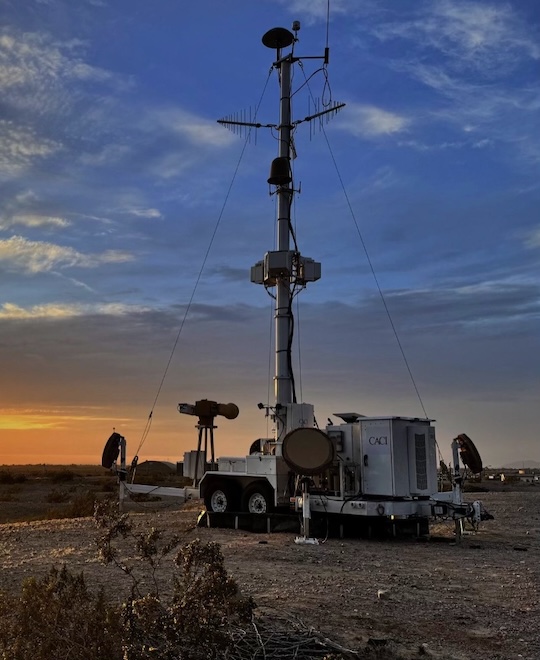 SkyValor. Source: CACI International
The system combines multiple detection methods into a unified operating picture, enabling operators to identify threats long before they reach critical assets.
Another fascinating technology is called SPaRK.
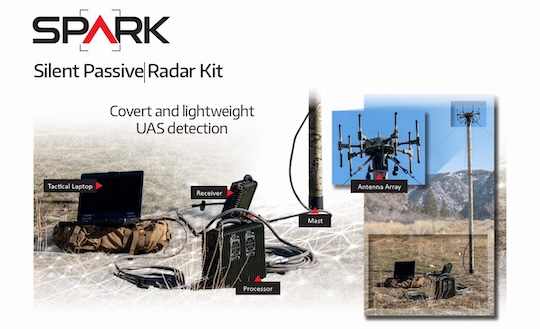 Source: CACI International
The system helps detect so-called "dark drones" that do not actively emit electronic signals.
Instead of relying on traditional methods, it passively analyzes reflected commercial television and radio broadcasts to identify and track threats without revealing its own position.
Think about that for a moment.
The battlefield has evolved to the point where military systems are using ordinary broadcast signals to locate stealthy aerial threats.
CACI also produces mobile defense systems, such as X-MADIS, which combines radar, cameras, and electronic warfare capabilities into a deployable platform designed to protect forces on the move.
Meanwhile, systems such as BEAM and CORIAN provide electronic attack capabilities that can disable or disrupt hostile drones without relying on expensive missiles.
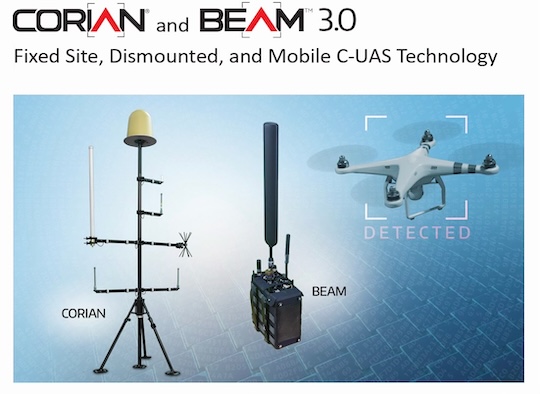 Source: CACI International
In many cases, these so-called "soft kill" solutions may prove far more economical than traditional interception methods.
Perhaps most interesting of all is the software layer that ties everything together.
CACI's Nightstalker platform integrates sensors and defensive systems from multiple vendors into a unified command-and-control framework.
It allows operators to rapidly assess threats and coordinate responses while continuously adapting to new drone technologies.
That adaptability may prove critical.
Drone warfare is evolving at an extraordinary pace.
The tactics being used in Ukraine today often look very different from those used just a year ago.
Any company hoping to remain relevant in this space must constantly update its systems, software, and threat databases.
According to CACI, its platforms can rapidly adapt to new signals and emerging drone threats within hours or days, rather than months or years.
This Could Be the “Next Cybersecurity”
It's worth noting that DAWG isn't the only sign of government interest.
Separate Pentagon initiatives have reportedly explored funding arrangements with drone-related companies that could include direct investments or even equity stakes.
In other words, Washington is increasingly behaving less like a traditional customer and more like a strategic partner.
That represents a meaningful shift in how the government is approaching critical defense technologies.
For me, that's what makes this theme so fascinating.
The headlines focus on the offensive side of drone warfare because explosions make for compelling television.
But history suggests that defense often becomes the larger and more durable market.
Cybersecurity followed a similar path.
Two decades ago, most organizations barely thought about cyber threats.
Today, cybersecurity spending is considered essential infrastructure.
I can't help but wonder whether drone defense is heading down a similar road.
If drones become a permanent feature of modern life and modern warfare, then every military base, airport, port, power plant, refinery, government facility, and piece of critical infrastructure may eventually require some form of protection.
That creates a very large addressable market, which is why I find the company extremely interesting.
It appears to be operating directly in the path of a powerful long-term defense theme that is only beginning to receive mainstream attention.
Whether CACI ultimately becomes the biggest winner remains to be seen. But one thing feels increasingly clear.
The drone revolution is no longer coming. It's already here.
And the companies helping defend against it may become just as important as the companies building the drones themselves.
Sign Up Today for Free!
Truth & Trends brings you market insights and trading tips you won't find anywhere else — unless you have your own personal hedge fund manager on speed dial...
Meet Enrique Abeyta, one of Wall Street’s most successful hedge fund managers. With years of experience managing billions of dollars and navigating the highs and lows of the financial markets, Enrique delivers unparalleled market insights straight to your inbox.
In Truth & Trends, Enrique shares his personal take on what’s moving the markets, revealing strategies that made him a star in the world of high finance. Whether it’s uncovering the next big trend or breaking down the hottest stocks and sectors, Enrique’s insights are sharp, actionable, and proven to work in any market condition.
Inside these daily updates, you’ll gain:
- 50 years of combined trading wisdom distilled into actionable insights.
- A behind-the-scenes look at how Wall Street pros spot opportunities and avoid pitfalls.
- Exclusive strategies that Enrique personally uses to deliver exceptional returns — no fluff, just results.
To have Truth & Trends sent directly to your inbox every weekday, just enter your email address below to join this exclusive community of informed traders.
Don’t miss your chance to learn from one of the best in the business.
Sign up now and take your trading game to the next level.

Get Ready for $40 Oil
Posted June 18, 2026
By Enrique Abeyta

The Melt-Up Case Makes Itself
Posted June 15, 2026
By Enrique Abeyta

The SpaceX Hangover Trade
Posted June 12, 2026
By Greg Guenthner

TOMORROW: Unleash the Cash Flood
Posted June 11, 2026
By Enrique Abeyta

Friday's Violent Sell-Off (It Changes Nothing)
Posted June 08, 2026
By Enrique Abeyta
