Posted September 14, 2026

By Enrique Abeyta
Forget the Rate Hike Question for a Minute
A 4% interest rate only gives you so much information. Same goes for oil at $100 a barrel.
Those numbers tell us where we are, but they don’t tell us anything about how we got there.
That's worth remembering this week.
Wall Street enters Wednesday's Federal Reserve meeting expecting Kevin Warsh and company to raise interest rates.
Meanwhile, oil has climbed above $100 as the conflict with Iran escalates.
Most of the conversation is focused on the levels.
Where will interest rates be after Wednesday's meeting, a few months from now, or even next year? How high could oil go?
But there's another part of the equation: how quickly they're moving.
Think of it as level versus velocity.
Looking at both gives us a much better sense of what's happening right now — and where the real risks could emerge next.
Let’s start with interest rates.
How Much Does One Rate Hike Matter?
The Consumer Price Index rose 0.4% in August and 3.4% from a year ago, while gasoline jumped 3.9% last month.
That pushed market expectations heavily toward a Fed rate hike at the September meeting.
Kalshi's odds of a hike this week are sitting around 85% right now.
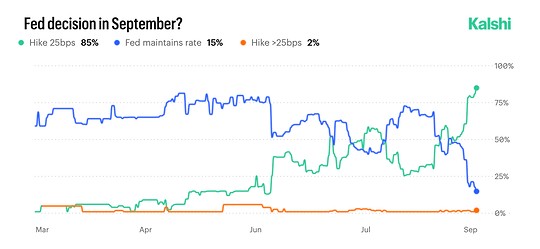 Source: Kalshi
If the Fed does end up raising rates, it will likely be by 25 basis points, or one-quarter of a percentage point.
I'm not dismissing that. It would be the Fed's first hike in some time and send a clear change in direction.
But everybody has been talking about it for days. Markets have already priced in much of that possibility.
More importantly, a 25-point hike isn't unusual.
However, if Warsh suddenly raised rates by, let’s say, 100 basis points, he'd have my full attention. Why?
Because the size and speed of the move would tell us the Fed sees a problem serious enough to demand quick action.
That's where velocity comes in.
No magic number of rate hikes automatically causes a recession. But history gives us a useful lesson about speed.
Consider 2022.
The Fed began that year with rates near zero. By December, it had raised them 425 basis points, including four straight 75-point hikes.
The effects came quickly.
Stocks entered a bear market. Housing slowed. Borrowing costs surged. And real GDP contracted during the first two quarters of 2022.
Now compare that with the cycle leading into the Great Recession.
From 2004 through 2006, the Fed raised rates from 1% to 5.25%. But it did so through a long series of smaller, 25-point moves.
The recession didn't technically begin until December 2007.
I'm not suggesting Fed hikes alone caused either downturn. Economies are far more complex than that.
But the comparison supports an important idea.
The level matters, and so does the speed.
A quarter-point move Wednesday would be worth watching. A rapid series of hikes would be something else entirely.
That brings me to the part of the market that concerns me more than interest rates.
Something Has Changed in the Oil Market
Throughout the Iran conflict, I've focused on one question: Is the world's ability to produce and move oil actually being damaged?
For months, the answer was largely no. Oil jumped and fell with each new attack, ceasefire, and diplomatic pause.
Meanwhile, crude kept moving through alternative routes and the so-called "dark" fleet.
But that has changed recently.
Iran has attacked U.S. assets and ships.
The U.S. has retaliated against Iranian oil infrastructure and has now destroyed 10 Iranian tankers.
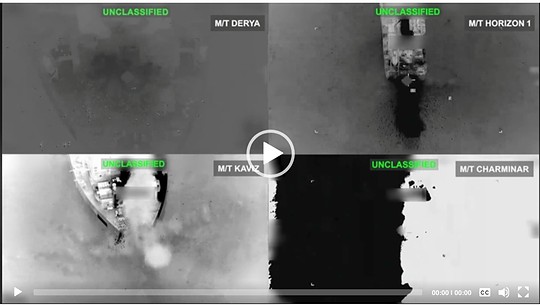 Source: U.S. Central Command
Iran-aligned Houthi forces have also stepped up their attacks on Saudi Arabia.
And last Thursday, they hit something especially important.
Saudi Arabia temporarily shut down its critical East-West crude oil pipeline following multiple projectile and drone attacks. The strikes caused fires and injuries.
Why does that matter?
The East-West pipeline has become a lifeline for Saudi oil. It moves crude across the country to the Red Sea, allowing Saudi Arabia to bypass the troubled Strait of Hormuz.
Now that alternative is under pressure, too.
Meanwhile, Houthi forces have pushed farther along Yemen's Red Sea coast, increasing the threat around the Bab el-Mandeb Strait, another key route for global shipping.
The effects are becoming measurable.
Saudi crude supply fell sharply in August to its lowest level in more than three decades.
Think about what's happening.
First, Hormuz became harder to use.
Then Saudi Arabia relied more heavily on moving oil west toward the Red Sea.
Now the pipeline that helps get that oil west has been attacked, while the shipping route on the other side faces a growing threat.
This isn't merely another headline from the Middle East.
The system that moves millions of barrels of oil around the world is being damaged at multiple points.
Oil Has a Velocity Problem, Too
Oil above $100 isn't historically extreme.
Brent crude briefly approached $150 per barrel in 2008. It climbed above $120 in 2022 after Russia invaded Ukraine.
The world has lived through expensive oil before.
Again, the important question is how quickly prices are moving and why.
Brent moved above $100 last week and approached $105 earlier today.
And this time, the move reflects damage to the system that produces and transports oil.
Consider those 10 Iranian tankers.
A Very Large Crude Carrier (or VLCC) can carry roughly 2 million barrels of oil. A new one can cost well over $100 million and take roughly two years to build.
So, if all 10 ships were that size, they could carry about 20 million barrels of oil on a single voyage.
And you can't replace that capacity next week.
Of course, not every tanker is a VLCC. The point isn't that these 10 ships alone will devastate the global oil market.
It's that ships are being destroyed while pipelines, production sites and shipping routes are coming under attack.
We're already seeing the cost of that risk.
The freight charge to move oil aboard a giant tanker from the Gulf of Oman to China recently surged to roughly $11.50 for every barrel carried, according to Baltic Exchange data.
In other words, the conflict isn't just affecting oil prices.
It's making the oil itself far more expensive to move.
That's velocity.
And unlike a quarter-point rate hike, markets can't easily price where this escalation ends.
It All Comes Back to Your Portfolio (and Pocket)
We all know that oil doesn't stay in the oil market. It reaches our wallets.
U.S. diesel prices are now around $6 per gallon, and gasoline also rose sharply in August.
Higher diesel costs make it more expensive to move food, clothes, and building supplies.
Higher jet fuel costs hit airlines.
Higher shipping costs hit retailers and manufacturers.
Eventually, much of that reaches consumers.
And that's where our two stories collide.
Higher oil means higher inflation. Higher inflation means pressure for higher rates.
That can squeeze consumers, slow the economy, and hurt company profits. Eventually, it can hurt stock prices, too.
Wall Street will spend the next few days focused on Kevin Warsh. And I'll be watching Wednesday's Fed decision just like everyone else.
But a 25-basis-point hike isn't what concerns me most right now.
Oil is.
We've spent months watching this conflict while crude remained within ranges the global economy has handled before.
Now production is falling, infrastructure is being hit, tankers are being destroyed, and shipping routes are becoming harder and more expensive to use.
The level matters.
But the velocity matters too. For investors, that's the change worth watching.
Sign Up Today for Free!
Truth & Trends brings you market insights and trading tips you won't find anywhere else — unless you have your own personal hedge fund manager on speed dial...
Meet Enrique Abeyta, one of Wall Street’s most successful hedge fund managers. With years of experience managing billions of dollars and navigating the highs and lows of the financial markets, Enrique delivers unparalleled market insights straight to your inbox.
In Truth & Trends, Enrique shares his personal take on what’s moving the markets, revealing strategies that made him a star in the world of high finance. Whether it’s uncovering the next big trend or breaking down the hottest stocks and sectors, Enrique’s insights are sharp, actionable, and proven to work in any market condition.
Inside these daily updates, you’ll gain:
- 50 years of combined trading wisdom distilled into actionable insights.
- A behind-the-scenes look at how Wall Street pros spot opportunities and avoid pitfalls.
- Exclusive strategies that Enrique personally uses to deliver exceptional returns — no fluff, just results.
To have Truth & Trends sent directly to your inbox every weekday, just enter your email address below to join this exclusive community of informed traders.
Don’t miss your chance to learn from one of the best in the business.
Sign up now and take your trading game to the next level.
The 4 “Insider” Documents Wall Street Reads Before You Do
Posted September 13, 2026
By Nick Riso

The Melt-Up Is Coming. But First...
Posted September 11, 2026
By Greg Guenthner

The COVID Economy Never Ended
Posted September 10, 2026
By Enrique Abeyta

6 Horsemen of the OpenAI-pocalypse
Posted September 07, 2026
By Enrique Abeyta

The Man Taking Apple to $10 Trillion
Posted September 04, 2026
By Chris Cimorelli