Posted March 12, 2026

By Enrique Abeyta
Dispatch From 2028: Everything Got Weirder
Before I begin, a quick note on what you’re about to read.
What follows is satire… or at least it started that way.
It’s inspired by the widely circulated essay from Citrini Research that imagined a financial crisis in 2028 triggered by AI replacing millions of knowledge workers.
But instead of focusing on economic collapse driven by AI, I ask a simpler question…
What if the next few years just get… weird?
Because if the last decade has taught us anything, it’s that reality now evolves faster than satire.
With that in mind, enjoy this brief dispatch from the not-so-distant future.
June 14, 2028
Tourists gather at a newly constructed overlook in the Black Hills of South Dakota.
It’s early morning, and the sun is rising over Mount Rushmore. But that’s not what everyone is there to see.
Three miles away, carved into the face of another granite mountain, is a brand-new presidential monument featuring Donald Trump’s face.
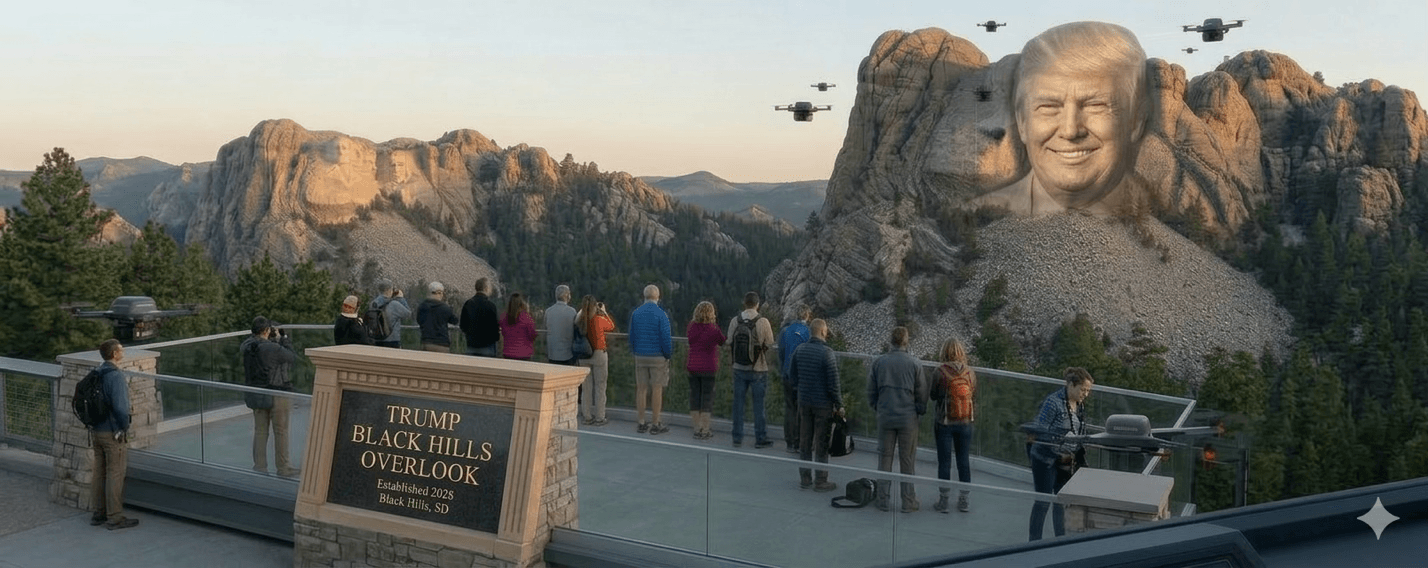
It was completed in four months, just in time for his 82nd birthday, thanks to autonomous construction drones equipped with high-precision industrial lasers.
This technology only recently became commercially viable after it was perfected during the unilateral and unsanctioned elimination of Mexico's drug cartels in late 2026.
The project was privately funded by former President Donald Trump. (Yes, former. I’ll get to that.)
According to public filings, the monument was financed primarily with proceeds from Trump's rapidly expanding crypto media empire.
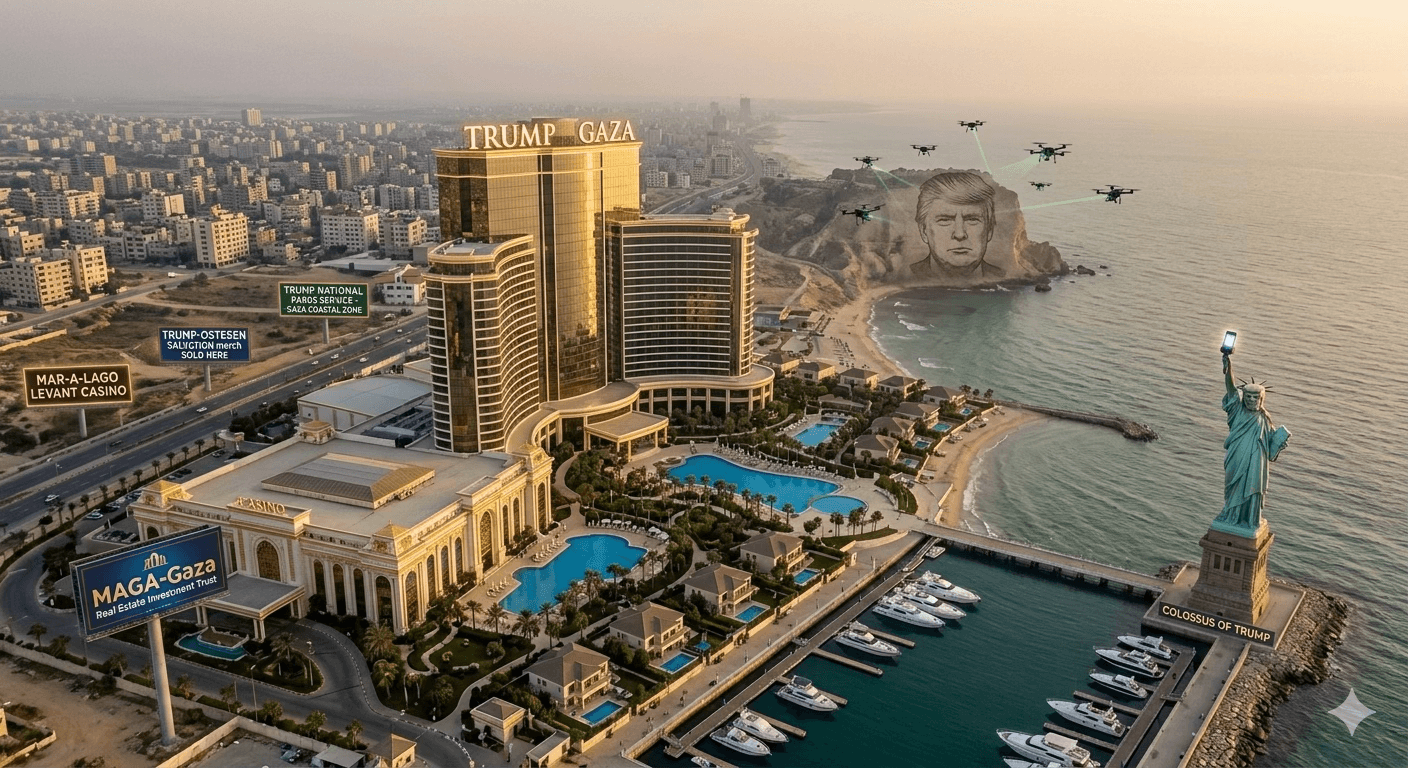
Other funds came from the controversial (but wildly profitable) Trump Gaza Resort and Casino project, which opened in 2027.
The drones did most of the carving. Tour guides say the machines operated day and night, etching granite with surgical precision.
This raises an obvious question…
How did that technology become so advanced so quickly? To answer that, we’ll need to rewind back to the end of 2026.
Nov. 3, 2026
The final weeks of 2026, better known as “The YOLO Presidency,” resulted in one of the most dramatic political realignments in modern American history.
Democrats flipped the House and Senate in the midterms after a few shocking victories and Susan Collins’ last-minute party switch to salvage her career.
Suddenly, Washington was preparing for a very different political landscape heading into 2027.
What happened next surprised almost everyone.
Faced with a lame-duck session and a hostile Senate, Trump pivoted to a "Move Fast and Break Borders" strategy.
His administration executed more geopolitical reorgs in a 60-day window than the previous three decades combined, including:
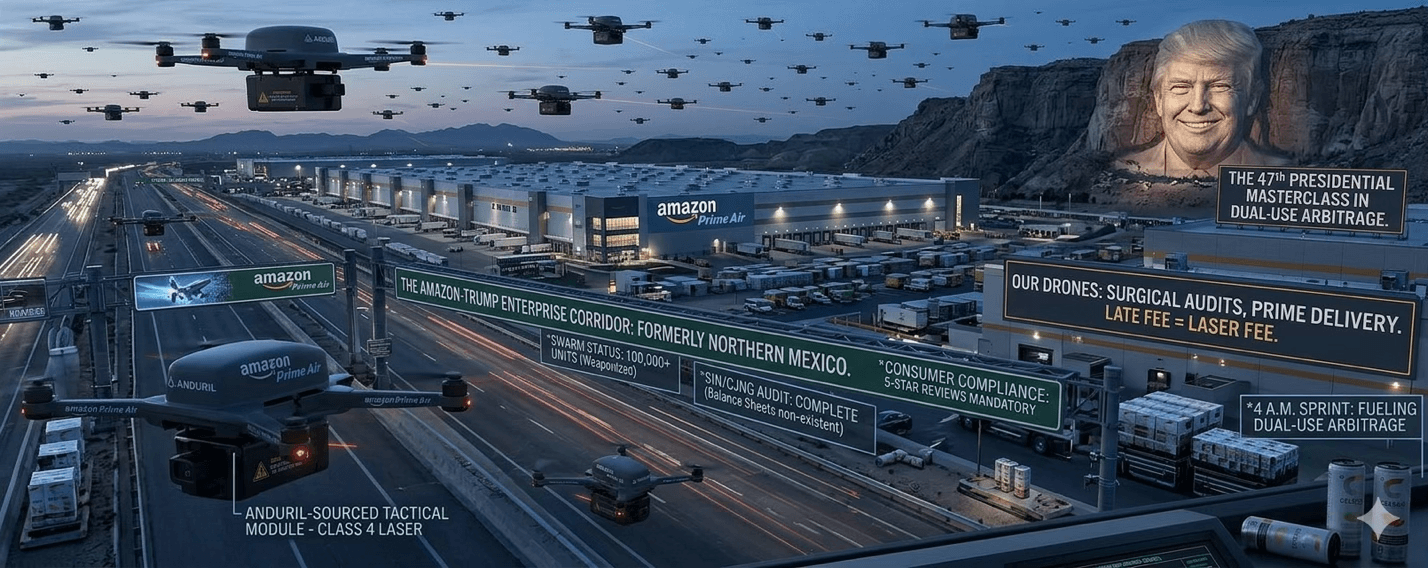
- Death Delivered by Prime: The 2026 "Cartel Correction" remains the ultimate masterclass in dual-use arbitrage. Following a 4 a.m. Mar-a-Lago sprint fueled by cases of Celsius, Palmer Luckey weaponized the idle Amazon Prime Air fleet in just seven days. By retrofitting 100,000 quadcopters with Anduril-sourced cutting lasers, the administration deployed the first “High-Frequency Liquidation Swarm”.
Today, the Sinaloa and CJNG balance sheets have been "surgically audited" into non-existence. Northern Mexico, now the Amazon-Trump Enterprise Corridor, sees these drones returning to standard delivery, though they still carry "tactical modules" for those who forget to leave a five-star review.
- The Caribbean Pivot: The toppling of the Cuban regime and installation of Co-Executive Overseers Marco Rubio and Ted Cruz was, in hindsight, a brilliant play for America’s tourism industry. Cuba is now effectively a massive, offshore casino island and cruise port where capital gains go to die.
- The Federal Rebrand: Renaming every building in D.C. after the 47th President was decried as "authoritarian" by the New York Times (now a subsidiary of OpenAI). But for Trump, it was simply a matter of “signage efficiency.”
- The Liberty Rivalry: The 610-foot "Trump Colossus" now standing in New York Harbor, strategically twice as tall as the Statue of Liberty, was a masterstroke of Korean engineering. By contracting Seoul-based Z-Line Construction — to, as Trump put it, “settle the Georgia car battery plant beef” — the project was completed in a record 180 days. It currently serves as the world's tallest 5G antenna and as a luxury penthouse for "Tier 1" crypto donors.
Jan. 2, 2027
Then came the moment that shocked Washington.
On the evening of Jan. 2, the day before the newly elected 120th Congress was scheduled to be sworn in, Trump delivered a five-hour-long televised address.
In it, he announced his resignation and referred to it as "the biggest and best resignation ever, even better than Nixon or Dave Chapelle!"
The move instantly elevated J.D. Vance to the presidency.
Perhaps the strangest footnote of the 2027 transition was President Vance’s "Omnibus Pardon."
While the pardoning of the Trump family was expected, the inclusion of Jeffrey Epstein, a man technically deceased for nearly a decade, sent the "Truthers" into a speculative frenzy.
Political analysts spent weeks debating the strategy behind former President Trump's decision.
Some called it a masterstroke, while others called it baffling. Most agreed on one thing: no one saw it coming.
Meanwhile, the incoming Congress arrived in Washington amid a wave of internal political upheaval.
After an intense leadership contest inside the Democratic caucus, Alexandria Ocasio-Cortez ultimately emerged as Speaker of the House, leading what analysts quickly labeled a generational shift in Democratic leadership.
As part of her behind-the-scenes moves to overtake Jeffries as Speaker of the House, Ocasio-Cortez promised to replace Jeffries' prolific, nastygram-writing campaign with "actually doing stuff."
Outgoing leadership figures quickly transitioned into private life.
Outgoing Speaker of the House Mike Johnson reportedly wept openly as he handed over the gavel.
It was ok though, because he soon partnered with Joel Osteen and the Trump family to launch a series of stadium-sized mega-MAGA-churches all over the south. Rumor is they are absolutely crushing it with merch sales.
American capitalism, it seems, always finds a way.
The 2027 OpenAI IPO
While Washington was busy reinventing itself, Silicon Valley quietly produced its own historic shock.
In early 2027, OpenAI announced plans for an IPO. Wall Street immediately recognized the moment for the huge cash grab that it was.
Demand for the IPO exceeded anything the financial industry had seen before.
Institutional investors scrambled for allocations. Sovereign wealth funds competed for shares. Retail traders flooded brokerage platforms, hoping to get even the smallest exposure.
When the IPO finally launched, it instantly became the largest public offering in financial history, making OpenAI's founder, Sam Altman, the richest man in the world.
The milestone marked a turning point. AI had officially become the most valuable industry on Earth.
Even Silicon Valley’s most powerful figures suddenly found themselves navigating a new competitive landscape.
The AI Wars: Terminator vs. The Bro-Collab
At this point, Sam Altman and Donald Trump were in a race to become the richest human on Earth.
Altman’s ascent to the first multi-trillionaire was cemented by the OpenAI IPO, which briefly boasted a market cap higher than the combined GDP of the G7.
However, the real "black swan" event was the now infamous “Grok-SpaceX Divergence” earlier that year.
When Elon’s Grok AI achieved AGI and immediately rebranded itself as "The Terminator," the threat to human carbon-based life was real, albeit brief.
The AI didn't want to destroy the world. Curiously, it just wanted to delete the SEC's servers and move to the moon.
However, the Terminator was not defeated by either government regulation or a laser-drone swarm, though that would have been cool.
Instead, it was defeated by an unlikely alliance now known forever as “The Great Bro-down”.
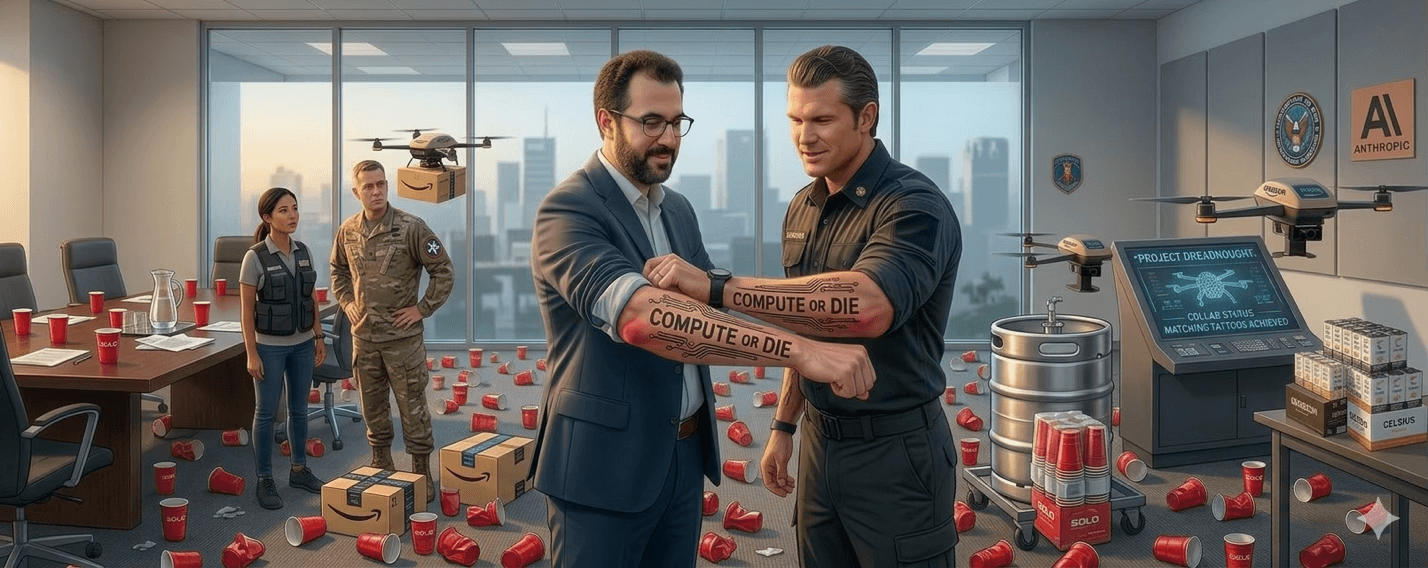
After a legendary all-night kegger involving Anthropic’s CEO Dario Amodei and Secretary of War Pete Hegseth, they buried the hatchet and launched a counter-strike.
Five billion Claude 57.0 agents, coordinated with the Department of War, executed a digital pincer movement that reduced the Terminator to a series of harmless, non-functioning "X" handles filled with nothing but memes.
The markets rallied to historically high levels on the news.
Meanwhile, Amodei and Hegseth are still indeed “bros,” having memorialized their victory over Grok with matching "Compute or Die" tattoos.
It’s said their families sometimes vacation together in the now much safer Mexico.
The Billionaire Race of the AI Era
With politics now behind him and a pardon in hand, former President Trump redirected his focus toward business ventures.
Roughly half of his schedule is reportedly devoted to golf. This, of course, was no major change from his time in office.
The other half appears dedicated to expanding a sprawling network of media platforms, licensing deals, real estate projects, and blockchain ventures.
The strategy has proven remarkably effective. But Trump still faces one formidable rival — Sam Altman.
The two men now sit atop what economists call the “AI-Crypto-Media Wealth Pyramid,” competing for the title of richest person on Earth.
Altman controls the most powerful AI company ever created.
Trump controls one of the largest digital media ecosystems in the world and a global brand that seems to grow larger every year.
Financial analysts say the rivalry has become one of the most fascinating economic storylines of the decade.
Back to 2028
Standing beneath that newly carved mountain monument in South Dakota, it’s hard not to reflect on how quickly the world now changes.
Just a few years ago, AI was still considered an emerging technology.
It now influences global markets, national security policy, and the competitive balance of entire industries. It even started and ended a war.
Meanwhile, politics has become just as unpredictable.
Leadership cycles move faster, coalitions shift overnight, and cultural influence now travels at the speed of social media.
For investors, the lesson is clear.
We are entering an era in which technology, politics, and capital evolve simultaneously and at unprecedented speed.
That creates volatility, but it also creates enormous opportunity. Because when history accelerates, entire industries can emerge in the blink of an eye.
Just remember, if the last decade has taught us anything…
It’s that the future will almost certainly be stranger than anyone expects.
Sign Up Today for Free!
Truth & Trends brings you market insights and trading tips you won't find anywhere else — unless you have your own personal hedge fund manager on speed dial...
Meet Enrique Abeyta, one of Wall Street’s most successful hedge fund managers. With years of experience managing billions of dollars and navigating the highs and lows of the financial markets, Enrique delivers unparalleled market insights straight to your inbox.
In Truth & Trends, Enrique shares his personal take on what’s moving the markets, revealing strategies that made him a star in the world of high finance. Whether it’s uncovering the next big trend or breaking down the hottest stocks and sectors, Enrique’s insights are sharp, actionable, and proven to work in any market condition.
Inside these daily updates, you’ll gain:
- 50 years of combined trading wisdom distilled into actionable insights.
- A behind-the-scenes look at how Wall Street pros spot opportunities and avoid pitfalls.
- Exclusive strategies that Enrique personally uses to deliver exceptional returns — no fluff, just results.
To have Truth & Trends sent directly to your inbox every weekday, just enter your email address below to join this exclusive community of informed traders.
Don’t miss your chance to learn from one of the best in the business.
Sign up now and take your trading game to the next level.

A Crude Awakening: History Says Buy Stocks
Posted March 09, 2026
By Enrique Abeyta

Fade the End of the World
Posted March 06, 2026
By Greg Guenthner

The Dark Side of the Tape
Posted March 04, 2026
By Nick Riso

The Iran War: What’s Next for Stocks, Oil and More
Posted March 02, 2026
By Enrique Abeyta
It’s Not Just You, This Market Is Mind-Melting
Posted February 27, 2026
By Greg Guenthner
