Posted September 21, 2026

By Enrique Abeyta
Coming Soon: Wall Street After Dark
Good news if you like trading stocks.
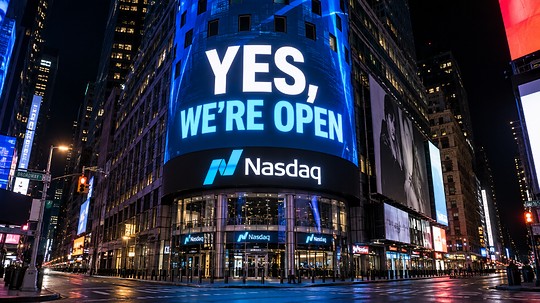
Starting this December, Nasdaq plans to keep its market open 23 hours a day, five days a week.
Trading will run nearly around the clock, with just a one-hour break each evening from 8 to 9 p.m. Eastern.
It’s not the only exchange moving in that direction either.
NYSE Arca and Cboe are preparing to offer 23-hour weekday trading, while others are pursuing similar plans.
But 23 hours may only be the beginning.
A major development last week could eventually push the market even closer to never closing at all.
And you could feel the effects even if you have no interest in trading stocks at 2 a.m.
So today, let’s look at where this is heading and what it could mean for your money.
The 23-Hour Market Is Coming
For some, these new trading hours will seem pretty normal.
Crypto markets, for instance, are already open 24/7.
Foreign exchange markets operate nearly around the clock during the workweek.
Futures trade for most of the day.
Even stocks have been moving in this direction.
Robinhood already offers overnight trading in many stocks and ETFs, as do several alternative trading systems.
But overnight stock trading remains tiny.
SEC Commissioner Hester Peirce said last week that extended-hours trading still accounts for less than 1% of trading in U.S.-listed stocks.
What's changing now is the scale.
Near-continuous trading is moving from the market's edges toward the mainstream.
There are some compelling reasons for the change.
The 9:30-to-4 trading day makes perfect sense if you're sitting in New York.
It makes considerably less sense if you're sitting in Tokyo, Seoul, or Singapore.
Nasdaq says growing global demand for U.S. stocks is one reason it's expanding its hours. And you can see the appeal.
For decades, foreign investors seeking the deepest access to American stocks largely had to operate on America's clock.
Soon, they could increasingly trade U.S. stocks during their day instead.
In a sense, it's another step toward democratizing access to America's markets.
And that could benefit the U.S. too.
Making American stocks easier to trade worldwide could attract more global capital and strengthen the country's position at the center of global finance.
There's another potential benefit.
News doesn't wait for the opening bell.
Wars break out, companies make announcements, and economic news hits overseas.
A longer trading day gives investors more time to respond when those events happen, instead of waiting for the market to reopen.
Of course, extending the trading day also raises some questions.
Just because a market is open doesn't mean it will behave the same way at every hour.
If fewer buyers and sellers participate overnight, trading could be thinner.
Spreads could widen.
Smaller trades could cause larger price swings.
Then there's corporate news.
What happens when a major announcement hits while most of a company's executives, analysts, and investors are asleep?
Regulators are asking many of these same questions.
Last Thursday, the SEC brought exchanges, brokers and major Wall Street firms together for a day-long roundtable focused on preparing for longer trading hours.
SEC Chairman Paul Atkins specifically raised questions about how extended trading could affect corporate announcements and SEC filings.
None of this means longer trading hours are bad.
It simply means the 2 a.m. stock market may look very different from the 2 p.m. stock market.
We'll find out soon enough. Now for where things really get interesting…
One Step Closer to 24/7 Trading
The change to trading hours in December is 23/5, not 24/7.
Nasdaq will still close for an hour each weekday, and weekends remain weekends. But regulators are already thinking about what could come next.
Last week's SEC roundtable specifically discussed a possible future move toward 24/7 trading and what would be required to make it work.
On the same day, the SEC made another potentially important move.
It created a five-year regulatory pathway for certain tokenized U.S. stocks.
At its simplest, tokenization means representing ownership of an asset on a blockchain. This digital record tracks who owns what and allows that ownership to be transferred.
For example, Bitcoin uses blockchain technology to track ownership.
A tokenized stock applies that same basic idea to stocks.
Under the SEC's new “Innovation Exemption,” qualifying platforms can facilitate limited trading of tokenized U.S.-listed stocks.
Those tokens must provide the same basic rights as traditional shares, including dividends and voting rights.
Companies can also object to having their shares offered this way.
To be clear, this does not mean 24/7 stock trading is coming next.
But blockchain-based markets aren't bound by traditional exchange hours. So, tokenization could eventually become one piece of a market that operates continuously.
For now, that's a possibility, not a plan.
When the new Nasdaq hours take effect on Dec. 6, we'll get our first real look at what happens when a major U.S. stock exchange stays open almost all day.
That could make American markets easier to access worldwide.
It could allow stocks to react faster to breaking news.
And it could change everything from overnight liquidity to how companies release information.
That's why this matters to us as investors.
We don't necessarily need to trade at 2 a.m.
But we need to understand what happens to our investments when somebody else can.
Sign Up Today for Free!
Truth & Trends brings you market insights and trading tips you won't find anywhere else — unless you have your own personal hedge fund manager on speed dial...
Meet Enrique Abeyta, one of Wall Street’s most successful hedge fund managers. With years of experience managing billions of dollars and navigating the highs and lows of the financial markets, Enrique delivers unparalleled market insights straight to your inbox.
In Truth & Trends, Enrique shares his personal take on what’s moving the markets, revealing strategies that made him a star in the world of high finance. Whether it’s uncovering the next big trend or breaking down the hottest stocks and sectors, Enrique’s insights are sharp, actionable, and proven to work in any market condition.
Inside these daily updates, you’ll gain:
- 50 years of combined trading wisdom distilled into actionable insights.
- A behind-the-scenes look at how Wall Street pros spot opportunities and avoid pitfalls.
- Exclusive strategies that Enrique personally uses to deliver exceptional returns — no fluff, just results.
To have Truth & Trends sent directly to your inbox every weekday, just enter your email address below to join this exclusive community of informed traders.
Don’t miss your chance to learn from one of the best in the business.
Sign up now and take your trading game to the next level.

A Revolution in All the “Wrong” Stocks
Posted September 18, 2026
By Greg Guenthner

How to Hedge Against Killer Robots (You Don’t)
Posted September 17, 2026
By Enrique Abeyta

Unusual Airplanes
Posted September 16, 2026
By Nick Riso
Forget the Rate Hike Question for a Minute
Posted September 14, 2026
By Enrique Abeyta
The 4 “Insider” Documents Wall Street Reads Before You Do
Posted September 13, 2026
By Nick Riso
