Posted August 27, 2026

By Enrique Abeyta
Argentina's Texas: The Energy Boom Nobody Expected
An energy boom is taking off in one of the world's most troubled economies.
For decades, Argentina has been known to investors for its inflation, debt defaults, and currency crises.
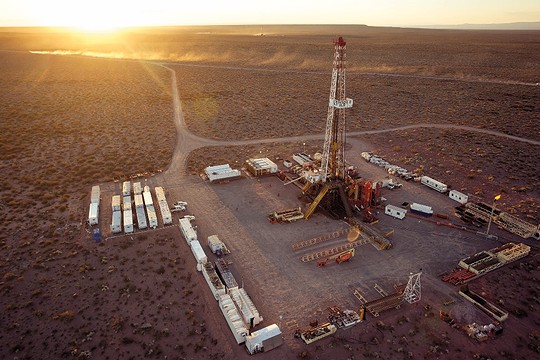
But thousands of feet beneath Patagonia lies Vaca Muerta, which translates to "dead cow" in Spanish.
It’s a massive shale formation holding the world's fourth-largest shale oil reserves and second-largest shale gas reserves.
The deposits aren't new. Argentina has known about Vaca Muerta for decades.
What’s new is the country's growing ability to extract oil and gas from the ground and sell it to the world.
 Source: Government of Argentina
Production is soaring. Pipelines are going up. Billions of dollars of investment are pouring in. And some of the world's biggest energy companies are taking notice.
Meanwhile, disruptions to global oil flow amid the Iran war have reminded the world how much of its energy supply comes from a politically volatile region.
That makes new sources of oil and natural gas outside the Middle East increasingly valuable.
Argentina has plenty of both.
The boom is already creating opportunities for oil producers, drillers, and the companies building the infrastructure to support them.
Some of those companies trade right here in the U.S. And as Vaca Muerta grows, there could be plenty more winners to come.
Black Gold in the Land of Dead Cows
Vaca Muerta stretches across a large section of western Argentina, centered in Neuquén Province.
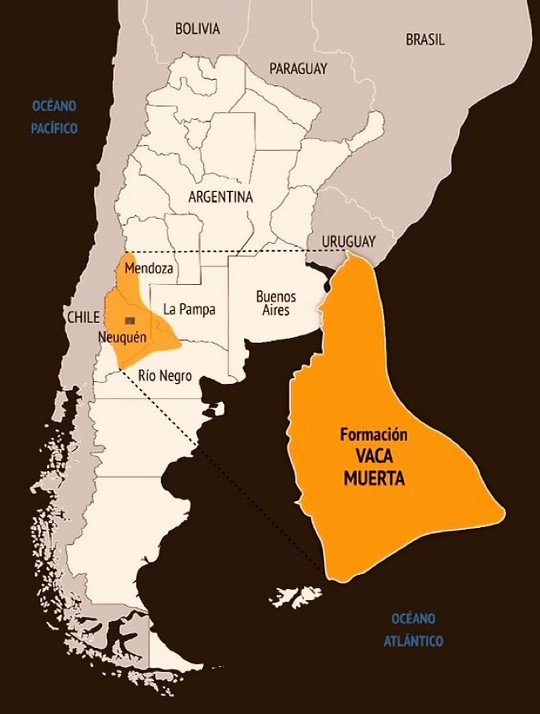 Source: Government of Argentina
Argentina now produces more than 850,000 barrels of oil per day, up from roughly 500,000 a decade ago.
This year, crude oil even overtook soy flour as the country's top export for the first time. Activity underground is accelerating, too.
Vaca Muerta recorded nearly 15,000 hydraulic fracturing stages during the first half of 2026, including a monthly record in June.
The boom is changing life above ground as well.
Añelo, the small town at the heart of Vaca Muerta, has doubled its population in two years.
Hotels, apartment buildings, restaurants, and truck dealerships are popping up across what was recently empty desert.
Workers are arriving from across Argentina in search of jobs. This is what the early stages of a resource boom can look like.
But Vaca Muerta could matter far beyond Patagonia…
Argentina has spent the past several decades trapped in a cycle of economic crises. Energy could provide something it badly needs: dollars.
A decade ago, Argentina ran a multibillion-dollar energy trade deficit. Vaca Muerta has helped turn that into a surplus.
Rising exports could bring billions more foreign dollars into the economy in the years ahead.
President Javier Milei's government has tried to speed that process through tax incentives, deregulation, and rules designed to encourage large investments.
But this story didn't begin with Milei, and its success won't depend on one politician.
Several Argentine governments helped lay the groundwork for Vaca Muerta.
What's more important is that infrastructure and private capital are finally catching up with the geology.
One example is the Vaca Muerta Sur pipeline now under development.
The roughly 270-mile project is designed to eventually carry up to 700,000 barrels per day toward the Atlantic coast.
Argentina is also pursuing huge liquefied natural gas projects that could eventually open global markets to its enormous gas reserves.
That brings me to the investment angle…
How to Play the Patagonian “Gold Rush”
Companies sitting on the resource could be some of the biggest beneficiaries of Argentina’s energy boom.
State-controlled YPF (YPF) is Vaca Muerta's dominant operator.
Its shale oil production jumped 47% year over year during the second quarter to 213,000 barrels per day.
YPF plans to invest roughly $6.2 billion this year as it expands production.
Vista Energy (VIST) is another early leader, and one of the more direct publicly traded ways to gain exposure to the boom.
The company has a large position in the heart of Vaca Muerta and has been rapidly expanding production.
Then there's Pampa Energía (PAM).
Its total oil and gas production recently reached a company record, helped by rapid growth from its Rincón de Aranda shale project.
Those are some of the obvious names. But they won't necessarily be the biggest winners.
Remember what happened during America's gold rushes.
Fortunes weren't made only by the people who found gold. Businesses supplying picks, shovels, transportation, and other essentials prospered, too.
The same principle could apply here.
Halliburton (HAL) and SLB (SLB) are already major providers of the hydraulic fracturing services needed to unlock Vaca Muerta.
Tenaris (TS), meanwhile, supplies the pipes and services needed to drill and complete wells.
Pipeline operators, LNG developers, and other infrastructure companies could also benefit as production grows.
And new money continues to arrive.
American shale pioneer Harold Hamm and commodities trader Mercuria recently announced plans to invest about $4 billion over five years to expand production in Argentina.
In other words, the ecosystem around Vaca Muerta may only be getting started.
Vaca Muerta may not transform Argentina's economy by itself. But it could deliver a badly needed shot in the arm.
And if this trend continues, some of tomorrow's most interesting energy investments could be taking shape right now in the Argentine desert.
The story is still being written.
I'll be watching closely to see who the real winners are, and making sure you hear about them as they emerge.
Sign Up Today for Free!
Truth & Trends brings you market insights and trading tips you won't find anywhere else — unless you have your own personal hedge fund manager on speed dial...
Meet Enrique Abeyta, one of Wall Street’s most successful hedge fund managers. With years of experience managing billions of dollars and navigating the highs and lows of the financial markets, Enrique delivers unparalleled market insights straight to your inbox.
In Truth & Trends, Enrique shares his personal take on what’s moving the markets, revealing strategies that made him a star in the world of high finance. Whether it’s uncovering the next big trend or breaking down the hottest stocks and sectors, Enrique’s insights are sharp, actionable, and proven to work in any market condition.
Inside these daily updates, you’ll gain:
- 50 years of combined trading wisdom distilled into actionable insights.
- A behind-the-scenes look at how Wall Street pros spot opportunities and avoid pitfalls.
- Exclusive strategies that Enrique personally uses to deliver exceptional returns — no fluff, just results.
To have Truth & Trends sent directly to your inbox every weekday, just enter your email address below to join this exclusive community of informed traders.
Don’t miss your chance to learn from one of the best in the business.
Sign up now and take your trading game to the next level.

Whale Watching
Posted August 26, 2026
By Nick Riso

Countdown to the OpenAI-pocalypse
Posted August 24, 2026
By Enrique Abeyta

The 0DTE Club Just Got Bigger
Posted August 21, 2026
By Nick Riso

Want to Invest Like a Venture Capitalist? Now You Can
Posted August 20, 2026
By Enrique Abeyta

3 Stocks of Tomorrow Nobody's Talking About Today
Posted August 17, 2026
By Enrique Abeyta