Posted April 15, 2025

By Ian Culley
Always Buy Death
You can add yet another reason to be nervous about the market right now…
The S&P 500 just posted a “Death Cross.”
To put it simply, that’s when a stock’s 50-day moving average (the average price over the trailing fifty trading days) crosses below its 200-day moving average (the average price over the trailing two hundred trading days).
In common parlance, the market’s ready to move lower.
And if I didn’t already see it on my screen, it’s buzzing all over the news and social media feeds. I’m sure it’s convincing many armchair chart-watchers to get out of stocks…
But don’t move quite yet.
Today, I want to talk to you about why this viral bearish “indicator” is actually bullish.
If this cycle follows a similar path to 2020 and 2022, which I believe it will, you’ll see higher prices through the end of next week.
The herd has it all wrong. And we’ll use that to our advantage.
You’ll see how the pattern works, why so many folks are worried about it, and how the market has historically performed when this indicator has triggered in the past.
While everyone else is selling the fear, you should be buying.
Here’s why…
Embracing the “Death Cross”
You can think of a “death cross” as the next step toward bear market territory following an initial trendline break.
Check out the S&P 500 registering its first death cross (highlighted in yellow) since March 2022…
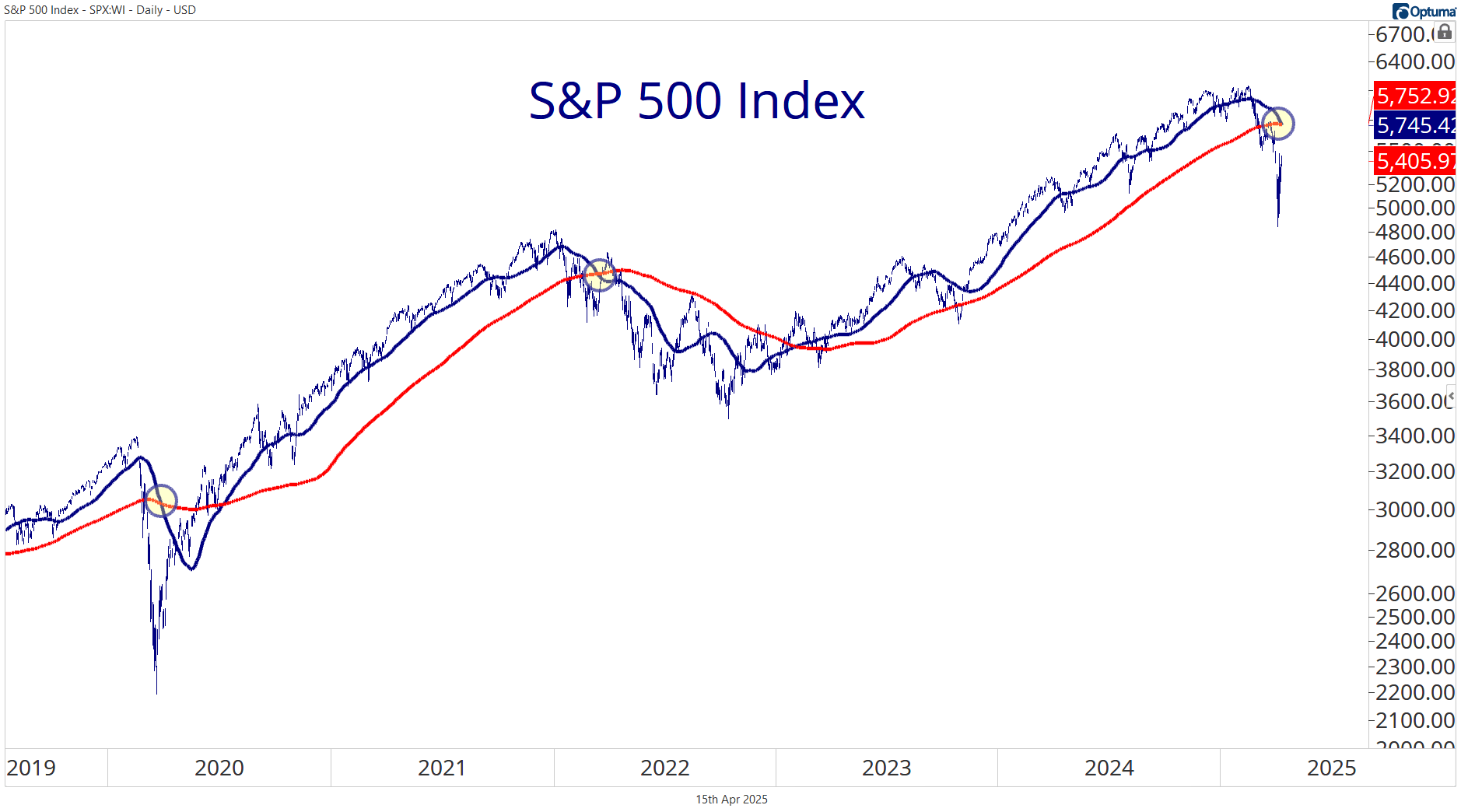
You can think of it as confirmation that the bull market is dead and a new bear market is just around the corner. That’s why you’ll find most investors in a tizzy.
Here’s the catch: The death cross signal lags.
By the time the intermediate term average slices through the longer term average, prices have usually carved out a near-term low. That was the case during the COVID pandemic and the 2022 bear markets.
In 2022, the market went on to rally for two weeks before peaking in late March, while the S&P 500 never looked back following the 2020 signal.
To be clear, I don’t anticipate another V-bottom rally this time around. Uncertainty looms large. And tariffs are no joke.
But remember, price doesn’t move in a straight line, regardless of sellers’ attempts to prove otherwise over the past few weeks.
This simple market truth, coupled with the death cross’s lagging nature, suggests a near-term bounce ahead.
Buy the Blood
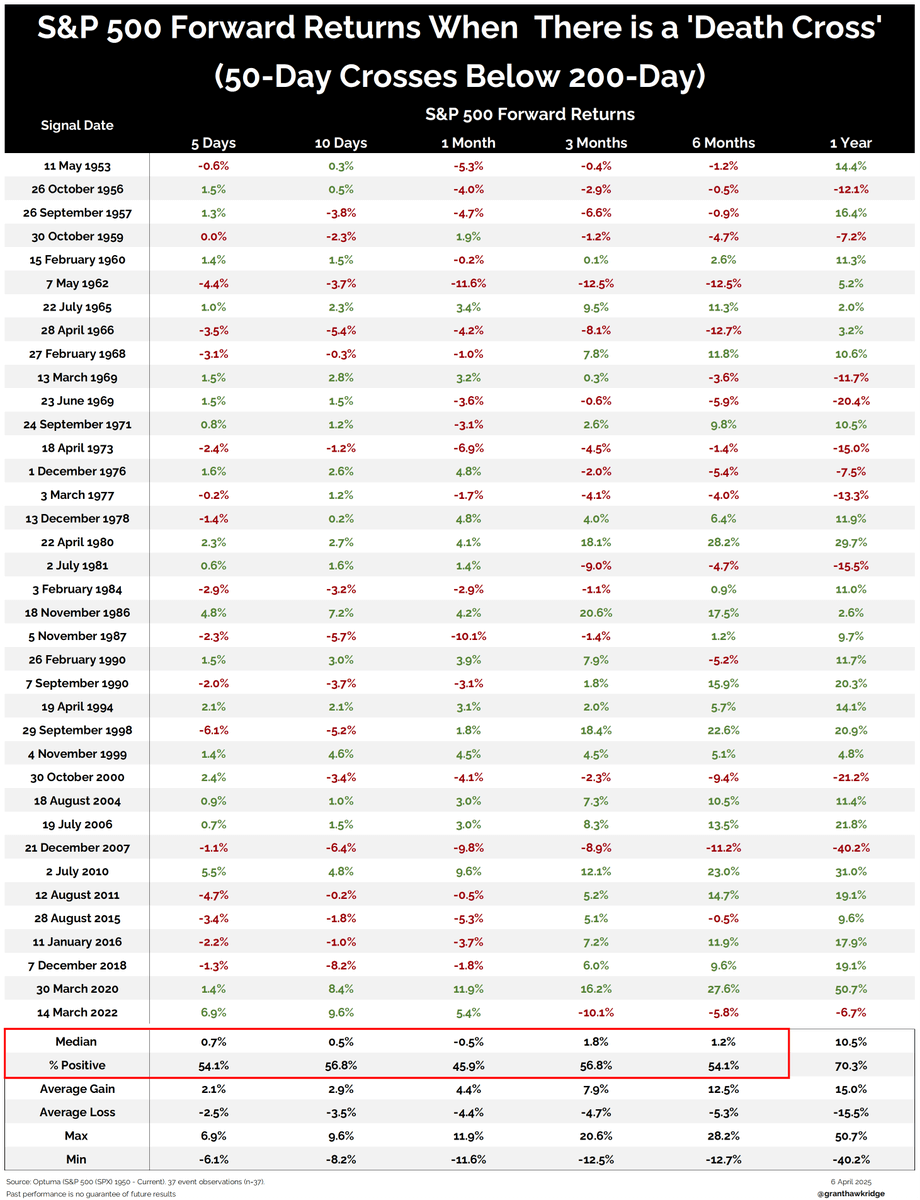
My former colleague and friend Grant Hawkridge ran the numbers leading up to yesterday’s bearish signal (the S&P 500’s 38th death cross since 1953)…
Source: @Granthawkridge
At a glance, the returns aren’t overwhelmingly bullish after the 50-day crosses below the 200-day moving average. The odds of the market registering a positive return in the next 5 to 10 days are slightly greater than a coin toss.
Upon closer inspection, a pattern emerges…
Alternating clusters of positive and negative returns dominate the past 25 years. Notice the 5- and 10-day performances from 1999-2006 are predominantly green, while the post-GFC years of 2011-2018 are all red.
The patterns are likely a result of one or two dominant fundamental factors that defined those market regimes. The regime we’re navigating now began in 2020.
If today’s market tracks the 2020 and 2022 cycles, higher prices will dot the charts through the end of next week.
I understand if you’re nervous. The current volatility demands vigilance, flexibility, and discipline. The market’s moving fast, and another steep sell will likely hit before all this tariff nonsense is over.
In the meantime, I prefer to fade the news, fade the herd, and fade the “Death Cross.”
Now’s not the time to reach for a Cathie Wood special, though. Instead, find the quality names that have been beaten down over the past month. They’ll offer the best opportunities.
Are you buying a snapback rally?
If not, why? What am I missing?
Email AskGreg@paradigmpressgroup.com to send me your answer. I’d love to hear from you.
Sign Up Today for Free!
Truth & Trends brings you market insights and trading tips you won't find anywhere else — unless you have your own personal hedge fund manager on speed dial...
Meet Enrique Abeyta, one of Wall Street’s most successful hedge fund managers. With years of experience managing billions of dollars and navigating the highs and lows of the financial markets, Enrique delivers unparalleled market insights straight to your inbox.
In Truth & Trends, Enrique shares his personal take on what’s moving the markets, revealing strategies that made him a star in the world of high finance. Whether it’s uncovering the next big trend or breaking down the hottest stocks and sectors, Enrique’s insights are sharp, actionable, and proven to work in any market condition.
Inside these daily updates, you’ll gain:
- 50 years of combined trading wisdom distilled into actionable insights.
- A behind-the-scenes look at how Wall Street pros spot opportunities and avoid pitfalls.
- Exclusive strategies that Enrique personally uses to deliver exceptional returns — no fluff, just results.
To have Truth & Trends sent directly to your inbox every weekday, just enter your email address below to join this exclusive community of informed traders.
Don’t miss your chance to learn from one of the best in the business.
Sign up now and take your trading game to the next level.

You’re Not Crazy. This Market Action Stinks!
Posted October 23, 2026
By Greg Guenthner

The Tesla-SpaceX Merger: 3 Stocks That Could Win Big
Posted October 22, 2026
By Enrique Abeyta

The Hidden Cost of Being Right
Posted October 19, 2026
By Enrique Abeyta

In Praise of Greed
Posted October 16, 2026
By Greg Guenthner

The AI House of Cards II: First One to Fall
Posted October 15, 2026
By Enrique Abeyta