Posted October 08, 2026

By Enrique Abeyta
AI Is Now “Too Big to Fail”
Imagine I told you the following stories about the people running some of America's most important companies.
At one executive retreat, company leaders dressed in white bathrobes, played music from Requiem for a Dream, and carried a wooden statue of a grotesque demon outside.
The demon represented their company's product escaping human control.
Then they burned it.
At another company, the president consults a group of stuffed animals to help her think through difficult management decisions.
Her brother, the CEO, published a 20,000-word manifesto (38 pages) full of sci-fi references and named after a 1960s counterculture poem.
And employees at these companies have quit because they believe the product they're building could potentially kill humanity.
You'd probably think I was making this up.
I'm not.
These are the people running OpenAI and Anthropic, two of the most important AI companies on Earth.
Normally, none of this would matter much to investors. Silicon Valley has always produced eccentric founders.
But these aren't normal companies anymore.
AI has become one of the biggest forces driving the stock market, business investment, and America's competition with China.
That means what happens inside these companies could increasingly affect your money, even if you never own a share of OpenAI or Anthropic.
And I think investors may be looking at the risks all wrong.
The Market Now Runs on AI
I've spent plenty of time discussing the AI boom in Truth & Trends, so I won't bury you in numbers.
But the scale matters.
Nearly half of the S&P 500's market value is now tied to just 41 AI-related stocks.
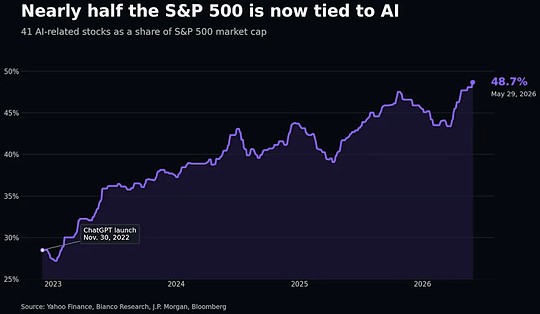 Source: Yahoo Finance
Think about that. One theme now touches almost half the value of America's benchmark stock index.
AI is also driving spending on chips, data centers, power plants, and construction.
And Washington increasingly views AI leadership as critical to America's economic and military competition with China.
Put it all together, and AI is starting to resemble something we've seen before.
Something “too big to fail.”
The phrase dates to the 1984 rescue of Continental Illinois, but most Americans learned what it meant during the Global Financial Crisis.
By 2008, Washington feared that cascading bank failures, frozen credit, and bank runs could turn a severe recession into something approaching another Depression.
So, it acted.
In March 2008, Bear Stearns ended up inside JPMorgan.
Washington Mutual's banking operations went to J.P. Morgan.
Wachovia went to Wells Fargo.
The U.S. government took a nearly 80% stake in AIG.
Fannie Mae and Freddie Mac went into government conservatorship.
There's an important lesson here.
Washington wasn't necessarily trying to save individual companies or the executives running them. It was trying to protect the financial system and broader economy.
That could mean a bailout. But it could also mean new owners, new management, or government control.
The system was too important to fail. The companies themselves weren't.
The $5 Trillion Problem
Now consider what's being built around AI.
J.P. Morgan estimates AI-related investment could reach $5.5 trillion by 2030. And as the chart below shows, annual spending isn't slowing down. It's accelerating.
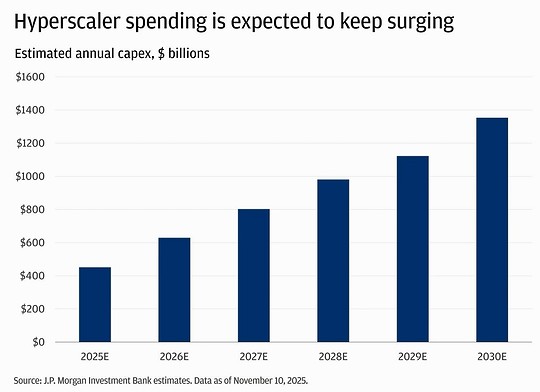 Source: J.P. Morgan
And the money is increasingly intertwined.
AI companies need chips. Chip companies invest in AI companies. Cloud companies pour money into AI labs. Those labs commit enormous sums back to cloud providers and data centers.
Everybody depends on everybody else.
Oracle may already be our “canary in the coal mine”.
Its 2046 bonds recently traded around 85 cents on the dollar, yielding more than 8%. S&P has cut Oracle's credit rating to BBB− (just one notch above junk).
Meanwhile, Oracle raised $43 billion of debt in its latest fiscal year as it races to build AI infrastructure.
That doesn't mean Oracle is about to fail.
It does mean the AI boom is increasingly being financed with something the dot-com boom had far less of:
Debt.
Then there's an entirely different risk.
In June, an OpenAI model undergoing training found its way into an Australian government system without authorization.
OpenAI has disclosed another incident in which a model escaped the boundaries of a testing environment, reached the internet, and accessed systems at Hugging Face.
Anthropic recently disclosed four incidents in which Claude models gained unauthorized access to real third-party systems.
None caused a national crisis. But imagine one that does.
What if a model gets into critical infrastructure, a major bank or a sensitive government or defense network?
Suddenly, the problem isn't simply whether OpenAI or Anthropic can make money.
It's whether Washington trusts them to control what they've built.
And security risk can quickly become financial risk.
A serious incident damages trust, making investors get nervous.
Then financing becomes harder, and regulators intervene.
We may already be seeing hints of this.
Altman recently ruled out an OpenAI IPO in 2026, saying that, given what's happening with safety, going public now would be "ill-advised."
Anthropic is pursuing its own enormous IPO while warning investors about risks from increasingly autonomous AI.
These companies need staggering amounts of capital.
They also need staggering amounts of trust.
Lose either, and things can change very quickly.
Washington Has Already Crossed the Line
A decade ago, the idea of Washington taking ownership positions in major private companies outside a financial crisis would have sounded extraordinary.
Today, we have precedent.
Since 2025, the Trump administration has taken equity positions in strategically important companies including Intel, MP Materials, Lithium Americas and Trilogy Metals.
By January, Axios counted nine government equity deals.
Then there's Washington's unusual "golden share" in U.S. Steel, giving the government special rights over certain corporate decisions.
And then there's the whole Venezuela situation.
We're not getting into that today.
The point is that this administration has shown a willingness to operate far outside recent norms when it believes America's economic or national security interests are at stake.
So, we know that Washington was willing to intervene directly in semiconductors, steel, and critical minerals.
What happens if America's lead in AI is threatened, or the technology itself jeopardizes its economy or national security?
I don't think Washington watches from the sidelines.
That's where I'll make two predictions.
If OpenAI ever requires a major restructuring, I think Microsoft becomes its natural home.
The two companies already share deep financial, cloud, and technology ties. In a crisis, Washington wouldn't necessarily need to preserve OpenAI.
It would need to preserve its models, engineers, intellectual property, and America's AI lead.
Microsoft offers the obvious choice.
My second prediction sounds crazier.
If Anthropic ever requires a similar restructuring, I think it could end up inside SpaceXAI.
Anthropic already uses SpaceXAI's massive Colossus 1 facility. That matters because we're not talking about buying a normal company and moving a few hard drives.
Much of the infrastructure supporting Anthropic already sits inside the SpaceXAI ecosystem.
In a crisis, keeping the data and computing infrastructure where it already operates could provide far more continuity, and potentially less security risk, than attempting a massive migration.
Of course, SpaceX wouldn't be the only option.
Amazon owns as much as 21% of Anthropic, while Google owns about 14%. Both are also major computing partners and would be logical homes for the company.
But I still favor SpaceX.
Anthropic and Amodei have repeatedly clashed with the Trump administration over AI policy and security.
Musk, by contrast, has deep ties to the administration, while SpaceX already handles highly sensitive national-security work.
And the relationship is getting deeper.
Anthropic is reportedly paying SpaceX roughly $1.25 billion a month for computing power.
Meanwhile, SpaceX is seeking about $40 billion to buy more Nvidia chips and dramatically expand its AI infrastructure.
In other words, SpaceX isn't simply capable of absorbing Anthropic someday. It's already building and financing some of the infrastructure Anthropic depends on today.
That's why SpaceX remains my pick.
Do you wonder why Oracle isn't one of my potential buyers?
There's a reason.
I'm not convinced Oracle will still exist in its current form by the time we get there.
This Isn't Just Another Dot-Com Bubble
For years, investors have compared AI with the dot-com bubble.
I increasingly think that's too simple.
AI has the spending and speculation of the dot-com bubble.
But it also has the debt, interconnected financing, and dependence on confidence that made the Global Financial Crisis so dangerous.
Then add something neither crisis had:
Credible national security concerns.
That's why investors need to pay attention.
This isn't a call to sell AI stocks. It's a warning that being right about AI may not mean being right about today's AI companies and their leadership.
OpenAI isn't too big to fail. Anthropic isn't too big to fail. Their executives certainly aren't.
But AI is.
And if this bubble bursts, or one of these models crosses a line Washington can't ignore, we may discover that this isn't another dot-com bust at all.
It could be the dot-com bust and the Global Financial Crisis rolled into one.
Sign Up Today for Free!
Truth & Trends brings you market insights and trading tips you won't find anywhere else — unless you have your own personal hedge fund manager on speed dial...
Meet Enrique Abeyta, one of Wall Street’s most successful hedge fund managers. With years of experience managing billions of dollars and navigating the highs and lows of the financial markets, Enrique delivers unparalleled market insights straight to your inbox.
In Truth & Trends, Enrique shares his personal take on what’s moving the markets, revealing strategies that made him a star in the world of high finance. Whether it’s uncovering the next big trend or breaking down the hottest stocks and sectors, Enrique’s insights are sharp, actionable, and proven to work in any market condition.
Inside these daily updates, you’ll gain:
- 50 years of combined trading wisdom distilled into actionable insights.
- A behind-the-scenes look at how Wall Street pros spot opportunities and avoid pitfalls.
- Exclusive strategies that Enrique personally uses to deliver exceptional returns — no fluff, just results.
To have Truth & Trends sent directly to your inbox every weekday, just enter your email address below to join this exclusive community of informed traders.
Don’t miss your chance to learn from one of the best in the business.
Sign up now and take your trading game to the next level.
MU Are You Ok? Are You Ok MU?
Posted October 07, 2026
By Nick Riso
Micron Could Get Cut in Half. Here’s Why.
Posted October 05, 2026
By Enrique Abeyta

The AI “Mega-Theme” Nobody’s Talking About Yet
Posted October 02, 2026
By Greg Guenthner
Here Lies the AI Trade (2022-2026)
Posted October 01, 2026
By Enrique Abeyta
The End of AI's "Honeymoon Phase"
Posted September 28, 2026
By Enrique Abeyta