
Posted October 26, 2026

By Enrique Abeyta
6 Stages of a Credit Bubble: From Mania to Meltdown
I've spent more than three decades on Wall Street.
In that time, I’ve made money in bull markets, bear markets, and even financial crises.
One thing I've learned is that you don't have to predict the next crash to navigate it successfully.
You need to recognize the risks and be prepared.
That's why I've been studying financial bubbles, looking for lessons that might help us navigate today's AI boom.
Last week, I wrote to you about technology bubbles and some of the most notable examples in modern history.
This week, I want to turn your attention to something potentially even more dangerous — credit bubbles.
We're going to look at three examples, going all the way back to 1837. As you’ll see, the lessons are still relevant today.
But before we hop in the time machine, let’s talk about what a credit bubble is.
What Is a Credit Bubble?
Credit is borrowed money.
Consumers like you and me use credit to buy homes, businesses use it to expand, and investors use it to purchase stocks and other assets.
And that's a good thing. Borrowing helps fuel economic growth.
But problems arise when lenders get too comfortable extending credit and borrowers take on more debt than they can afford.
As asset prices rise, both sides grow more confident, fueling even more borrowing.
Eventually, the entire boom depends on one assumption: Tomorrow will be even better than today.
When that assumption breaks down, the consequences can spread far beyond the original borrowers, threatening banks, businesses, and sometimes the entire economy.
And while every credit bubble is different, history reveals striking similarities in how they develop and eventually burst.
Drawing on decades of economic research and financial history, we can identify six stages that often appear as credit bubbles develop and then collapse:
- Displacement: A new opportunity captures investors' attention, whether rising land prices, a booming industry, or a promising investment strategy.
- Credit Expansion: Lenders rush to finance it. Borrowing becomes easier, and rising asset prices encourage more lending.
- Euphoria and Leverage: Confidence turns into overconfidence. Investors borrow heavily, convinced prices will keep rising. Lenders overlook mounting risks.
- Distress and Margin Calls: Prices fall, or financing tightens. Borrowers must find more cash, repay loans, or sell assets.
- Contagion: Losses spread to lenders and businesses. Fear grows, and even healthy companies struggle to secure financing.
- The Crash: Defaults, forced selling, and collapsing confidence turn financial trouble into a broader crisis.
These stages can overlap, and sometimes the worst outcome is avoided.
The most notable example in our lifetimes was the 2008 Global Financial Crisis (GFC), when a debt-fueled housing bubble collapsed and nearly brought down the global financial system.
The GFC deserves its own deep dive. But that’s not one of the crises I want to talk about today.
The Panic of 1837: America's Land Bubble
In the 1830s, Americans believed buying land out West was a ticket to riches.
The country was expanding rapidly. Land values were soaring. And banks were eager to lend money.
Speculators borrowed heavily to buy property, often with little interest in developing it.
Why bother? As long as prices kept rising, they could sell the land to someone else for a profit.
Banks issued more loans, driving prices higher and attracting more speculators.
But cracks were forming.
President Andrew Jackson had helped dismantle the Second Bank of the United States, leaving the country without a comparable national banking institution.
Then, in 1836, he ordered that most federal land purchases be paid for in gold or silver rather than paper money.
That pressured banks' reserves. Meanwhile, tighter lending conditions in Britain and falling cotton prices made it harder for American borrowers to repay debts.
By May 1837, New York banks had stopped redeeming paper money for gold and silver.
As panic spread, banks stopped lending and businesses began to fail, plunging the economy into a severe downturn.
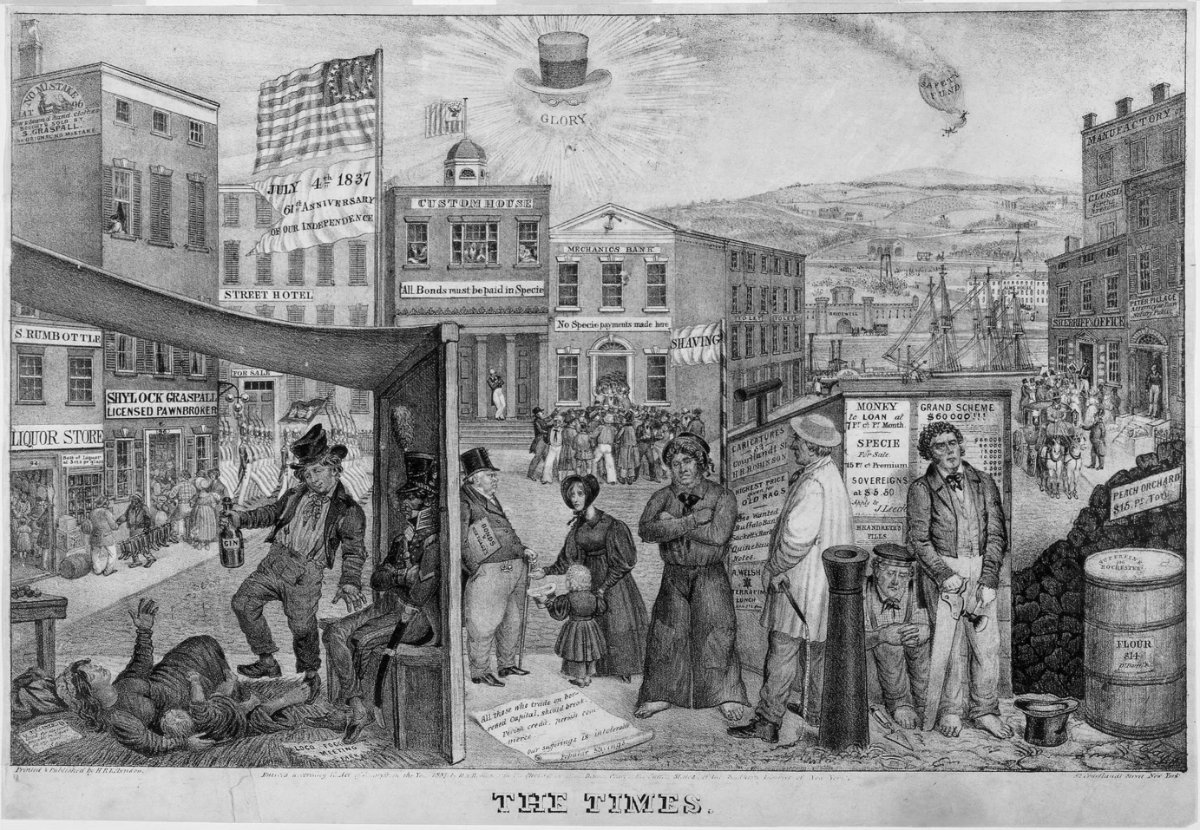 Archival illustration depicting the Panic of 1837. Source: Wikipedia
The speculation started with land. But the damage spread through the banking system.
The lesson: Credit bubbles don't require revolutionary technology. They need an asset people believe will keep rising in value, and lenders willing to finance that belief.
The Great Crash of 1929: How the Great Depression Began
Ever wonder what triggered the Great Depression?
It began with one of the most spectacular stock market crashes in history.
In October 1929, Wall Street suffered a series of devastating selloffs that wiped out billions of dollars in wealth.
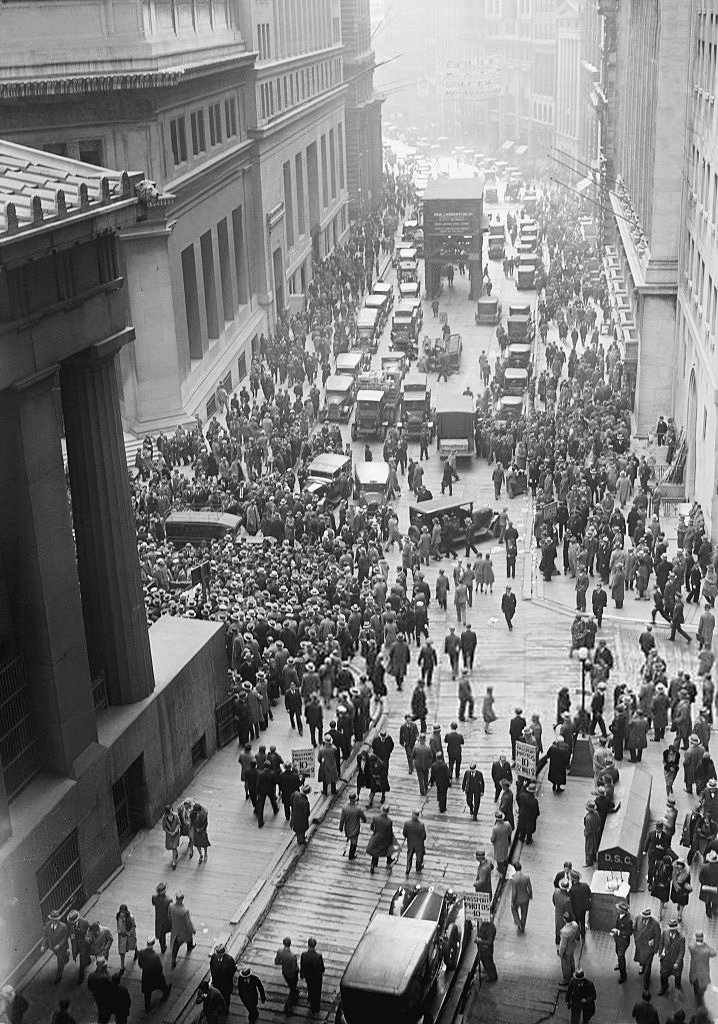 A crowd gathers on Wall Street after the 1929 Crash. Source: Wikipedia
But the disaster's roots had been growing for years.
During the Roaring Twenties, Americans became convinced that stocks were an easy path to riches.
And thanks to the growing popularity of buying on margin, investors didn't need enough money to buy shares outright.
For example, at times during the 1920s, buyers could put down just 10% and borrow the remaining 90%.
That meant $1,000 could control $10,000 worth of stock.
A 20% gain would turn that $1,000 into $3,000, before borrowing costs. But a 10% decline could wipe out the investor's entire stake.
By September 1929, loans to stockbrokers had reached roughly $8.5 billion.
As stocks fell, lenders demanded more cash. Investors sold shares to repay loans, pushing prices lower and triggering more forced selling.
By July 1932, the Dow had lost nearly 90% of its value from its 1929 peak.
Dow Jones Industrial Average (1929–1932)
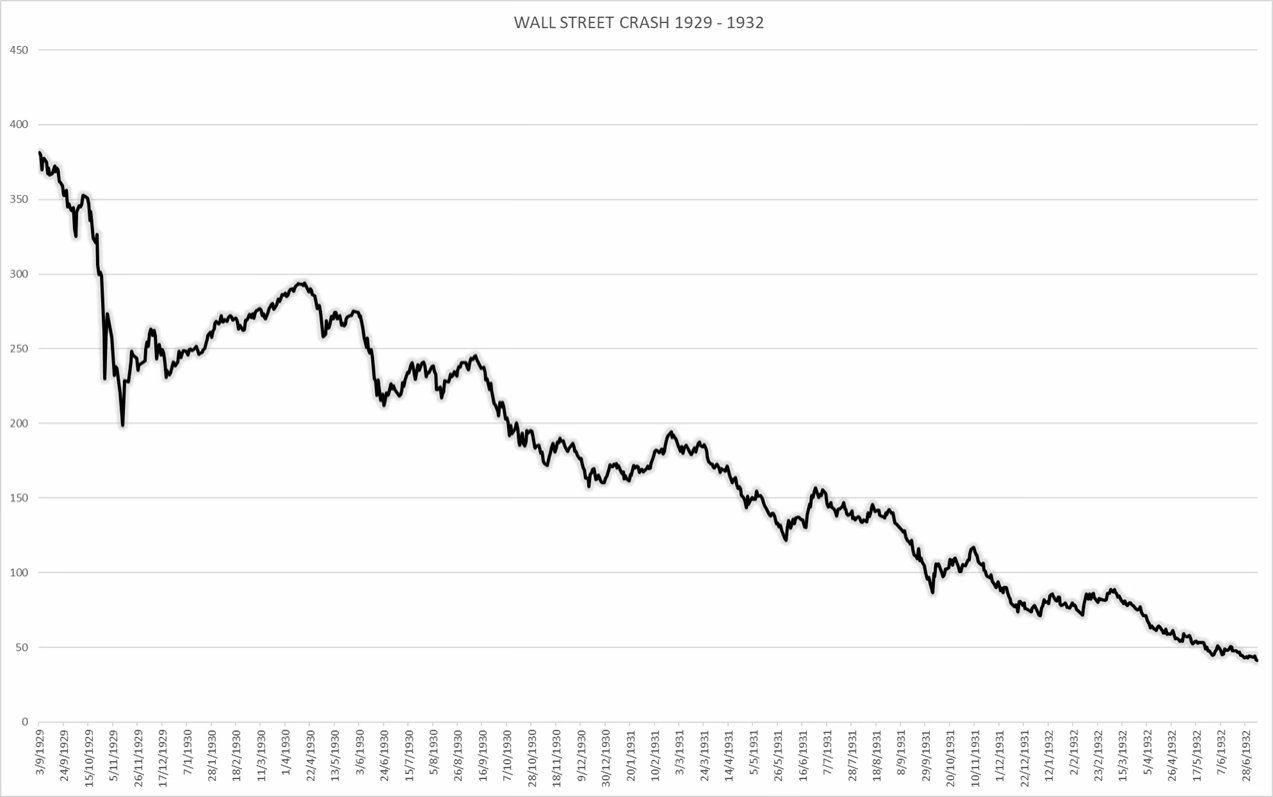 Source: Wikipedia
The stock crash wasn't the sole cause of the Great Depression.
Banking panics from 1930 through 1933, falling spending, and policy mistakes deepened the disaster.
But excessive borrowing helped turn a roaring bull market into a financial trap.
The lesson: Debt magnifies gains when prices rise. When prices fall, leverage can create a vicious cycle of forced selling and mounting losses.
The 1998 LTCM Crisis: Disaster Averted
Our final example ends differently.
In the 1990s, a hedge fund called Long-Term Capital Management (LTCM) employed some of Wall Street's brightest minds, including two Nobel Prize-winning economists.
Its strategy used mathematical models to profit from tiny price differences between financial assets.
The strategy delivered impressive returns, but exploiting those small differences required enormous borrowing.
By the end of 1997, LTCM had borrowed roughly $30 for every $1 of its own capital.
Then, in August 1998, Russia devalued its currency and defaulted on domestic government debt.
Investors fled risky assets, and markets moved sharply against LTCM's trades.
The fund lost approximately 44% in August alone.
As its capital evaporated, its assets reached roughly 55 times its remaining capital.
The chart below shows what happened to a hypothetical $1,000 investment in LTCM compared with the Dow Jones and U.S. Treasuries.
After years of spectacular gains, LTCM's value collapsed in 1998, wiping out nearly all those profits.
LTCM vs. Dow Jones and U.S. Treasuries (1994–1998)
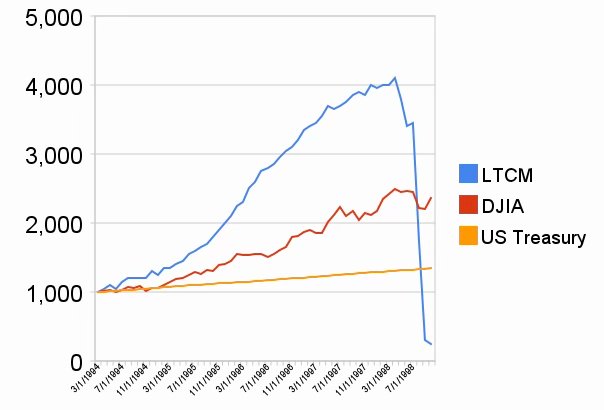 Source: Wikipedia
Because LTCM had extensive dealings with major banks, a sudden collapse threatened widespread forced selling and losses throughout financial markets.
On September 23, 14 financial firms agreed to a roughly $3.6 billion private rescue coordinated by the New York Fed. The Fed itself provided no money.
LTCM's investors suffered enormous losses.
But the intervention let its positions unwind gradually rather than dump into already stressed markets.
A wider financial disaster was avoided.
The lesson: Even when dangerous leverage threatens the financial system, decisive action can sometimes contain the damage.
Could AI Become a Credit Bubble?
Now, let's return to today's AI boom.
Tech giants are spending unprecedented sums on data centers, chips, and electricity.
This massive capital expenditure (or CapEx) is pressuring cash flow and driving more borrowing.
And as more companies seek financing, borrowing costs can rise, making future investments more expensive.
Meanwhile, circular financing also exists.
For example, a chipmaker might invest in an AI company that then uses that money to buy its chips.
Such arrangements can fuel growth. But they also create financial dependence between companies, increasing the risk that trouble at one spreads to others.
Then there's off-balance-sheet financing.
Companies can make financial commitments that don't immediately appear as liabilities on their balance sheets.
For example, a hyperscaler might agree to lease a data center when it's completed.
The developer can use that commitment to obtain financing. At the same time, the hyperscaler generally won't record the lease liability until the lease begins.
Sound familiar?
Off-balance-sheet financing played a major role in the 2008 GFC.
Banks used separate entities to hold mortgage-related investments. When those investments soured, some risks came roaring back onto their balance sheets.
Today's arrangements are different.
But the lesson remains: Financial obligations don't become harmless simply because they're off the balance sheet.
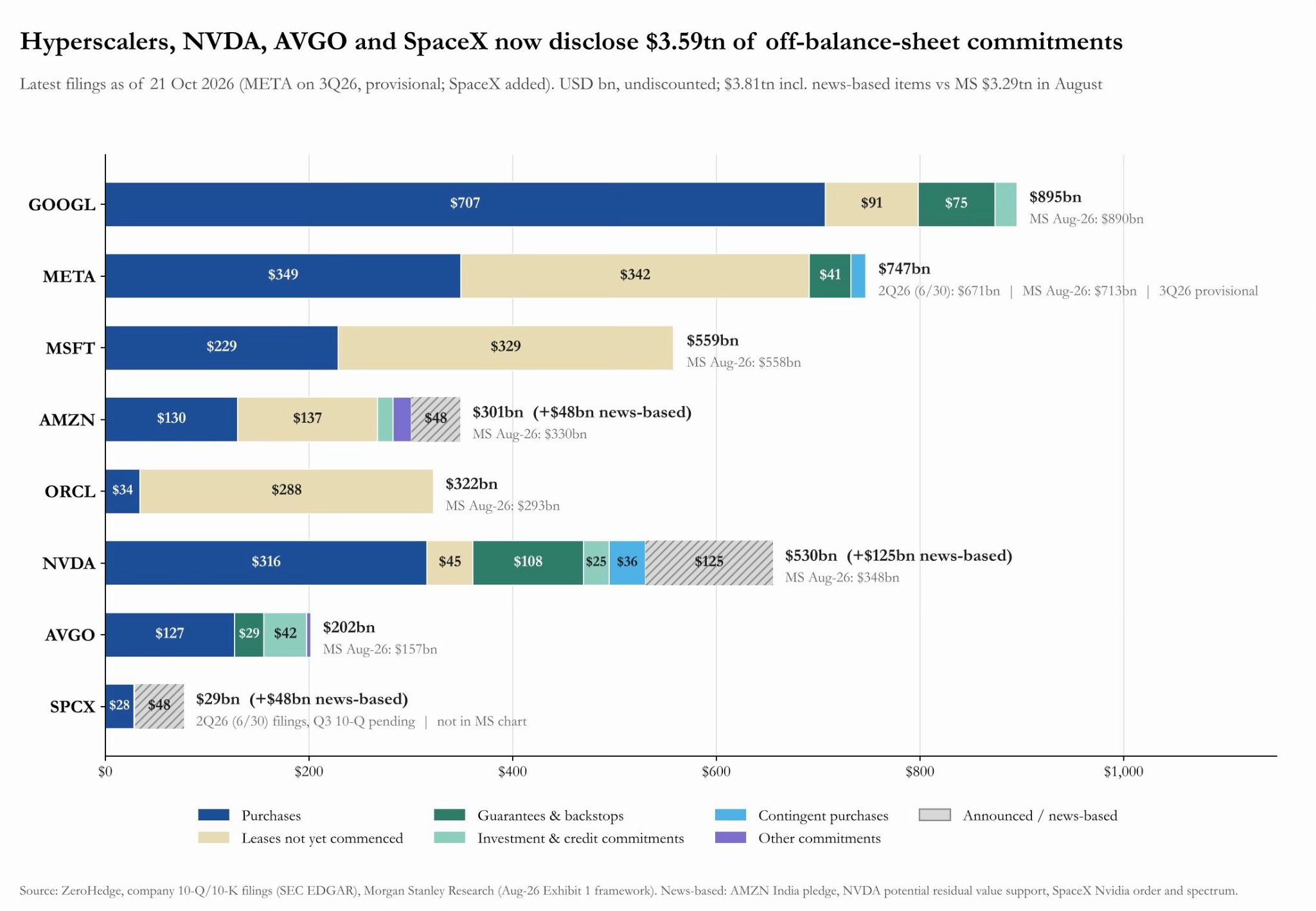
A recent analysis on X by ZeroHedge estimates roughly $3.6 trillion in off-balance-sheet commitments across eight major AI-related companies.
 Source: ZeroHedge on X
These include future purchases, leases, guarantees, and other obligations. Not all are debt or directly tied to AI, and many stretch years into the future.
Still, the scale is extraordinary.
And what happens if AI demand grows more slowly than expected?
If AI demand falls short of expectations, developers could struggle to repay their loans, potentially causing lenders to cut off financing and spreading trouble throughout the industry.
That's how a technology bubble could turn into a credit bubble.
To be clear, I'm not predicting another 2008.
But I am closely watching whether AI revenues and cash flow can support these enormous financial commitments.
Are We Watching a Slow-Motion Crash?
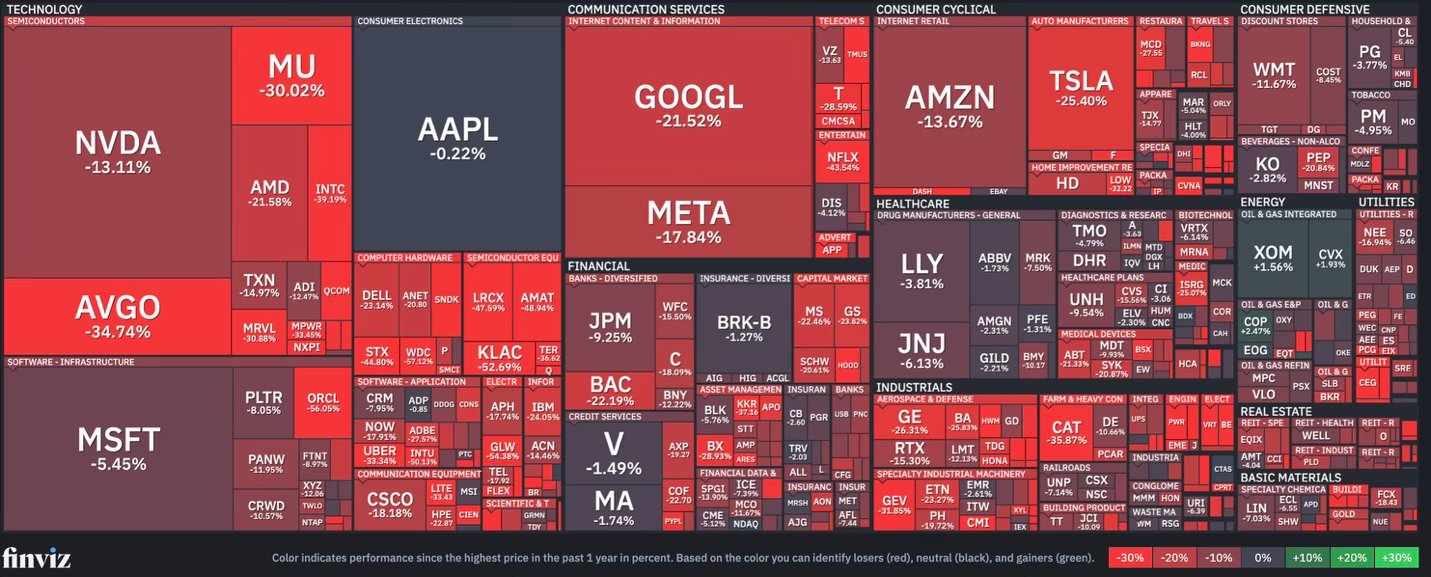
Cracks are already appearing in the stock market.
As of Oct. 22, nearly 60% of S&P 500 stocks were at least 10% below their highs, while roughly one-third had fallen more than 20%.
The S&P 500's Hidden Decline: Stocks Below Their 52-Week Highs
 Source: FinViz
Yet the overall index remained close to its record.
So, are we watching a slow-motion car crash, with everyone seeing the danger but unable to stop it?
Or could these market corrections, along with greater scrutiny of AI spending and borrowing, help prevent a much bigger crisis?
The crises of 1837 and 1929 show just how devastating credit bubbles can become.
But LTCM reminds us that the worst-case scenario isn't inevitable.
I'm not a bear, and I'm certainly not hoping for another crash.
But after more than 30 years on Wall Street, I know that understanding the warning signs can help investors protect their wealth, avoid costly mistakes, and find opportunities when others are panicking.
That's why we're studying these bubbles.
In the end, history tells us what can go wrong, but not what must happen next.
Sign Up Today for Free!
Truth & Trends brings you market insights and trading tips you won't find anywhere else — unless you have your own personal hedge fund manager on speed dial...
Meet Enrique Abeyta, one of Wall Street’s most successful hedge fund managers. With years of experience managing billions of dollars and navigating the highs and lows of the financial markets, Enrique delivers unparalleled market insights straight to your inbox.
In Truth & Trends, Enrique shares his personal take on what’s moving the markets, revealing strategies that made him a star in the world of high finance. Whether it’s uncovering the next big trend or breaking down the hottest stocks and sectors, Enrique’s insights are sharp, actionable, and proven to work in any market condition.
Inside these daily updates, you’ll gain:
- 50 years of combined trading wisdom distilled into actionable insights.
- A behind-the-scenes look at how Wall Street pros spot opportunities and avoid pitfalls.
- Exclusive strategies that Enrique personally uses to deliver exceptional returns — no fluff, just results.
To have Truth & Trends sent directly to your inbox every weekday, just enter your email address below to join this exclusive community of informed traders.
Don’t miss your chance to learn from one of the best in the business.
Sign up now and take your trading game to the next level.
You’re Not Crazy. This Market Action Stinks!
Posted October 23, 2026
By Greg Guenthner
The Tesla-SpaceX Merger: 3 Stocks That Could Win Big
Posted October 22, 2026
By Enrique Abeyta

The Hidden Cost of Being Right
Posted October 19, 2026
By Enrique Abeyta

In Praise of Greed
Posted October 16, 2026
By Greg Guenthner

The AI House of Cards II: First One to Fall
Posted October 15, 2026
By Enrique Abeyta