Posted September 07, 2026

By Enrique Abeyta
6 Horsemen of the OpenAI-pocalypse
A few weeks ago, I introduced you to my “OpenAI-pocalypse” theory.
OpenAI sits near the center of an enormous web of spending on chips, data centers, power, and other infrastructure.
If its growth slows or its massive spending plans change, the effects could spread to companies many investors already own.
I didn’t expect to revisit the topic this soon. But a lot has happened in just the past two weeks.
And now, I’m more concerned about OpenAI’s downfall than ever.
So today, I want to run through six new signs that the OpenAI-pocalypse is fast approaching.
#1: The Executive Exodus
When I first laid out my OpenAI-pocalypse theory, roughly a dozen senior leaders had already left or stepped back this year.
Now that number has climbed to at least 14 executives, according to a new Business Insider tally.
The departures include former COO Brad Lightcap, Applications CEO Fidji Simo, Chief Revenue Officer Denise Dresser and, most recently, data-center chief Chris Malone.
Other senior researchers and leaders have left as well.
Executive turnover happens at every fast-growing company.
But losing leaders across revenue, operations, science, technology, hardware, and infrastructure just before one of history's most anticipated IPOs deserves our attention.
And management is only one of OpenAI's many problems.
#2: The Token-Price Collapse
Last week, CNBC reported that AI token prices are hitting new record lows.
Multiple outlets, analysts, and AI industry researchers are now reporting on the sharp decline in what users pay to access large language models.
Silicon Data's LLM Token Expenditure Index recently fell to just $0.97. That's its lowest reading ever and more than 50% below its summer high.
This is fantastic news for consumers. But for frontier AI labs, maybe not.
OpenAI has committed to spending huge sums on chips, computing power and data centers. Yet the price of the product produced by all that infrastructure keeps falling.
Competition is a big reason why. Cheap and free open-source models are improving, Chinese models are pressuring prices, and OpenAI itself cut prices on two GPT-5.6 models in July.
Falling computing costs add even more pressure.
Businesses, institutions, individuals, and even governments now have more cheap or free alternatives. That should put even more pressure on token prices.
Last week, Nvidia made an extraordinary bet on that trend.
It agreed to acquire Hugging Face, one of the world's largest platforms for open AI models, for nearly $13 billion. Nvidia says it intends to keep the platform open.
Think about that.
The company making billions selling chips to frontier labs just made a $13 billion bet on the open-model ecosystem.
And that only adds to the pressure on OpenAI’s business model.
OpenAI has committed hundreds of billions of dollars to building the infrastructure needed to produce AI.
But the price of what it produces keeps falling.
#3: The Commoditization Threat
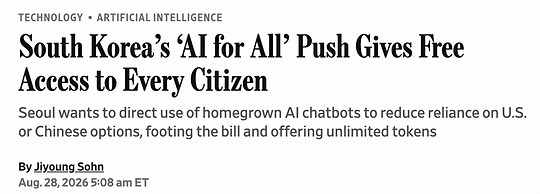
Then came an extraordinary announcement out of South Korea.
 Source: The Wall Street Journal
South Korea plans to give free AI access to its entire population of more than 50 million people, with at least 80% of usage expected to run through Korean-built models.
Read that again…
One of the world's most advanced nations plans to give AI away!
South Korea could be the first of many.
Other wealthy nations could eventually follow its lead and treat AI as a public good, much like education or basic digital infrastructure.
In other words, treating AI as a citizen's right.
That might sound far-fetched. But it sounded considerably more far-fetched before South Korea decided to do it.
And governments have a huge advantage over OpenAI, Anthropic, and other frontier labs.
They don't necessarily need to make money selling tokens.
If taxpayer-backed models can provide citizens with AI for free, it creates even more competition for private companies that try to charge for the same basic service.
That could further erode the value of AI tokens just as frontier labs prepare to ask public investors for enormous valuations.
Which brings us to Anthropic.
#4: The Anthropic IPO Rush
OpenAI and Anthropic were both preparing to go public when we last talked about the OpenAI-pocalypse.
But things have moved quickly.
Anthropic reportedly plans to unveil its IPO prospectus after Labor Day and could begin trading as soon as late September or early October.
Why the rush?
I don't know. Maybe Anthropic sees strong investor demand and wants to strike while the iron is hot. But consider what's happening around it.
Token prices are plunging, open models are improving, and governments are funding alternatives. Questions about the cost of the AI buildout are growing too.
Maybe Anthropic wants to get it while the getting is good. If it can go public now at an enormous valuation, why wait?
For the first time, investors will value a frontier AI lab every trading day, comparing its revenue, losses, and growth against falling token prices and rising competition.
If Anthropic's IPO struggles, or its shares eventually fall as investors question the economics of frontier AI, that could make OpenAI's own path to Wall Street much harder.
I could even see Anthropic getting through the IPO window before it closes… but not OpenAI.
#5: The Adoption Backlash
The pressure isn't coming only from competitors.
Last week, New York City announced a one-year moratorium on student-facing generative AI for elementary and middle-school students.
That's roughly 600,000 students in America's largest school district. Then, just days later, Los Angeles followed.
Think about how quickly this changed.
In the span of just a few days, America's two largest school systems have both slammed the brakes on student AI use.
One district could be an outlier. Two starts to look like a trend.
What happens if Chicago, Miami, Houston and other major school systems follow?
For years, one of the core assumptions behind AI adoption has been that today's children will grow up using these tools as naturally as previous generations grew up with the internet and smartphones.
Maybe they will. But New York and Los Angeles just reminded us that AI adoption isn't guaranteed to move in a straight line.
#6: The Data-Center Backlash
Then there are the buildings that make AI possible.
Data centers have become political targets because of their huge electricity needs, effects on utility bills, water use, and demands on local infrastructure.
And the opposition is increasingly bipartisan.
New York recently became the first state to impose a statewide moratorium on new hyperscale data centers. Other states are considering their own restrictions.
That's another wrinkle in my original theory.
Two weeks ago, I asked where OpenAI would find enough money to fund its enormous infrastructure plans.
Now there's another question…
What if OpenAI can raise the money, but its partners can't build everything as quickly or cheaply as planned?
This Isn't Just About OpenAI
You don't need to own OpenAI or Anthropic to have money riding on their success.
The AI spending boom reaches Nvidia and other chipmakers, cloud companies, data-center operators, utilities, networking companies, and plenty of other stocks you probably own.
And none of what I’ve shown you means AI is going away.
In fact, cheaper AI could cause usage to explode.
But exploding usage and exploding profits are not the same thing.
If AI becomes cheaper, more open, and harder to monetize, the companies spending hundreds of billions of dollars to build it may eventually have to rethink those plans.
And if that happens, the effects won’t stop with OpenAI. They’ll ripple through the entire AI investment boom.
That’s what the OpenAI-pocalypse is really about.
Sign Up Today for Free!
Truth & Trends brings you market insights and trading tips you won't find anywhere else — unless you have your own personal hedge fund manager on speed dial...
Meet Enrique Abeyta, one of Wall Street’s most successful hedge fund managers. With years of experience managing billions of dollars and navigating the highs and lows of the financial markets, Enrique delivers unparalleled market insights straight to your inbox.
In Truth & Trends, Enrique shares his personal take on what’s moving the markets, revealing strategies that made him a star in the world of high finance. Whether it’s uncovering the next big trend or breaking down the hottest stocks and sectors, Enrique’s insights are sharp, actionable, and proven to work in any market condition.
Inside these daily updates, you’ll gain:
- 50 years of combined trading wisdom distilled into actionable insights.
- A behind-the-scenes look at how Wall Street pros spot opportunities and avoid pitfalls.
- Exclusive strategies that Enrique personally uses to deliver exceptional returns — no fluff, just results.
To have Truth & Trends sent directly to your inbox every weekday, just enter your email address below to join this exclusive community of informed traders.
Don’t miss your chance to learn from one of the best in the business.
Sign up now and take your trading game to the next level.

The Man Taking Apple to $10 Trillion
Posted September 04, 2026
By Chris Cimorelli
Welcome to Wall Street’s Most Dangerous Month
Posted September 03, 2026
By Enrique Abeyta
Who’s Afraid of the Big Bad VIX
Posted September 02, 2026
By Nick Riso

The $2T Question for Anthropic
Posted August 31, 2026
By Enrique Abeyta
Breaking the Bitcoin Bear
Posted August 28, 2026
By Greg Guenthner